The Death of the Landing Page
For twenty years, the landing page sat at the centre of digital marketing strategy, and for good reason. A user typed a query into Google, scanned ten...
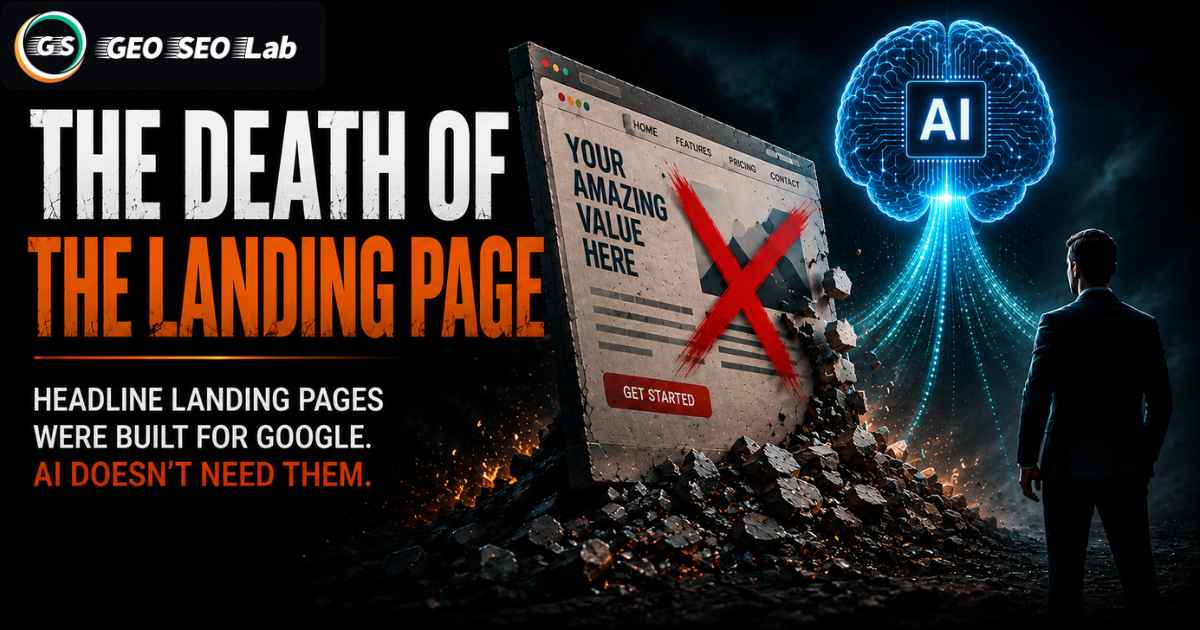
For twenty years, the landing page sat at the centre of digital marketing strategy, and for good reason. A user typed a query into Google, scanned ten blue links, clicked one, and landed somewhere designed specifically to convert that single moment of intent into an email address, a demo request, or a sale. Every element of the landing page, the headline, the hero image, the single call to action, stripped of navigation distractions, existed because a human had to arrive, read, decide, and act, all within one page and usually within seconds.
That entire structure assumed something that's no longer reliably true in 2026: that a person clicks before they understand what a product does.
AI systems flip that assumption on its head. By the time someone asks ChatGPT, Perplexity, or Google's AI Mode to compare a few options in a category, the AI has already read the equivalent of a dozen landing pages, several review sites, a handful of forum threads, and whatever documentation it could get its retrieval tools into. It has summarised, synthesised, and often already formed an opinion, all before the user has clicked on anything at all. The click, if it happens, comes after the decision has largely been shaped, not before.
That's a genuinely different order of operations than the one the landing page was engineered for. And it raises an uncomfortable question for a lot of marketing teams sitting on years of carefully tested, carefully optimised landing pages: if AI is doing the summarising before the click, what exactly is that landing page for anymore?
This report walks through why the landing page's core job, converting cold traffic through persuasive, single-purpose design, is becoming a smaller and smaller part of the actual buying journey. It looks at what's replacing that function: knowledge pages, comparison pages, research hubs, evidence libraries, and documentation. And it lays out a practical way to think about which of these formats deserves your team's attention first, without pretending the landing page is going to vanish overnight or that this is purely an SEO tactic. It isn't. It's a shift in how buying decisions get made before a brand ever gets a chance to make its pitch.
Why the Landing Page Was Built for Google, Not for Buyers
It's worth being honest about what the landing page actually optimised for, because it wasn't really "helping the buyer decide." It was designed to win a very specific, narrow contest: converting a single visit from an ad or organic click into a measurable action, as efficiently as possible.
That's why landing pages strip out navigation. That's why they collapse a company's entire value proposition into one scroll, backed by a single headline formula and a handful of trust badges. That's why so much of conversion rate optimization over the last decade has obsessed over button colour, form field count, and headline wording, tiny variables that matter enormously when you're trying to squeeze conversion out of a single, isolated visit with no other context.
None of that design logic assumes the visitor arrives already informed. It assumes they're arriving cold, mid-search, needing to be persuaded in real time. The entire page is built around overcoming objections a visitor hasn't even voiced yet, because there's no other channel through which those objections could surface before the click happens.
AI-mediated search breaks that premise. When a buyer asks an AI system to compare project management tools, or explain the tradeoffs between two SaaS platforms, or summarise what a product actually does, the AI has already synthesised information from dozens of sources before that buyer ever lands on a single company's website. The objections have often already been addressed, or at least surfaced, inside the AI's answer. The visitor who eventually clicks through is no longer cold. They're often close to a decision, sometimes down to comparing two finalists, and what they need from the page they land on is confirmation and depth, not persuasion from scratch.
That's a fundamentally different job than the one landing pages were built to do. A page optimised to overcome first-touch scepticism isn't necessarily the same page that serves someone who's already been convinced by an AI-generated summary and just wants to verify the details before committing.
How AI Actually Reads and Summarises Your Product Before Anyone Clicks
To understand why this shift matters, it helps to look at what's actually happening to click behaviour right now, because the numbers are fairly stark.
Zero-click search has become the default rather than the exception across most categories. According to KORTX data referenced in a recent AEO and GEO guide, over 50% of Google searches now end without a click at all, and Gartner has separately predicted a 25% drop in traditional search volume by 2026 as users shift toward AI-generated answers instead of scanning results pages themselves. Once an AI Overview shows up on a query, the effect on click-through gets sharper still. Writer's analysis of Ahrefs data covering 300,000 keywords found that AI Overviews cut the click-through rate for the page ranking in the top organic spot by up to 58%, dropping from roughly 7.3% down to 1.6% on the keywords where an Overview appears. A separate study from Seer Interactive, looking at just over 3,100 informational queries, found organic click-through for AI Overview queries falling 61%, from 1.76% down to 0.61%.
Those aren't small dips. They describe a search environment where, for a large and growing share of queries, the AI's summary is functionally replacing the visit to the source page entirely. The user gets their answer, forms an impression of the available options, and either moves on satisfied or clicks through to one specific source, usually to verify a detail rather than to be introduced to the topic for the first time.
That changes what the click, when it does happen, is actually for. Convert's guide to AI searchoptimizationn put it plainly: buyers now toggle between AI-assisted research and traditional browsing throughout the same search session, often multiple times, rather than committing to one mode start to finish. The page someone lands on after an AI-assisted research phase isn't making a first impression. It's my follow-up question.
There's also a structural shift in where AI systems pull their answers from in the first place, and it doesn't favour the traditional landing page format. Branded queries on AI engines draw roughly 77% of their citations from sources the brand itself doesn't own, according to Omniscient's January 2026 research, meaning review platforms, forums, and third-party comparison sites carry outsized influence over how a brand gets described before a buyer ever reaches the brand's own site. And within owned content specifically, AI systems appear to favour pages built around fact density and clear structure over persuasive copywriting. Incremys's GEO content strategy research found that community platforms like Reddit, YouTube, and specialist forums account for roughly 48% of AI citations across categories, reinforcing that a brand's own polished landing page is competing with a much wider, messier, and more independent set of sources for the AI's attention.
Put together, this paints a picture of a search environment that no longer rewards a single, highly persuasive page sitting at the end of a click. It rewards a broader footprint of specific, structured, citable content spread across several formats, because that's what the AI is actually drawing from when it builds its answer in the first place.
Introducing the Post-Click Content Stack
This is where GEO SEO Lab's original framework comes in. We call it the Post-Click Content Stack, and it's a simple way of organising the five content formats that are increasingly doing the work landing pages used to do alone: knowledge pages, comparison pages, research hubs, evidence libraries, and documentation.
The framework isn't meant to suggest these five formats are new inventions. Most brands already have some version of each, scattered across a blog, a help centre, a resources tab, and maybe a case studies page nobody's updated since last year. What's new is the recognition that these formats, taken together and treated as a coordinated system rather than a scattered afterthought, are now doing the heavy lifting that a single landing page used to handle on its own. Each format answers a different kind of question that an AI system, and by extension a buyer, is likely to be asking at a different stage.
Knowledge pages answer the "what is this and who is it for" question. Comparison pages answer the "how does this stack up against the alternative" question. Research hubs answer the "is this brand a credible, ongoing source of expertise" question. Evidence libraries answer the "can I actually trust the claims being made here" question. Documentation answers the "will this actually work for my specific situation" question.
A landing page tries to answer all five of those questions on a single page, for a single visitor, in a single visit. That approach made sense when the visitor was cold, and the page was the only chance to make an impression. It makes a lot less sense when an AI system is already answering versions of those same five questions before the visitor ever lands anywhere, and the visitor arrives already holding a partial answer they're looking to confirm or deepen.
Knowledge Pages, the New Front Door
Knowledge pages are the closest thing to a modern homepage replacement, but they're built with a very different intent. Rather than a persuasive pitch, a knowledge page functions as a clear, well-structured explanation of what something is, who it's genuinely built for, and how it fits into the broader category it belongs to.
This matters because AI systems are increasingly pulling from the first sentence of each content section as a standalone answer, according to Incremys's research into GEO content strategy, since that first sentence is often extracted on its own rather than read in the full context of the surrounding paragraph. A knowledge page built with that in mind, where each section opens with a clean, self-contained statement rather than a scene-setting lead-in, gives an AI system something it can lift cleanly and cite accurately.
The tone matters to her,e too. Knowledge pages perform best when they read like a well-organised reference source rather than a sales pitch. That means naming the specific use cases a product is and isn't well-suited for, rather than claiming universal appeal. It means defining terms clearly instead of assuming familiarity. And it means resisting the temptation to fold in a call-to-action at every turn, because a knowledge page's job is to be genuinely useful as a standalone resource, not to funnel every reader toward an immediate conversion.
For most brands, the highest-leverage move here is consolidating what's currently scattered across a "what we do" page, a features overview, and a handful of blog posts into a smaller number of authoritative, well-maintained knowledge pages that an AI system can point to with confidence.
Comparison Pages, the New Sales Conversation
If knowledge pages replace the homepage, comparison pages replace the sales call, or at least the earliest part of it. This is where a huge share of AI-assisted buying research actually happens, because the question buyers are asking an AI system most often isn't "what does this product do," it's "how does this compare to the two or three alternatives I'm already considering."
The research is fairly clear that honesty performs better than polish here. A comparison page willing to admit where a product isn't the cheapest option, or isn't the right fit for a particular use case, gives an AI system something concrete and balanced to cite, rather than a page that reads as one-sided and therefore less trustworthy as a source. That's a real departure from how comparison content traditionally got written, where the instinct was almost always to frame every comparison as a clean win.
Precision matters as much as honesty. Incremys's content strategy research found that specific, concrete data gets cited more reliably than vague claims, giving the example that a stated rate of "15%" is more citable than a vague reference to "about 15%." That precision extends to comparison content generally: naming exact pricing tiers, specific feature gaps, and concrete tradeoffs gives an AI system material it can quote with confidence, rather than paraphrasing something too vague to repeat accurately.
Comparison pages also need to account for the sheer range of ways a single comparison gets asked. A single head-to-head between two products might actually represent dozens of underlying variations, by company size, by budget, by specific feature priority, and a comparison page that only addresses the broadest version of that question misses most of the actual queries being asked behind the scenes.
Research Hubs, the New Authority Signal
Research hubs serve a different purpose than knowledge or comparison pages. Their job isn't to explain a product. It's to establish that a brand is a credible, ongoing source of expertise in its category, the kind of source an AI system would reasonably treat as authoritative rather than merely self-interested.
Original research carries real weight here. Producing and publishing genuine data, even something modest in scale, gives a brand a chance to become a primary source that other sites, and by extension AI systems, end up referencing. That's a meaningfully different kind of content investment than most marketing teams are used to making, because it requires actually generating new information rather than repackaging existing knowledge in a fresh format.
A research hub works best as a living collection rather than a one-off report that gets published and forgotten. Recency plays a real role in whether AI systems continue treating a source as relevant, and a research hub that's regularly updated with fresh findings, updated benchmarks, or follow-up studies signals ongoing authority in a way a single archived whitepaper doesn't.
The other function a research hub serves is providing exactly the kind of citable statistics that comparison pages and knowledge pages can then reference internally. A brand that publishes its own category benchmark data has something specific and ownable to cite across its entire content ecosystem, rather than relying entirely on third-party statistics that any competitor could equally reference.
Evidence Libraries, the New Testimonials Page
Evidence libraries replace what used to be a scattered testimonials section or a handful of case study PDFs buried three clicks deep. Their purpose is to give an AI system and a sceptical human researcher concrete proof that a brand's claims actually hold up.
This category matters more than most teams currently realise, because AI systems consistently lean on evidence that doesn't come directly from a brand's own marketing language. Third-party corroboration, independent reviews, verified case studies with real numbers, and documented outcomes carry more weight in an AI-generated answer than polished internal copy ever will, simply because that evidence is harder to dismiss as self-serving.
A genuinely useful evidence library goes beyond a few quotes with headshots. It includes case studies with specific, verifiable numbers rather than vague success language. It includes links out to independent review platforms rather than only curated in-house testimonials. And increasingly, it benefits from including author credentials and clear attribution, since signals of real expertise and accountability behind a piece of content function similarly to the E-A-T signals Google has long looked for, giving AI systems added reason to treat the content as credible and citable.
The evidence library is also where a brand's off-site reputation and its owned content most directly connect. Keeping G2, Capterra, and similar review profiles current matters just as much as anything published on the brand's own domain, because AI systems are drawing on both in roughly equal measure when constructing an answer about whether a brand's claims can be trusted.
Documentation, the New Product Page
Documentation might be the most underrated format in this entire shift, and it's the one most likely to already exist inside a company without anyone thinking of it as a marketing asset at all.
There's growing evidence that AI systems are directing real traffic straight to documentation pages, treating them as a fact-based, technical source that's far easier to extract reliable information from than a persuasive product page written with conversion in mind. One recent GEO checklist noted that for software companies specifically, developer docs and knowledge bases have become prime opportunities for AI visibility, with ChatGPT observed sending visitors directly to documentation pages in client analytics, a clear signal that AI systems are treating this content as a trustworthy, fact-dense source in its own right.
That makes sense once you consider what documentation actually contains: specific, unambiguous, technically precise answers to real implementation questions, exactly the kind of concrete material an AI system prefers over broad marketing claims. A migration guide, an integration walkthrough, or a detailed FAQ addressing a genuine limitation isn't traditionally thought of as a marketing asset, but inside an AI-mediated search environment, it functions as one of the most citable pieces of content a brand has.
The practical implication is that documentation deserves the same editorial attention historically reserved for landing pages and blog content. That means clear structure, current information, and a genuine effort to answer the specific, narrow questions a real user or evaluator would actually have, rather than treating documentation as a purely technical afterthought maintained separately from the rest of the content strategy.
What Happens to Conversion Optimization in an AI-First World
None of this means conversion rate optimization becomes irrelevant. It means the moment conversion optimization needs to focus on shifts later in the journey than it used to.
In the old model, the landing page carried the entire weight of persuasion, because it was often the only touchpoint a cold visitor would ever have before deciding to bounce or convert. In an AI-mediated model, a meaningful share of that persuasive work has already happened by the time someone actually lands on a page, because the AI's summary shaped their impression first. What the landing page, or more accurately, whichever of the five formats they land on, needs to do now is confirm what the AI already told them and remove any remaining friction to taking the next step.
That's a real shift in what "conversion" content should optimise for. Instead of overcoming first-touch scepticism, it needs to reward a visitor who's already leaning toward a decision, giving them the specific detail, the exact pricing tier, the precise integration requirement, that turns a near-decision into a completed one. A page that keeps repeating broad value propositions to someone who's already convinced of the broad value proposition risks feeling redundant rather than persuasive.
There's also a measurement shift that has to happen alongside this. Elementor's 2026 GEO research pointed out that traditional SEO reporting, built around keyword rankings and organic traffic, fails to measure what actually matters now, visibility inside the answer itself. The suggested replacement metrics, inclusion rate (how often a brand gets cited as a source across target queries), brand mentions and citations even without a link, entity performance (how accurately an AI system understands and represents a brand's core people, products, and organization), and sentiment analysis of how a brand is actually framed when it does appear, apply just as directly to this content shift as they do to broader GEO measurement generally.
Making the Transition Without Losing Existing SEO Equity
None of this is an argument for deleting landing pages outright. Paid campaigns, retargeting, and certain high-intent bottom-of-funnel queries still benefit from a focused, single-purpose page, and plenty of existing landing pages carry real SEO equity worth preserving. The argument here is narrower and more practical: the landing page can no longer function as the sole vehicle for how a brand gets discovered, understood, and trusted across an AI-mediated buying journey.
A sensible transition starts with an honest audit of what already exists. Most brands will find they already have partial versions of all five formats scattered across the site, an FAQ page that's really a knowledge page in disguise, a features comparison chart buried in a PDF that should be a proper comparison page, and a handful of well-written case studies that deserve to be pulled into a real evidence library. Consolidating and strengthening what already exists is almost always faster than starting from zero.
From there, prioritisation matters more than completeness. GEO strategy guidance from ToTheWeb suggests starting with the pages that already drive buyers and revenue, core service pages, high-traffic educational resources, and existing landing pages, since that's where restructuring effort pays off fastest and most measurably. The same logic applies to this five-format shift: build out comparison pages first for the products or categories where competitive comparison queries are already common, then expand into research hubs and evidence libraries as capacity allows.
It's also worth remembering that this isn't a one-time redesign project. AI Overview, presence, citation patterns, and which sources get pulled into an answer all shift as retrieval systems and training data evolve. Solid SEO still forms the foundation underneath all of this. Incremys's research found that 99% of AI Overviews still cite pages from the organic top 10, meaning strong traditional SEO remains a prerequisite for AI visibility rather than something GEO replaces outright. The five formats in the Post-Click Content Stack aren't a substitute for that foundation. They're what gets built on top of it once the foundation is solid.
Key Takeaways
- Landing pages were engineered to persuade a cold, first-time visitor within a single page and a single visit, an assumption that increasingly doesn't hold when AI systemssummarisee products and comparisons before a click ever happens.
- Zero-click search is now common enough, and AI Overview click-through drops steep enough, that a meaningful share of buying research completes without ever reaching a brand's own site.
- Five content formats, knowledge pages, comparison pages, research hubs, evidence libraries, and documentation, are increasingly doing the work that a single landing page used to handle alone.
- Honesty and specificity outperform polish inside comparison content, since AI systems favour citable, precise, balanced material over one-sided persuasive copy.
- Documentation has quietly become one of the most valuable GEO assets a brand has, precisely because it was never written to persuade in the first place.
- Traditional SEO remains foundational. GEO and this content shift build on top of strong organic fundamentals; they don't replace the need for them.
- Conversion optimization still matters, but the moment it needs to focus on has moved later in the journey, toward confirming a near-decision rather than overcoming first-touch scepticism.
About GEO SEO Lab
GEO SEO Lab researches the evolution of search and discovery across Google Search, Google AI Mode, ChatGPT, Gemini, Claude, Perplexity, and other AI-powered platforms. Our mission is to help businesses understand and adapt their content strategy for an AI-mediated buying journey, combining current industry research with original, practical frameworks for content structure, evidence-building, and long-term brand trust in an increasingly AI-shaped marketplace.
References
- Elementor: How to Optimise Content for AI Search Engines in 2026
- Omnius, AI Search & GEO Report 2026: New Front Door of the Internet
- ToTheWeb, GEO: The Complete Guide to AI-First Content Optimization 2026
- Incremys, GEO Content Strategy 2026: AI-Cited Content
Tags
Frequently Asked Questions
Find answers to common questions about this topic
About the Author

Anubhav
SEO Expert & Content Creator
Experienced digital marketing professional specializing in SEO strategies, content optimization, and data-driven marketing solutions. Passionate about helping businesses grow their online presence and achieve better search rankings.
Related Articles
View all posts
SEO vs GEO: What's the Difference? A Complete Guide for 2026
SEO vs GEO, What's the Difference, and Why Your Business Needs Both in 2026, Introduction For most of the last two decades, the goal of digital marketing c...
GEO SEO Lab vs Semrush: Which SEO & GEO Platform Is Best in 2026?
Picking a search visibility platform used to be a fairly narrow decision. You wanted rankings, backlinks, and maybe a competitor snapshot, and most of...
Why Does Search Volume Miss AI Search Prompts? The Prompt Gap
The Keyword Tool Everyone Trusts Is Quietly Going Blind Every marketing team has some version of the same ritual. Open a keyword research tool, type in...