The AI Knowledge Advantage: Why AI Search Rewards Knowledge Networks, Not Just Content
The AI Knowledge Advantage: Why AI Search Rewards Knowledge Networks, Not Just ContentHow Businesses Can Build Connected Knowledge Ecosystems That Cha...
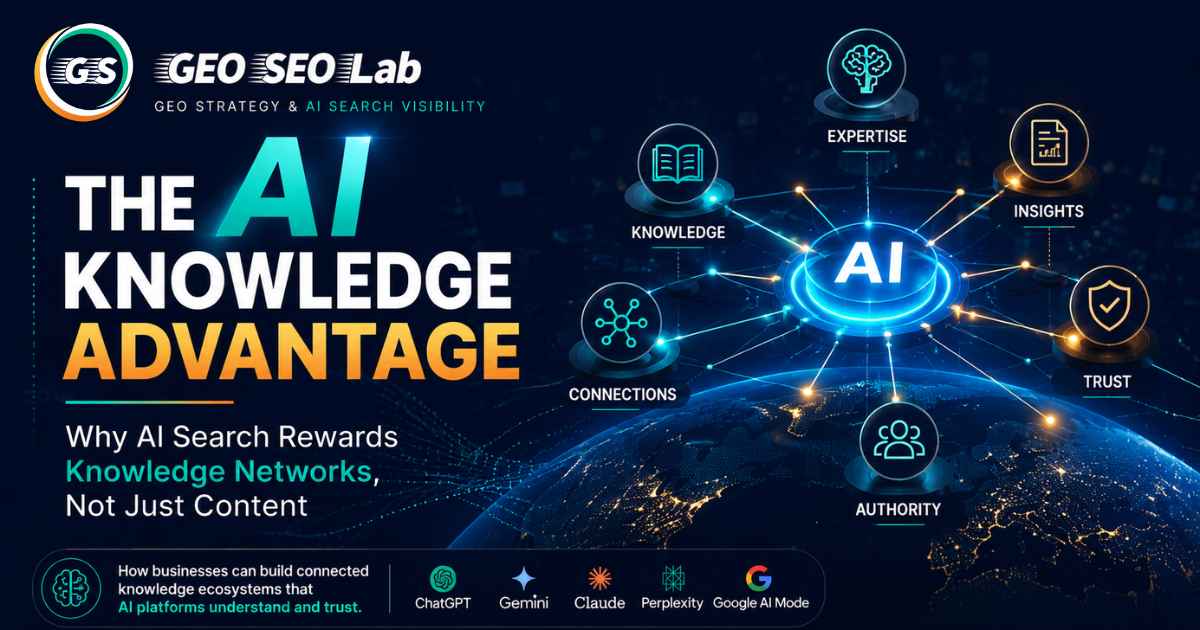
Introduction: When Knowing More Isn't Enough
There's a pattern digital marketing teams are starting to notice with real unease. An organization has spent years on content — the blog is comprehensive, the resource library is huge, keyword coverage is broad. By every measure that used to signal success, the program looks strong.
And yet someone asks ChatGPT to recommend vendors in the space, or asks Gemini to explain a topic the organization has written about extensively, and the organization rarely shows up. Competitors with thinner libraries and lower domain authority get referenced instead.
That's not a fluke, and it's not something better metadata will fix. It reflects a real difference between how traditional search evaluated content and how AI systems evaluate knowledge. Traditional search engines were document retrieval systems at heart — index documents, evaluate signals like relevance and link authority, rank them for a query. The unit was the page. AI-powered search is a knowledge synthesis system — it tries to understand what someone's actually trying to accomplish, retrieves relevant information from wherever it's available, synthesizes a coherent answer, and (where attribution is supported) identifies what contributed most. The unit isn't the page anymore — it's the concept, the entity, the claim, and the relationship between them.
That difference changes what an organization's knowledge assets need to look like. A pile of well-optimized pages, each addressing one keyword in isolation, is built for old search. A connected, internally coherent ecosystem that lets AI systems build a rich, reliable picture of an organization's expertise is what actually gets rewarded now. Call the resulting edge the AI Knowledge Advantage — what organizations earn by moving from publishing content to engineering knowledge, from building libraries to cultivating ecosystems, from optimizing pages to architecting understanding.
This piece walks through what that transition actually means, why it matters, how to build toward it across different industries, and how to measure progress in ways that go past the traffic and ranking numbers traditional content strategy has always leaned on.
Understanding the AI Knowledge Advantage
Why volume became the default strategy in the first place. The logic was genuinely compelling for a long time: more content meant more pages ranking for more keywords, meaning broader visibility, meaning more traffic, meaning more revenue opportunity. In an environment where search evaluated individual documents and returned ranked lists, producing more documents was a rational bet. That logic built the content-factory model — churning out volume, often trading depth and originality for coverage. It worked well enough when evaluation was document-centric.
AI search changes the incentive by changing what's actually being evaluated. When an AI system is building a response to a sophisticated question, raw published volume is nearly irrelevant. What matters is whether it can develop a coherent, reliable, rich understanding of an organization's domain from what's available — and whether that understanding is specific, well-connected, and trustworthy enough to actually inform a response. A thousand loosely connected, thin, keyword-optimized articles don't produce that kind of understanding. A carefully built ecosystem of interconnected, evidence-rich resources — even a much smaller one — usually does.
Content library versus knowledge ecosystem. This isn't a semantic distinction — it describes genuinely different structures with genuinely different value in an AI context. A content library is additive: each new piece just gets added, value grows roughly linearly with size, and items exist fairly independently of each other, organized for retrieval rather than understanding. A knowledge ecosystem is multiplicative: each new piece strengthens the whole, value grows faster than size because connections create compound understanding no single piece could provide, and items are explicitly related, organized for comprehension rather than just lookup. AI systems trying to understand what an organization knows benefit far more from an ecosystem than a library, even a much larger one. The practical implication for anyone with years of content already published: that investment isn't wasted, but it may need real restructuring — explicit connections between resources, terminological consistency, hub structures that signal authority, and genuine original knowledge that gives the ecosystem depth rather than just breadth.
How AI actually processes knowledge differently. Traditional search matched query terms to indexed content, evaluated relevance signals, and returned a ranked list — no real attempt to understand meaning beyond keyword and basic semantic matching, no synthesis across sources. AI systems work differently at every step: interpreting intent (not just the words used, but what someone's actually trying to accomplish), retrieving based on informational need rather than term matching, synthesizing across multiple sources by resolving tensions and filling gaps, and generating a response shaped by how the retrieved information actually applies to the specific situation. That processing difference is exactly where the Knowledge Advantage comes from — organizations whose knowledge is well-connected give AI systems something fragmented content can't: a sense of how concepts relate, how expertise builds across a domain, and how specific insights connect to the questions people are actually asking. AI systems don't think in pages. They think in concepts, relationships, entities, and evidence — and organizations organized around those dimensions are simply better aligned with how these systems actually work.
The GEO SEO Lab AI Knowledge Advantage Mode.
Picture a progression from raw expertise to business outcome. It starts with original expertise — genuine knowledge built through experience, research, and sustained engagement with a domain. That's the raw material, but it has limited AI value until it's organized into connected knowledge — isolated insights turned into an ecosystem where relationships are explicit, terminology is consistent, and different knowledge types reinforce each other. That connected knowledge enables AI understanding — retrieval and synthesis systems developing a rich, reliable comprehension of the domain — which produces AI visibility, the consistent appearance of that knowledge in generated answers. Visibility builds brand authority — recognition as a trusted source by both AI systems and the people they serve — which drives business growth, the commercial payoff that justifies the whole investment. Each stage depends on the quality of the one before it: weak expertise produces shallow connections AI can't use, disconnected knowledge (however expert) blocks the contextual comprehension that drives visibility, and visibility without real substance underneath is fragile — increasingly easy for AI systems to detect as surface-level rather than genuine.
Building a Knowledge Network AI Can Actually Understand
Relationships are the real unit of understanding. Human expertise runs on relationships, not isolated facts. An experienced cardiologist doesn't just know facts about the heart — they understand how anatomy relates to function, how function shapes presentation, how presentation responds to intervention, how intervention interacts with a patient's other conditions. The expertise isn't in the facts (those are in any textbook) — it's in the relationships between them, built through years of practice. AI systems trying to understand what that cardiologist knows benefit from knowledge that reflects that same relational structure, not just "hypertension affects blood pressure" but the whole web connecting causes, organ effects, interactions, treatment mechanisms, and the specific clinical contexts where different approaches apply. Organizations publishing domain knowledge need that same relational richness — not just explaining what things are, but explicitly stating how A connects to B, how evidence C supports claim D. That explicit articulation, woven consistently through an ecosystem, is what actually enables genuine AI understanding.
Beyond topic clusters, toward knowledge networks. Topic clusters — a pillar page surrounded by supporting subtopic pages, linked internally — were a real improvement over disconnected pages, organizing content into recognizable hierarchies. Knowledge networks push further in ways clusters don't quite reach. Clusters organize around topics; networks organize around meaning — the link between a pillar on AI search and a page on entity authority isn't just topical proximity, it's an explicit conceptual relationship (entity authority matters for AI search because AI evaluates organizations as entities, and stronger entity signals mean more reliable retrieval). Clusters are largely self-contained; networks explicitly connect outward to the broader relevant knowledge ecosystem. And clusters are mostly structural, while networks are semantic — the connections reflect genuine conceptual relationships, not just organizational convenience, which is exactly what makes them more useful to systems that understand meaning rather than just structure.
The Knowledge Network Architecture
At the center sits an organization's core expertise — the specific intellectual territory where genuine, deep insight actually exists, not defined by keyword groups but by real accumulated knowledge. Around that core sit several interconnected dimensions: research and evidence (the empirical basis for claims — original research, referenced studies, benchmarks), products and services (the offerings expertise gets applied through, connected to the problems they solve), methodologies and frameworks (the distinctive approach that shows AI systems how the organization actually thinks), and case studies and examples (the concrete instances that make abstract expertise tangible enough to match specific user contexts). None of these sit in isolation — evidence supports methodology, methodology connects to product application, products connect to use cases, use cases connect to industry context, case studies demonstrate methodology in action. That network of connections is what creates the coherent, contextually rich picture AI systems need to represent an organization's expertise accurately and confidently.
Semantic relationships, made explicit. AI systems increasingly understand information through meaning-based connections rather than keyword proximity, and building knowledge that reflects this is one of the most technically specific parts of ecosystem development. These relationships take several forms — definitional (what something is and how it differs from related concepts), hierarchical (broader category to specific instance), causal (how one thing leads to another), compositional (how complex ideas break into simpler parts), and contextual (how relevance shifts across situations). There's a real difference between "entity authority is the measurable credibility of an organization's digital identity" (a bare definition) and "entity authority matters for AI retrieval because AI systems evaluate organizations as entities, and the strength of those signals shapes how confidently a system can retrieve information tied to that organization" (a causal, contextual relationship) — the difference between isolated information and connected knowledge. Organizations should actually review their existing content for this relationship density, asking whether connections between concepts are made explicit or just implied.
Knowledge hubs as anchors. Within a network, certain resources serve as anchors — comprehensive, authoritative treatments of core topics that both AI systems and human readers can return to. A real knowledge hub isn't just a long article — it's built specifically to establish an organization's authoritative account of a significant topic, with foundational definitions, explanations of how core concepts relate to adjacent ones, practical implementation guidance, documented evidence for key claims, and explicit connections to the rest of the ecosystem. Hubs create real efficiency because supporting resources can reference them instead of re-establishing context independently — reducing redundancy and strengthening overall coherence.
Creating an AI-First Knowledge Ecosystem
Treat knowledge as a system, not a product. Products get created and then exist in finished form; systems get designed, deployed, and continuously maintained as the environment changes. That distinction matters enormously for investment strategy — a product model treats knowledge as project-based (build it, move on), while a system model treats it as operational (build it, then keep maintaining and extending it as the domain, user needs, and AI sophistication all evolve). That shift touches editorial process (ongoing review, not just initial publication), content strategy (evolving existing knowledge alongside creating new), governance (keeping the whole ecosystem coherent as pieces get added), and measurement (tracking the health of the system, not just the count of assets).
Four layers worth investing in. The foundational layer establishes the conceptual baseline — clear, consistent definitions, explanations of how core concepts relate, introductory guides, shared glossaries. It's not the most impressive knowledge in an ecosystem, but without it, more advanced material floats without grounding. The applied layer shows how concepts translate into action — how-to guides, implementation frameworks, decision criteria, practical guidance tailored to real contexts. This is where AI systems most often find what they need for implementation-focused questions ("how do I do X given constraint Y"), and organizations that get specific here — real contexts, not generic hypotheticals — build knowledge AI can match precisely to actual questions. The evidence layer turns informed opinion into trustworthy knowledge — original research, synthesized analysis, benchmark studies, documented outcomes. Claims backed by verifiable evidence get treated with more confidence by AI systems than equivalent unsupported claims, which makes this layer genuine trust infrastructure, not just persuasive content. The organizational intelligence layer is the highest-value tier — proprietary methodologies, original frameworks, distinctive perspectives that competitors literally can't replicate by reading the same sources, because they reflect insight built through direct, sustained engagement with the domain. This is the most durable AI visibility advantage there is, because it gives AI systems something genuinely unique to cite rather than generically summarize.
How this plays out differently by industry. Healthcare organizations need knowledge that's both rigorously accurate and organized the way patients actually think — not by medical taxonomy, but by experience: a symptom, a diagnosis, a treatment being considered, a recovery being navigated. Connecting information across a patient's actual journey (surgical process, recovery timeline, warning signs, follow-up care) serves AI systems answering real patient questions far better than the same information scattered across disconnected pages. Software and technology companies need technical knowledge that stays synchronized with product development while staying accessible across varying technical sophistication — API docs, feature explanations, and tutorials are high-value AI assets only if they're current, specific, and organized around the questions developers actually ask rather than internal product structure; treating documentation as a cost center rather than strategic infrastructure shows up directly as weaker AI retrieval, even for genuinely strong products. Professional services firms — consulting, law, financial advisory — face a distinct challenge: their real value has traditionally lived in personal relationships and confidential engagements. Building an AI-visible knowledge ecosystem here means systematically capturing and publishing what can be shared without breaching confidentiality — the frameworks used to analyze problems, the principles guiding judgment in specific situations, the patterns that emerge across many engagements — which builds AI visibility while also strengthening client trust in ways testimonials alone never could.
The Knowledge Growth Flywheel
The most important property of a well-built ecosystem is that it's self-reinforcing — each addition strengthens not just itself but everything already there. Original research produces new findings that ground new analysis; that analysis connects to existing foundational resources, deepening their context and reach; the combination produces a more comprehensive, coherent domain understanding that AI systems can actually develop and use; that understanding produces visibility across a widening range of queries; visibility generates recognition — press, speaking invitations, external citations — that reinforces the evidence supporting the organization's expertise; and that recognition creates new opportunities for research and insight, starting the cycle again. This is what actually distinguishes ecosystem investment from ordinary content production — traditional content hits diminishing returns as a topic gets more covered, while ecosystem investment compounds, since each new piece strengthens everything before it. Organizations that start early and sustain the investment build a position that gets progressively harder for later entrants to catch up to — not because the content itself can't be copied, but because the accumulated coherence and relational density built over years genuinely can't be replicated quickly.
Measuring the Knowledge Advantage, and Building an Enterprise Strategy
Why the old content metrics miss what actually matters. This measurement problem runs deeper than the usual AI-citation tracking gap — standard metrics were built to evaluate content production, and what actually needs evaluating is something qualitatively different: ecosystem health. Page counts, publish frequency, keyword coverage, and traffic-by-page answer "how much content do we have and is it being found." Ecosystem health needs different questions entirely: how well does our knowledge work together, how coherently does it represent our expertise, how effectively can AI systems actually use it? These are harder to turn into measurable indicators, which is exactly why most organizations haven't built systematic ways to answer them — but the difficulty doesn't make it less important. Organizations that can't assess ecosystem health can't systematically improve it, and that gap widens as AI systems get better at evaluating connected knowledge.
The Enterprise Knowledge Intelligence Framework
This traces investment through to outcome. Knowledge creation is the production stage, distinguished from ordinary content production by its focus on originality and depth over volume — asking not "what topics should we cover" but "what do we genuinely know that's valuable to the people and AI systems we want to serve." Knowledge organization is the architectural stage — structuring, connecting, and expressing created knowledge to maximize its usefulness: consistent terminology, explicit connections, hub structures, internal coherence. Knowledge relationships form the semantic layer — where clusters extend into networks, where conceptual relationships get made explicit rather than implied. These investments produce AI understanding, which leads to AI retrieval — the organization's knowledge consistently getting selected as relevant and trustworthy — which produces AI visibility, which builds business authority, which supports sustainable competitive advantage: the durable differentiation of being recognized as the most trustworthy, useful source in a domain.
A knowledge-centric KPI set. Coverage and coherence assessment checks whether comprehensive, well-connected resources exist across core domains — not just whether topics are covered, but whether coverage is deep enough for real understanding, whether foundational/applied/evidential/organizational knowledge types are all present, and whether connections between related resources are explicit. Consistency auditing checks how uniformly terminology and definitions hold across the ecosystem, since the same concept explained differently in different places creates ambiguity that undermines AI confidence. Original knowledge production tracking monitors the rate of genuinely new contribution — not more articles covering the same ground, but real research, new frameworks, distinctive insight — directly capturing the investment that produces the strongest visibility advantage. AI response monitoring — systematically querying major platforms for domain-relevant questions and evaluating how the organization actually gets represented — is the ground-truth check everything else should calibrate against. And indirect authority signals — external citations, media coverage, speaking invitations, the quality of earned backlinks — provide supporting evidence that recognized authority is actually building over time.
A four-stage roadmap. The audit stage starts with an honest look at the current state — where genuine depth exists versus where coverage is thin, where connections are strong versus fragmented, where original insight exists versus where content mostly synthesizes what's already public — plus baseline AI response monitoring to measure future progress against. The foundation strengthening stage addresses the most critical gaps identified: developing or improving hub resources, establishing and enforcing terminological consistency, building the explicit connections that turn a library into a network, and investing in the foundational layer everything else depends on. The knowledge expansion stage builds the original, differentiated material that creates the strongest advantage — original research, proprietary frameworks, applied and evidential knowledge that pushes past basic coverage into genuinely distinctive territory. The continuous evolution stage establishes the ongoing processes — editorial governance, regular review, systematic AI visibility monitoring — that sustain the ecosystem over time, since a great ecosystem left unmaintained gradually loses ground as the domain evolves and competitors keep investing.
Trends worth planning around. AI systems are getting better at distinguishing genuine domain understanding from superficial coverage, which will keep widening the gap between deep, connected ecosystems and broad, shallow libraries. AI is expanding beyond public search into internal knowledge management, customer service, and research assistants — meaning organizations with strong public-facing ecosystems get a head start building valuable internal applications on the same infrastructure. Entity understanding keeps getting richer, which makes years of consistent entity representation increasingly valuable versus starting that work late. And as AI gets better at recognizing (and discounting) knowledge that merely synthesizes what's already out there, genuine research and authentic expertise keep gaining strategic value over sophisticated curation of other people's work.
Key Takeaways
- AI search evaluates knowledge ecosystems, not just individual pages — collections of isolated content get treated very differently from interconnected ecosystems.
- The advantage is multiplicative, not additive — each new piece of knowledge strengthens everything already there, unlike a content library where value just grows linearly with size.
- Semantic relationships are the real unit of AI understanding — explicitly connecting concepts, entities, and evidence matters more than simply covering more topics.
- Original knowledge is the most durable visibility advantage, since AI systems are getting better at telling genuine expertise apart from sophisticated summarization.
- Ecosystem health needs ongoing investment, not a one-time project — sustained maintenance compounds in ways episodic effort can't match.
- Measurement has to expand past traditional content metrics into coverage coherence, connectivity, originality, and consistency.
- The Knowledge Growth Flywheel rewards early, sustained commitment — organizations that start seriously and early build a position that gets harder to replicate over time.
About GEO SEO Lab
GEO SEO Lab helps brands become discoverable, trusted, and recommended in the AI era. Traditional SEO alone is no longer enough — businesses now need visibility across AI search engines, LLMs, local search, reviews, and digital platforms. Our platform continuously monitors website health, AI visibility, content performance, competitor movements, local presence, and customer sentiment while providing actionable recommendations that drive real traffic, qualified leads, and measurable growth. Built specifically for modern businesses and MSMEs, GEO SEO Lab transforms complex digital marketing into a clear, intelligent growth system.
References and Further Reading
Information retrieval and AI systems: Lewis et al., "Retrieval-Augmented Generation for Knowledge-Intensive NLP Tasks"; Manning, Raghavan & Schütze, Introduction to Information Retrieval; Karpukhin et al., "Dense Passage Retrieval for Open-Domain Question Answering."
Knowledge management: Nonaka & Takeuchi, The Knowledge-Creating Company; Davenport & Prusak, Working Knowledge; Senge, The Fifth Discipline.
Semantic search and language models: Devlin et al., "BERT: Pre-training of Deep Bidirectional Transformers"; Reimers & Gurevych, "Sentence-BERT."
Content strategy: SparkToro research on topical authority and AI search; Moz on topic clusters and AI search; Search Engine Land on GEO and knowledge network strategy.
Tags
Frequently Asked Questions
Find answers to common questions about this topic
About the Author

Anubhav
SEO Expert & Content Creator
Experienced digital marketing professional specializing in SEO strategies, content optimization, and data-driven marketing solutions. Passionate about helping businesses grow their online presence and achieve better search rankings.
Related Articles
View all posts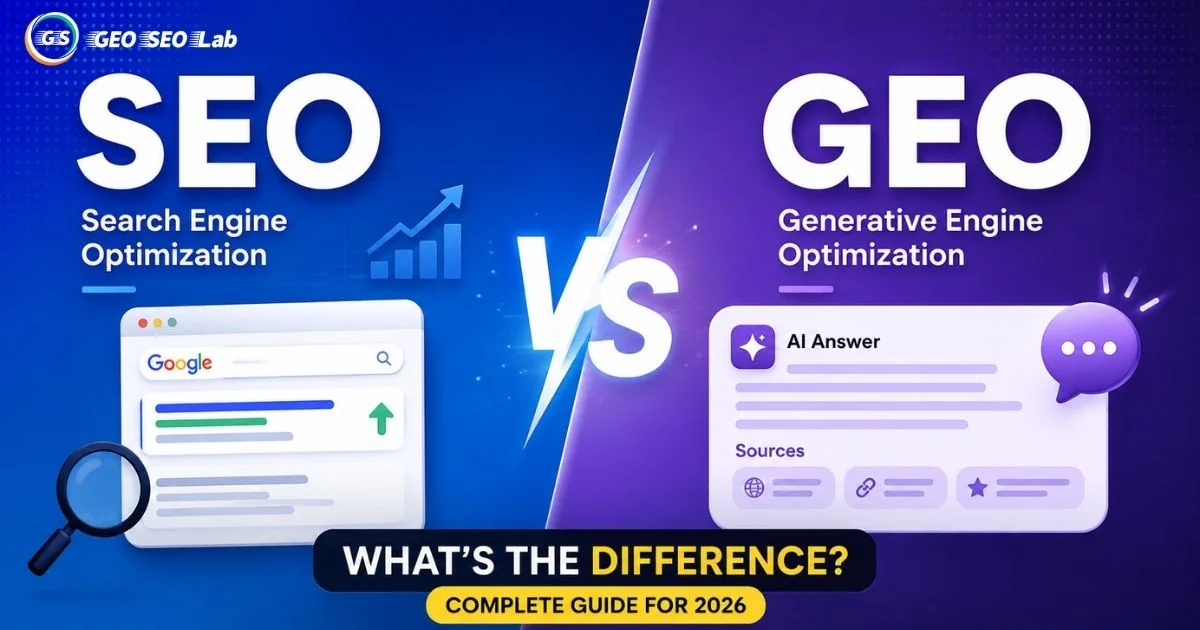
SEO vs GEO: What's the Difference? A Complete Guide for 2026
SEO vs GEO, What's the Difference, and Why Your Business Needs Both in 2026, Introduction For most of the last two decades, the goal of digital marketing c...
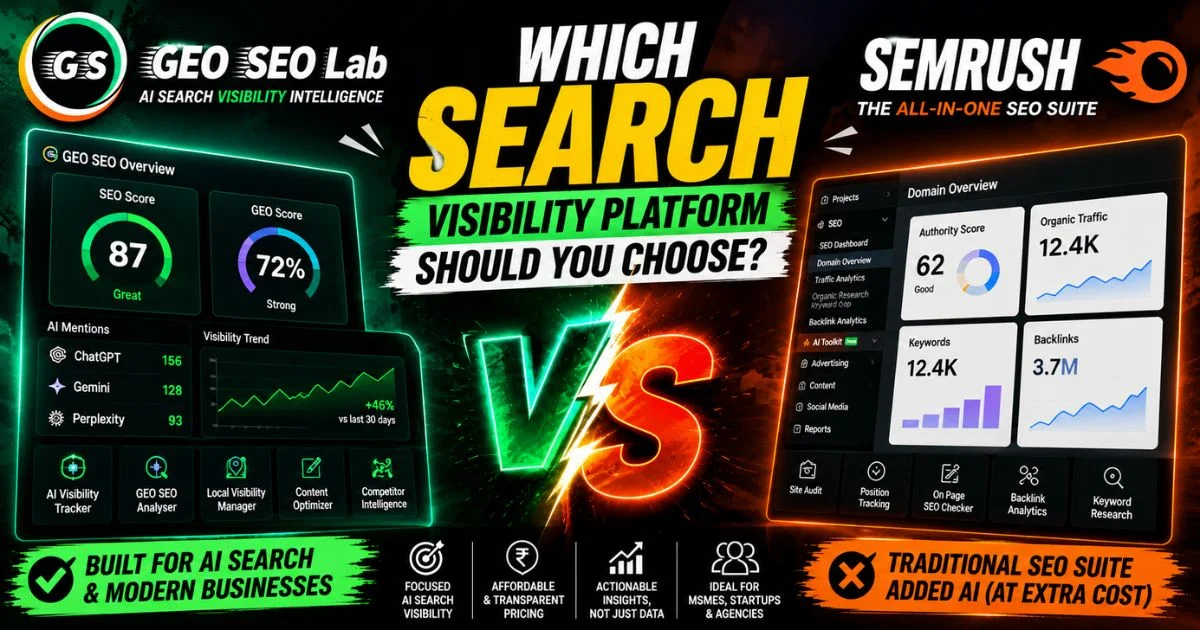
GEO SEO Lab vs Semrush: Which SEO & GEO Platform Is Best in 2026?
Picking a search visibility platform used to be a fairly narrow decision. You wanted rankings, backlinks, and maybe a competitor snapshot, and most of...
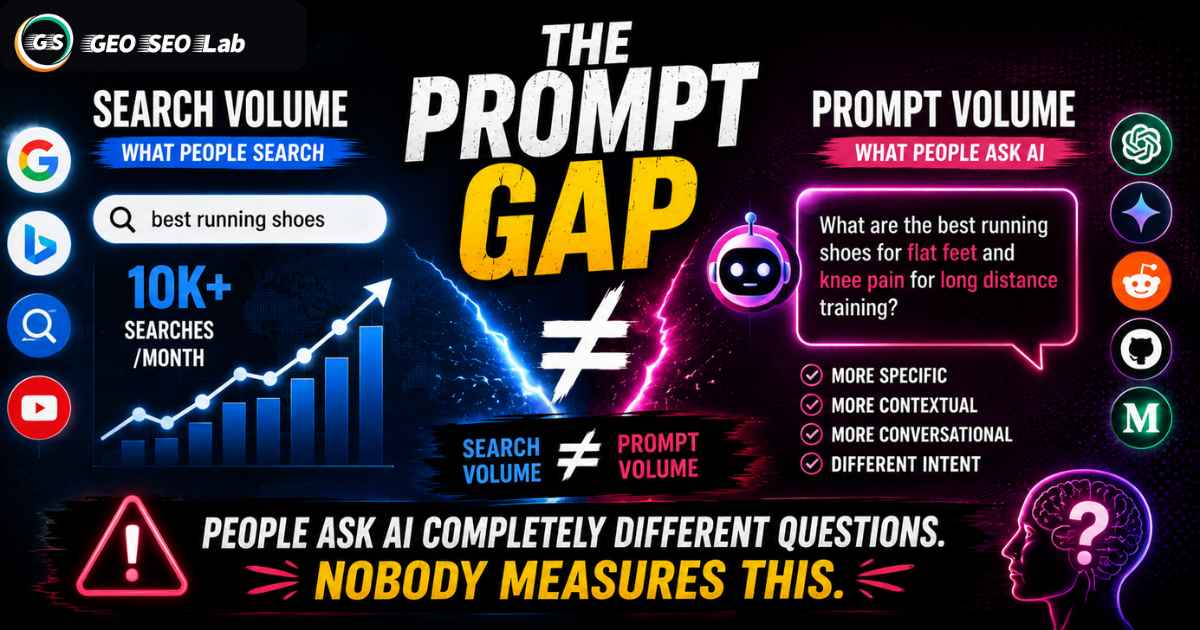
Why Does Search Volume Miss AI Search Prompts? The Prompt Gap
The Keyword Tool Everyone Trusts Is Quietly Going Blind Every marketing team has some version of the same ritual. Open a keyword research tool, type in...