The AI Black Box: Why AI Recommends Your Competitor Instead of You
Picture a marketing manager watching a live demo of ChatGPT answering a prospective customer's question about project management software. Three names...
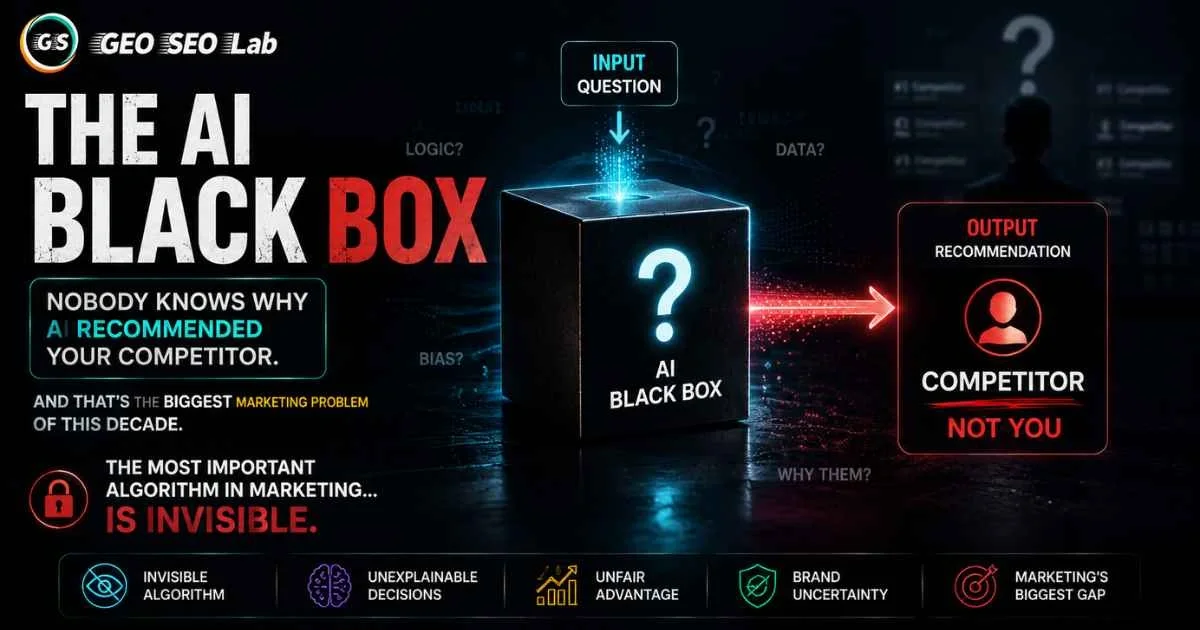
Picture a marketing manager watching a live demo of ChatGPT answering a prospective customer's question about project management software. Three names come back. Theirs isn't one of them. The product is solid. Reviews are good. It even sits on page one of Google for that exact search phrase. And still, nothing.
No warning came before this happened. No dashboard flagged a drop. No one filed a complaint. The brand just wasn't part of the conversation, quietly left out of an answer that mattered to someone actively shopping.
That scenario is playing out across marketing teams right now, and a lot of them have no idea it's happening at all. That's really the core problem here. You can't respond to something you can't measure, and this particular gap is almost impossible to see unless you're deliberately looking for it.
Ask a room full of marketing leaders why a competitor got named by an AI system instead of them, and you'll hear a dozen different theories. Company size. Domain authority. Some hidden pay-to-play arrangement nobody's talking about publicly. The truth is less tidy than any single explanation, and honestly, a bit more unsettling: even the engineers who build these models don't have a complete answer. What does exist is a growing pile of research pointing to recurring patterns, and that's what this report is built around: what the evidence actually shows, why this matters more than most marketing teams currently realize, and what a business can genuinely do about it.
It's worth acknowledging how jarring this shift feels for people used to channels that come with numbers attached. Paid media gives you a cost and a return. SEO, messy as it is, still hands you a rank you can point to on a calendar date. Even brand advertising, which has always resisted clean attribution, comes with reach and impression counts. AI-generated recommendations offer none of that comfort. A team can invest real time and real budget into content, reputation, and reviews, and still have zero reliable way of checking whether any of it changed what an AI system says about them the next time someone asks. That silence is exactly why this problem is so easy to overlook, and so costly to keep ignoring.
Understanding What the Black Box Actually Is
The term "black box" gets used loosely enough that it's worth pinning down precisely. A black box, in this context, describes a system where the input and the output are both visible, but the internal reasoning connecting them stays hidden, even from the people who designed it in the first place. You type a question, you get a response, and the actual chain of logic the model followed to arrive there is buried somewhere inside billions of parameters that don't translate neatly into anything a human could read line by line.
Large language models complicate this in ways older recommendation engines never did. With a classic algorithm, you could usually crack open a spreadsheet and identify which weighted variable drove which outcome. An LLM doesn't work that way. Its "reasoning" is spread across a sprawling network of associations learned during training, and even full-time researchers studying these systems describe their understanding of the internals as partial at best. A widely referenced 2026 overview of AI interpretability research notes that the field has splintered into several separate approaches precisely because no single method fully accounts for what these models are doing internally: some try to explain outputs after they've already happened, some attempt to reverse-engineer the underlying math directly, and others try to design models that are interpretable from the ground up rather than reverse-engineered later.
Why does that matter to a marketer specifically? Because it means there's no single knob to turn. There's no control panel where you plug in a brand name and get a clean percentage breakdown of exactly why you did or didn't show up in an answer. What exists instead is a body of patterns that researchers have surfaced by repeatedly testing these systems and comparing what gets surfaced against what quietly disappears.
What Actually Separates the Brands That Get Recommended
Here's the genuinely useful part. Nobody can hand you a precise formula, but there's a solid, growing body of research pointing to what correlates with getting named in an AI answer. None of these factors guarantees anything by itself. Stacked together, though, they explain most of what's really going on behind the scenes.
Crawlability and accessible content. If the retrieval systems an AI model relies on can't actually reach your pages, or your site is structured in a way that trips up automated parsing, you're starting several steps behind before the race even begins. Studies focused specifically on this question found that brands showing up consistently in ChatGPT's answers tend to have crawlable pages, direct product and comparison content, and copy that states plainly who a product is built for, rather than pages leaning heavily on brand storytelling. Strong, usable content frequently outperforms a genuinely superior product when the AI simply doesn't have anything concrete to point to.
Clear entity identity. This is a slightly technical way of asking a simple question: does the system have a clean, unambiguous grip on who you are and what category you belong in? A brand with a vague name, a thin online footprint, or descriptions that shift depending on where you look can end up poorly represented in a model's internal associations, even when the actual product is excellent. If your name means several different things across the internet, or your positioning changes from page to page, the model may simply fail to connect you with the right category at the exact moment it matters.
Independent, third-party corroboration. This might be the single most overlooked factor of all. AI systems lean heavily on evidence that isn't coming directly from the brand itself. That includes comparison write-ups, independent reviews, forum threads, marketplace listings, and mentions inside industry publications. A smaller, leaner brand that gets discussed consistently and accurately across a handful of independent sources can genuinely outperform a bigger, better-funded competitor whose visibility mostly comes from talking about itself. Polished internal marketing copy simply carries less weight than what strangers on the internet are saying about you unprompted.
Recency of evidence. Freshness matters here more than most brands assume. Systems designed to browse the live web tend to favor sources with recent activity, meaning a three-year-old comparison article carries noticeably less pull than one refreshed last quarter. If your strongest case studies and comparison pages haven't been touched in a while, you're quietly ceding ground to competitors who bother to keep theirs current.
Specific, structured evidence. Vague claims don't hold up well inside a generated answer. Vendors who publish detailed documentation, migration guides, real case studies, and clear integration specifics give these models far more concrete material to draw on when building a confident response. A brand whose messaging is mostly broad statements about being "the top choice for growing teams" leaves the model with very little it can actually cite.
The incumbent advantage, and how it gets challenged. There's real evidence that familiar, well-known brands enjoy a built-in edge simply through recognition. Research testing this directly found recognizable brands could dominate recommendation results even against functionally comparable competitors. But the same research uncovered something reassuring for smaller companies: a modest edge in the specificity and quality of available evidence was often enough to break that dominance. Size alone doesn't decide the outcome. A well-documented smaller brand can genuinely outcompete a household name that hasn't built out the same trail of evidence.
Put these together, and something that used to feel almost random starts making a lot more sense. Your competitor probably didn't get the nod because of hidden favoritism. They got it because, somewhere across the web, there was simply more usable, verifiable, current evidence tying them to that exact question than there was tying you to it.
It's worth sitting with how counterintuitive this can feel for a team doing everything "right" by the old playbook. A slick website, a confident tagline, hand-picked glowing testimonials, none of that carries the weight it used to inside these systems. What an AI model actually rewards looks a lot more like what a skeptical analyst wants: independent confirmation, specific figures, and an honest nod to tradeoffs rather than blanket superlatives. A comparison page that admits your product isn't the cheapest but explains clearly who it's built for and why often performs better inside these systems than a page insisting your product wins at everything. That's a genuinely different style of writing, and plenty of existing brand guidelines quietly work against it.
Why This Deserves to Be Called the Marketing Problem of the Decade
It would be tempting to file all of this under "yet another SEO tweak" and move on. That would be a mistake, and here's the reasoning behind that claim.
There's no alert system. Lose a Google ranking position, and you'll see it the same day, thanks to rank tracking tools built for exactly that purpose. When an AI system quietly stops mentioning your brand across an entire category of questions, nothing equivalent exists. No notification lands in anyone's inbox. The brand simply fades from the answer set, and unless someone happens to run the right prompt and notices the gap, that silence can stretch on indefinitely.
It's far closer to winner-take-all than traditional search ever was. A Google results page has room for ten organic listings, plus ads, plus a map pack, plus assorted extras. A typical AI-generated answer names a much smaller handful of options, sometimes just two or three. That narrower window creates a sharper split between the brands that get named and the ones that don't, which means the cost of exclusion carries far more weight than it ever did on a page with ten links.
Evaluation happens earlier in the buying journey than most teams are prepared for. People increasingly use these tools to shortlist vendors and research options long before they visit a company's website or speak with a salesperson. If a brand is missing from that early shortlist conversation, it may never get another shot at making its case, because the buyer's mental list was already narrowed before the brand ever had a chance to participate.
Regulatory pressure around explainability is real and building, and it isn't confined to one region. High-risk AI systems under the EU's AI Act face binding transparency and explainability obligations that are being phased in through 2026, and sector-specific rules covering credit, housing, and healthcare already carry their own explainability requirements regardless of which country's broader AI policy applies. Even in markets where the general regulatory stance toward AI has leaned lighter-touch, industry pressure to justify automated decisions hasn't gone anywhere. It's simply shifted from being a legal mandate to being a trust expectation instead.
And trust, as it happens, translates directly into revenue. Research tracking brands that invested in transparent, explainable recommendation systems found retention rates sitting somewhere between 85 and 89 percent, noticeably higher than brands that left their systems opaque. When people can see some version of the reasoning behind a recommendation, they trust it more and stick around longer. The reverse holds too: when a brand's own presence inside these systems feels arbitrary even to the marketing team managing it, that unease has a way of bleeding into how customers experience the brand more broadly.
There's an important nuance worth adding here, because the explainability conversation isn't as simple as "just make the AI show its work." Researchers studying this closely have started warning about something called interpretability illusions, where a system appears to be relying on a sensible, safe factor but is actually leaning on something else entirely underneath the surface. That means even the tools designed to open up the black box need careful scrutiny rather than blind trust, just because they produce an explanation that sounds plausible. The practical takeaway for marketers isn't to wait around for a flawless explainability tool to arrive. It's to start building a strong evidence trail now, so that whatever explanation standard eventually takes hold, your brand already has the raw material needed to come out looking favorable.
Add it all up, and you get a genuinely new category of marketing risk. It stays invisible until someone deliberately goes looking for it. It compounds quietly over time. It hits the earliest, most influential stage of the buying journey. And it's increasingly tangled up with regulatory and trust expectations that simply didn't exist five years ago. That's not a minor optimization tweak. That's structural.
A Framework for Making Sense of the Chaos
GEO SEO Lab's Evidence Trust Ladder breaks the black box down into six layers, arranged roughly from foundational to advanced. No brand needs to conquer all six overnight, but understanding where your own gaps sit is the first real step toward closing them.
Rung one: reach. Can automated crawlers actually access and parse your content without hitting technical dead ends? This is the floor everything else rests on, and skipping it undermines every layer above.
Rung two: identity. Is your brand name, category, and core offering described consistently and clearly everywhere it shows up online, so a model forms one clean association rather than several conflicting ones?
Rung three: proof. Do you have specific, detailed, verifiable material, case studies, documentation, honest comparison content, that gives an AI system something concrete to reference rather than generic marketing language?
Rung four: outside validation. Are independent, third-party sources discussing you accurately and in the right context? These external mentions consistently carry more weight than anything a brand says about itself.
Rung five: currency. Is that evidence actively maintained and updated, rather than sitting untouched since the day it was first published?
Rung six: precise relevance. Does your content actually answer the narrow, specific versions of the questions real buyers are typing in, rather than only covering broad category-level terms?
Most brands we've looked at land reasonably strong on rung one and start losing ground somewhere around rungs three through five, which happen to be exactly the layers that demand ongoing editorial effort instead of a single technical fix. That's also, not coincidentally, where the biggest opportunity sits for any brand willing to put in the consistent work.
What to Actually Do About It
Start by finding out where you currently stand. Run a broad set of realistic prompts, the kind actual customers would type in, across the major AI platforms, and track which brands come up, in what order, and framed in what way. Do this on a recurring basis rather than treating it as a one-off audit, since answers shift as underlying training data and retrieval systems change over time.
Build out the specific, detailed content these systems actually need to work with. That means comparison pages willing to be honest about tradeoffs, documentation that answers real implementation questions, and case studies backed by concrete numbers instead of vague success language. This isn't about producing more content for its own sake. It's about producing content an AI system can confidently point to.
Invest deliberately in third-party visibility. Encourage genuine customer reviews, pursue coverage in publications relevant to your category, and show up in the forums and communities where people actually discuss your space. This isn't traditional PR chasing headlines for its own sake, it's building exactly the kind of outside corroboration these systems lean on most heavily.
Keep everything current. Set a recurring schedule to refresh comparison content, update statistics, and retire claims that no longer hold up. Stale evidence quietly loses ground to fresher competitor content, even when nothing about your actual product has changed.
Treat this as a genuinely cross-functional effort rather than a side project handed off to the SEO team. The factors shaping AI recommendations touch content, PR, product marketing, and customer success all at once, and narrowing the response to a single technical task tends to produce narrow, technical-only results.
Give someone clear ownership of this, even if it ends up being a shared responsibility across a few roles. One quiet reason this problem festers inside organizations is that it doesn't fit cleanly under any existing job title. It's not quite SEO, because the mechanics differ. It's not quite PR, because a good chunk of the work involves technical content structure. It's not quite product marketing, because a lot of the needed evidence actually lives in customer success and support. Naming someone, even informally, to track this across the organization tends to be the difference between a brand that steadily closes the gap and one that keeps rediscovering the same blind spot every few months without ever actually fixing it.
Finally, resist treating any single fix as permanent. Training data updates, retrieval systems evolve, and competitor content keeps improving too. What earns a recommendation this quarter isn't guaranteed to earn one next quarter. Building this into an ongoing habit, reviewed on a regular schedule, matters far more than any single content project ever will.
Key Takeaways
- AI recommendation systems are genuinely opaque, even to the researchers who build them, which means there's no single lever a brand can pull to guarantee a mention.
- A consistent set of factors correlates strongly with getting recommended: crawl access, clear entity identity, specific evidence, third-party corroboration, freshness, and precise fit to real buyer questions.
- Getting left out of an AI-generated answer comes with no notification and no visible signal, unlike a dropped search ranking, which makes this risk easy to miss until damage has already been done.
- Familiar, well-known brands do get a built-in edge, but that edge can be disrupted by smaller brands offering sharper, more specific, better-documented evidence.
- Regulatory pressure around AI explainability is active and building through 2026, and brands that build transparency into their own systems tend to see meaningfully higher customer retention.
- Closing this gap takes ongoing editorial and PR investment rather than a one-time technical fix, and it belongs to marketing broadly rather than to any single isolated team.
About GEO SEO Lab
GEO SEO Lab researches the evolution of search and discovery across Google Search, Google AI Mode, ChatGPT, Gemini, Claude, Perplexity, and other AI-powered platforms. Our mission is helping businesses understand and improve their visibility inside AI-mediated buying journeys, pairing data-driven research with original, practical frameworks for entity clarity, evidence-building, and long-term brand trust in an increasingly AI-shaped marketplace.
Tags
Frequently Asked Questions
Find answers to common questions about this topic
About the Author

Anubhav
SEO Expert & Content Creator
Experienced digital marketing professional specializing in SEO strategies, content optimization, and data-driven marketing solutions. Passionate about helping businesses grow their online presence and achieve better search rankings.
Related Articles
View all posts
SEO vs GEO: What's the Difference? A Complete Guide for 2026
SEO vs GEO, What's the Difference, and Why Your Business Needs Both in 2026, Introduction For most of the last two decades, the goal of digital marketing c...
GEO SEO Lab vs Semrush: Which SEO & GEO Platform Is Best in 2026?
Picking a search visibility platform used to be a fairly narrow decision. You wanted rankings, backlinks, and maybe a competitor snapshot, and most of...
Why Does Search Volume Miss AI Search Prompts? The Prompt Gap
The Keyword Tool Everyone Trusts Is Quietly Going Blind Every marketing team has some version of the same ritual. Open a keyword research tool, type in...