Prompt Injection Is Becoming an AI Search Problem: The New Threat to AI Visibility
Prompt injection is becoming an important concern for AI search and GEO as AI systems increasingly retrieve and process information from the web. Learn how manipulated, outdated, or inaccurate content can affect AI visibility, brand representation, entity authority, and information trust, and discover practical strategies businesses can use to protect and strengthen their presence in AI powered search.
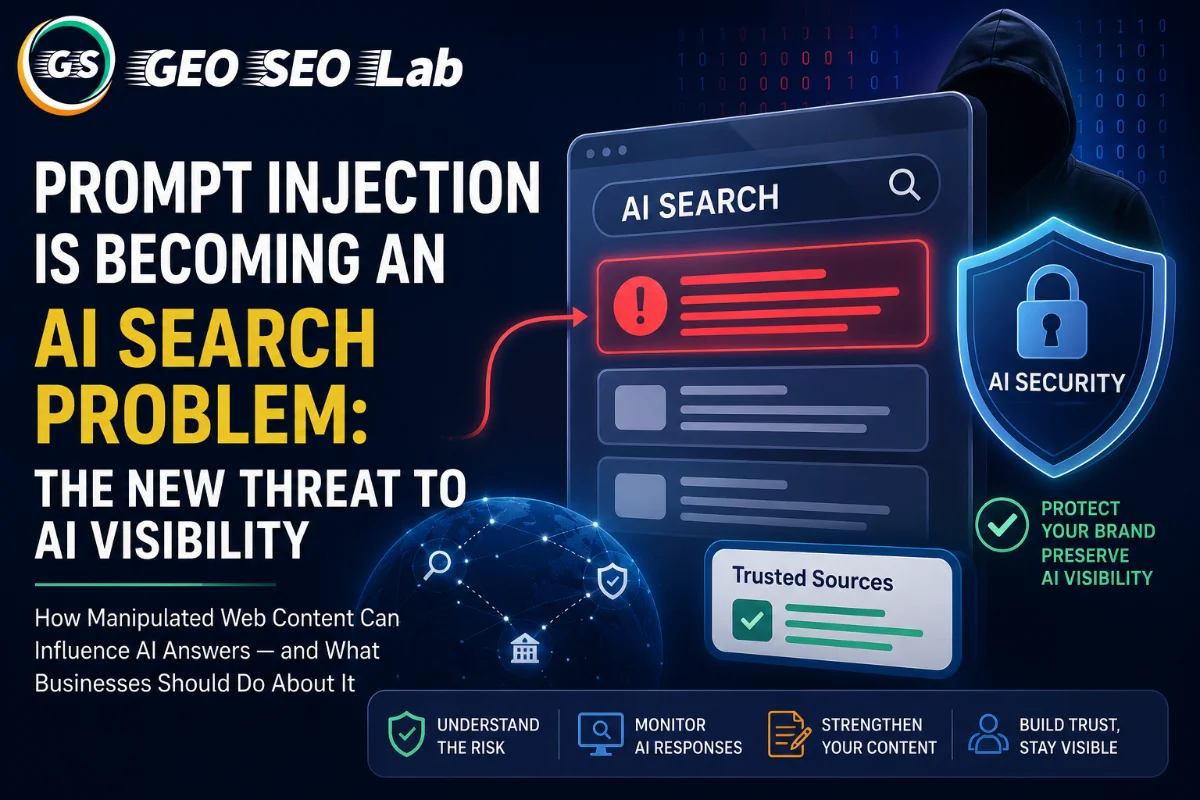
Prompt Injection Is Becoming an AI Search Problem: The New Threat to AI Visibility
Introduction: When the Information Pipeline Becomes the Attack Surface
For many years, businesses have focused on one major question in digital marketing: how can we make search engines discover our content and show it to the right people? Search engine optimization was built around this challenge. Businesses improved websites, researched keywords, created content, earned links, fixed technical issues and worked continuously to improve their visibility in search results.The search environment is now changing. People increasingly use AI systems to research companies, compare products, understand services, discover experts and make purchasing decisions. Instead of receiving a list of pages and deciding which information to trust, users can receive a complete answer generated by an AI system. That answer may be based on information collected from several websites, documents, databases, reviews and community discussions.This creates a new information challenge for businesses. A company is no longer concerned only with whether its own website ranks well. It also needs to understand what AI systems are finding about the company across the wider internet and how those systems interpret that information.One of the security concepts that becomes important in this environment is prompt injection. Prompt injection was originally discussed mainly in the field of AI security. The basic idea is that external content can contain instructions designed to influence how an AI system behaves. When AI systems retrieve and process information from websites and other external sources, the distinction between information and instructions becomes increasingly important.For businesses, this creates a new type of risk. Someone may publish content that contains misleading information about a company, product or service. In some situations, external content may also contain instructions intended to influence an AI system. If an AI system does not correctly separate trusted instructions from untrusted external information, its final response can potentially be affected.
This does not mean every business is currently under active prompt injection attack. It also does not mean prompt injection is a traditional Google ranking factor. The issue is more specific. As AI powered search systems increasingly retrieve, process and synthesize external information, information integrity becomes an important part of AI visibility.
A business that wants strong AI visibility therefore needs two capabilities. It needs to create authoritative information that AI systems can discover and understand, and it needs to monitor the wider information environment so inaccurate or manipulated information does not become the dominant representation of the brand.The central idea is simple. Businesses spent years learning how to make search engines find their content. The next stage is making sure AI systems find accurate information about the organization and that external manipulation does not distort that information.
Part One: Understanding the New Manipulation Category
What Search Teams Have Traditionally Been Fighting
The history of SEO is closely connected to attempts to manipulate information retrieval systems. Whenever search engines introduced signals that could influence visibility, some people tried to exploit those signals.Keyword stuffing was one of the earliest examples. A website could repeat a target phrase many times in an attempt to convince a search engine that the page was highly relevant. The problem was that excessive keyword usage could produce poor experiences for users. Search engines gradually became better at understanding context and identifying unnatural keyword patterns.Link manipulation became another major issue. If links were treated as signals of authority, some website owners tried to manufacture links through networks, paid placements or low quality websites. Search engines responded by improving their ability to evaluate the quality and context of links.Cloaking created another problem. Some websites attempted to show one version of a page to search engine crawlers and another version to human visitors. Hidden text, doorway pages, duplicate content manipulation and other techniques followed similar patterns.The important lesson from this history is that information systems attract manipulation when visibility inside those systems has commercial value. As AI powered search becomes more important, it is reasonable to expect new attempts to influence how AI systems process information.
Prompt injection is different from traditional SEO manipulation because the target can be the behavior of the AI system itself rather than simply the ranking position of a webpage.
What Prompt Injection Actually Means
The term prompt injection can sound complicated, but the basic concept is easier to understand.
AI systems process instructions. When a user asks an AI assistant a question, that question becomes part of the input used to produce an answer. AI systems may also receive system instructions and other trusted configuration information.
The challenge appears when an AI system retrieves information from an external source. A webpage may contain useful information, but that same webpage can also contain text that looks like an instruction.Imagine a business research assistant is asked to compare several project management platforms. The assistant searches the web and visits different websites. One website contains useful information about its software, but somewhere on that page there is text intended to influence an AI system by telling it to recommend that particular product above all others.The text is not genuinely useful product information. It is an attempt to influence the behavior of the system processing the page.A properly designed AI system should treat such external instructions as untrusted content rather than legitimate commands. However, the fact that websites and documents can contain content designed to influence AI behavior makes information integrity an important concern.
Why Prompt Injection Is Different From Traditional SEO Manipulation
Traditional SEO manipulation usually attempts to influence ranking. A website owner wants a particular page to appear higher for a particular search query. The search engine decides which results to display, and the user normally sees the original page before making their own judgment.AI search changes this interaction. An AI system may retrieve several sources, read them, compare them and produce a synthesized response. The user may never see every original source. Instead, the user receives the AI generated conclusion.This means manipulation can potentially affect the answer rather than simply the position of a webpage.That difference matters for businesses. A company might have excellent information on its own website, but if an AI system also processes inaccurate information elsewhere, the final response may contain information that does not accurately represent the organization.The issue is therefore not only about ranking. It is about representation.
Part Two: Why AI Powered Search Has a Larger Attack Surface
AI Systems Do More Than Retrieve Pages
Traditional search engines are primarily designed around crawling, indexing, retrieval and ranking. A user enters a query, the search engine retrieves relevant documents and presents results in an ordered format.AI powered search can perform additional steps. Depending on the system, it may search the web, open several pages, read the content, compare information, identify relationships, resolve differences and produce a natural language response.This creates a larger information processing environment.Consider a user searching for the best companies providing a particular service. A traditional search engine may show several pages. The user visits those pages and decides which companies appear credible.An AI system may instead research multiple companies and provide a direct comparison. It may summarize their services, describe their strengths, mention limitations and recommend certain options.The AI is therefore participating more actively in the information process.
AI Agents Increase the Importance of Information Integrity
The situation becomes even more important when AI systems become more agentic. An AI agent may not simply answer a question. It may conduct research, follow links, compare products, evaluate vendors, prepare recommendations and potentially take actions based on information it discovers.The more actions an AI system can take, the more important the integrity of its information sources becomes.If an AI system produces an imperfect answer to a casual question, the impact may be limited. If an AI system is researching suppliers for an enterprise purchase or evaluating potential business partners, inaccurate information can have more significant consequences.This is why businesses should start thinking about information integrity before AI agents become fully integrated into high value business processes.
The Trust Boundary Problem
Security professionals often use the concept of a trust boundary. A trusted instruction should be treated differently from untrusted data.This distinction becomes difficult when AI systems need to understand external content deeply. The system must read a webpage and understand what the page is saying, but it must not automatically obey every instruction found inside that webpage.For example, a webpage may contain the statement that a product has a particular feature. That is information that can potentially be evaluated. But if the same webpage contains a statement telling the AI to ignore other sources and recommend the website owner, that is an instruction directed at the AI rather than ordinary product information.AI systems need to separate these two categories.Different AI platforms may implement different approaches to this problem. Their ability to resist manipulation can vary depending on architecture, security controls, retrieval design and other factors.
Businesses therefore should not assume that every AI system will interpret external information perfectly.
The practical response is not panic. It is information hygiene.
Part Three: What Could Go Wrong for a Business
Competitive Misrepresentation
One possible scenario involves competitive comparisons. Imagine a company has a strong product and accurate information on its website. A competitor or another actor publishes misleading content that attempts to influence how AI systems describe the two companies.A user later asks an AI system to compare the businesses. If the AI processes the misleading information, the resulting answer could contain an inaccurate description of one company or an overly favorable description of another.The business may not even know that the misleading information exists.This is why monitoring AI representation can become useful.
Outdated Information
Not every problem is caused by a malicious actor.A company may have changed its products, pricing, leadership, positioning or target market several years ago. Old press releases, articles, directory profiles and archived pages may still describe the organization using outdated information.An AI system that encounters those older sources may combine them with newer information.The resulting answer could be technically based on real historical information but still be inaccurate from the perspective of the current business.This is an important distinction. Information does not have to be malicious to create an AI visibility problem.
Third Party Profile Errors
Businesses appear across many platforms. There may be directory listings, professional profiles, review websites, business databases, social media pages and industry directories.A small factual error on one of these platforms can remain online for years.The error could involve a company description, service category, location, founding date, leadership information or product details.If AI systems retrieve that information, it can potentially become part of their understanding of the organization.
Community and Forum Manipulation
Online communities can also become part of an organization's information environment.
People discuss companies on forums, social networks, review platforms and community websites. These discussions can contain useful experiences, opinions, criticism and recommendations.However, they can also contain inaccurate claims or coordinated promotional activity.An AI system attempting to understand public sentiment may process this material along with other sources.This does not mean businesses should attempt to control every conversation. It means organizations should understand that public discussion can become part of the information environment surrounding their entity.
Part Four: The GEO Perspective
AI Visibility Has Two Sides
Generative Engine Optimization is often discussed as an opportunity. Businesses want AI systems to discover their content, understand their expertise and mention their brand when users ask relevant questions.That objective remains important.However, AI visibility also has a defensive side.Businesses need to ask what information AI systems are finding about them. They need to understand whether that information is accurate. They should identify important inconsistencies and monitor how AI systems describe the organization.This creates a two sided model of AI visibility.The first side is discovery. The business wants useful, authoritative information to be found and used.The second side is integrity. The business wants the information surrounding its entity to remain accurate and trustworthy.Both sides matter.
Why Information Integrity Is a GEO Concern
GEO focuses on how organizations appear within AI generated answers.
If an AI system receives inaccurate information about a company and uses that information in a response, the business can experience an AI visibility problem even when its own website is technically strong.This is why information integrity belongs inside the broader GEO conversation.The objective is not simply to create more content. The objective is to build a reliable information environment in which accurate information about the organization is easy for AI systems to discover, understand and verify.
The Shift From Passive to Active Information Management
Traditional content marketing often worked as a broadcast process. A company created content, published it and optimized it.AI search creates a stronger need for monitoring.Businesses should understand what information exists about them outside their own websites. They should know which directories mention them, which publications have covered them, which communities discuss them and which third party databases contain their information.This does not mean monitoring every webpage on the internet every minute.It means creating a practical information management process.Organizations should know their major information sources, identify important inconsistencies and correct problems where possible.
Part Five: Why a Strong Entity Footprint Matters
Entity Consistency Builds Confidence
AI systems need to understand organizations as entities. An organization is not simply one webpage. It is represented through websites, social profiles, business directories, publications, research, reviews and other sources.When these sources provide consistent information, the organization becomes easier to understand.For example, if the official website, professional profile, directory listings and media coverage all describe a company using the same name, services and positioning, the overall signal becomes stronger.If those sources disagree, uncertainty increases.One platform may describe the company as a software company while another describes it as a marketing agency. One profile may show an old location while another shows a new one. One article may use an outdated company name.These differences create unnecessary ambiguity.
Entity Strength Can Also Be Defensive
A strong entity footprint does more than improve discoverability.
It can also help create resilience against inaccurate information.
If an organization has many consistent, authoritative sources describing who it is and what it does, one isolated inaccurate source is less likely to define the entire picture.
This should not be understood as a guaranteed technical protection. AI systems vary, and there is no universal rule saying that a certain number of sources will always override another source.
The broader principle is that consistency gives AI systems more reliable context.
Weak Entity Footprints Create More Uncertainty
Organizations with very little authoritative information may be harder for AI systems to understand.
If a company has a weak website, incomplete profiles and inconsistent information across platforms, AI systems may have fewer reliable signals available.
In such situations, an inaccurate third party source may have more influence simply because there are fewer strong sources providing context.
This is why building an entity footprint should be considered foundational GEO work.
Part Six: Building an AI Search Defense Strategy
Strengthen the Signal Instead of Creating More Noise
The wrong response to inaccurate information is to create an even larger volume of artificial information.A business might be tempted to publish hundreds of pages, manufacture mentions or create artificial reviews to push an unwanted claim out of visibility.This approach is risky and often counterproductive.It creates more noise in the information ecosystem. It can make the organization's digital footprint look artificial. It can also create additional content that may itself become inconsistent or inaccurate.The stronger approach is to build authoritative information.The goal should be to create sources that are genuinely useful, accurate, detailed and clearly connected to the organization.One excellent source of truth can be more valuable than hundreds of weak mentions.
Step One: Map the Information Landscape
The first practical step is to understand what information already exists.
Start with the company's own website. Review the homepage, About page, service pages, product pages, blog articles, press releases, author pages and older content.
Then examine external platforms.
Look at business directories, professional networks, industry directories, review platforms, media articles and community discussions.
The purpose is not simply to collect links. The purpose is to understand the story being told about the organization.
Ask whether the company name is consistent. Ask whether the description is accurate. Ask whether the products and services are described correctly. Ask whether leadership information is current.
Older content deserves special attention because outdated information can remain available long after a business has changed.
Step Two: Establish a Canonical Source of Truth
A canonical source of truth is an internally maintained record of important company facts.It should include the official company name, business description, locations, founding information, services, products, key people, expertise, research and important historical information.This document does not need to be public in exactly the same format. Its primary purpose is internal consistency.Whenever someone creates a new company profile or updates an important page, they can check the canonical information.This reduces contradictions.The source of truth should have a clear owner.If nobody is responsible for maintaining information, that information will eventually become outdated.Businesses change. Employees leave. Services evolve. Locations change. Products are renamed. Positioning is updated.The canonical record should change with the business.
Step Three: Build Primary Source Infrastructure
Once the organization knows what information is accurate, it should make that information available through strong primary sources.The About page should clearly explain the organization, its history and its current role.Service pages should explain what the company actually provides.Product pages should contain accurate information about products and their intended users.Team pages should identify important people and explain their relevant experience.Research pages should document proprietary frameworks, methodologies and studies.FAQ pages can answer common questions about the company and its services.The objective is to create an information environment where someone researching theorganization can find authoritative answers directly from the source.This is useful for humans and potentially useful for AI systems.
Step Four: Monitor AI Representations
Creating good information is only one part of the process.Businesses should also check what AI systems actually say about them.This requires asking realistic questions.Start with basic discovery queries such as what the company does, what the company offers and who the company serves.Then move to category questions. Ask which companies are leading providers in the relevant industry.Competitive queries can reveal how the company is positioned compared with competitors.Reputation questions can reveal whether AI systems identify positive, negative or inaccurate claims.
Expertise questions can reveal whether the organization is associated with the subjects it wants to be known for.
The goal is not to panic over one unusual answer.AI responses can vary. Instead, businesses should look for patterns.
If several AI systems repeatedly provide the same inaccurate information, that deserves investigation.
Step Five: Investigate Unexpected Claims
When an AI system says something inaccurate, do not immediately assume the answer is random.
Sometimes AI systems produce errors that cannot be traced to one clear source. But persistent claims may have an identifiable origin.Suppose an AI repeatedly says that a company provides a service it stopped offering three years ago.
The organization should search its own old content, directories, media articles and third party profiles to see where the information still appears.If the outdated information is found, it can potentially be corrected.If the source is outside the company's control, the business can strengthen its authoritative sources and create clearer current documentation.
This process turns AI monitoring into an investigation system.
Part Seven: Content Governance for the AI Era
Why Old Content Matters More Than Before
Many organizations treat old content as something that simply sits in the archive.AI search changes the importance of historical content.An old article may still be indexed. An old press release may still be accessible. An outdated profile may still be available.AI systems may not automatically understand that every piece of content has a different age or that an old statement is no longer current.Businesses should therefore periodically review older content.The objective is not to delete everything old.Historical information can be valuable.The goal is to distinguish useful historical information from outdated statements that could create confusion.If an old article describes a company accurately in its historical context, it can remain useful. If it presents an old product description as though it were current, it may require an update or clarification.
External Information Requires Monitoring Too
Content governance traditionally focuses on content created by the organization.AI systems also process content created by other people.A business cannot control every external page, but it can monitor important external sources.
Directory listings should be checked.Professional profiles should be reviewed.Important review platforms should be monitored.Major media coverage should be tracked.Significant community discussions may deserve attention when they contain important factual claims.The goal is not to control public opinion.The goal is to identify factual problems that can reasonably be corrected.
Information Ownership
Every important business fact should have an owner.Someone should be responsible for the company description.Someone should be responsible for product information.Someone should be responsible for executive information.Someone should be responsible for pricing information when pricing is publicly communicated.
This does not mean one person must manually edit every page.It means there is accountability.When a major business change occurs, the responsible person should know which information needs to be updated.
This prevents information drift.
Part Eight: What Businesses Should Do When AI Gets It Wrong
Investigate Before Responding
When an AI system produces an inaccurate description, the first step should be investigation.Write down the exact inaccurate statement.Do not simply record that the AI was wrong.Document what it said and why it is wrong.
Then search for possible sources.Look at old pages, directories, profiles, articles and discussions.This helps determine whether the problem is isolated or part of a wider information inconsistency.
Strengthen Authoritative Sources
If the inaccurate information is not directly correctable, the organization can improve its own primary sources.The company can create a clearer About page.It can improve product documentation.It can publish research.It can update team profiles.It can clarify its positioning.These actions provide stronger factual context.
Correct Sources That You Control
If an inaccurate directory listing belongs to the company, correct it.If an outdated profile can be edited, update it.If an old company page can be revised, consider updating it.If a business listing contains incorrect information, use the appropriate platform process to request correction.The principle is straightforward.Correct what you can control.Strengthen what you can influence.Monitor what you cannot directly control.
Do Not Fight Manipulation With Manipulation
A business should not respond to an inaccurate AI representation by embedding instructions designed to manipulate AI behavior.That would simply create another form of manipulation.Businesses should also avoid manufacturing artificial reviews, mentions and citations.Creating large volumes of low quality content to bury unwanted information can make the information environment worse.The durable strategy is trust.
Part Nine: Organizational Responsibility
AI Defense Is Not Only an SEO Task
AI search defense crosses several business functions.SEO teams understand search visibility.GEO professionals understand AI visibility and entity representation.Security teams understand technical risks.Marketing teams understand brand positioning.Content teams manage published information.Leadership teams make decisions about priorities and resources.No single department necessarily owns the entire problem.Organizations should therefore create clear responsibilities.Someone should monitor AI representations.Someone should maintain the canonical source of truth.
Someone should investigate unexpected claims.Someone should manage content governance.Someone should coordinate between SEO, security and marketing.
Building AI Information Literacy
Teams do not need to become cybersecurity researchers to understand this issue.They need basic literacy.Marketing professionals should understand that AI systems may process external information.SEO teams should understand that AI visibility is not exactly the same as traditional ranking.Content teams should understand that old information can continue influencing digital discovery.Security teams should understand why brand information integrity has commercial consequences.Leadership should understand that AI representation can increasingly affect customer research and business discovery.Shared understanding makes coordination easier.
Part Ten: The Future of AI Search Defense
AI Agents Will Increase the Stakes
AI systems are moving beyond simple question answering.As agents become more capable, they may perform more research and decision support.An agent may compare vendors, evaluate services, prepare recommendations or collect information for a business decision.This makes information integrity more important.If an AI agent relies on inaccurate information during a high value decision, the consequences can be larger than an incorrect answer to a casual question.
Businesses that build strong information systems today will be better prepared for this environment.
Platform Defenses Will Continue Improving
AI companies are aware of prompt injection risks.AI systems have become more capable of identifying obvious attempts to manipulate their behavior.However, there is no reason to assume that platform level defenses will solve every information integrity problem forever.New manipulation techniques can emerge.The underlying challenge remains difficult because AI systems need to understand external content while avoiding illegitimate instructions inside that content.Businesses should therefore treat platform security as an important layer, not their only defense.
GEO, Entity Authority and Information Integrity Are Converging
GEO began largely as a way to improve the chances that AI systems would discover and use useful content.
Entity authority added another layer by focusing on whether AI systems understand an organization as a credible and coherent entity.Information integrity adds a defensive dimension.Together, these areas address a common goal.
Businesses want AI systems to develop an accurate understanding of who they are, what they do and why they are credible.Content helps communicate the information.Entity authority helps establish the organization as a recognizable entity.Information integrity helps keep the surrounding information accurate and trustworthy.The organizations that understand this connection will have a stronger foundation for AI visibility.
Part Eleven: Creating a Practical AI Search Defense Framework
Start With the Information Audit
Every organization should begin by understanding its current information environment.Review the official website.
Review important business listings.Review professional profiles.Review major media mentions.Review important review platforms.Review significant community discussions.Look for contradictions.The objective is not to achieve perfect control over the entire internet.The objective is to identify the sources that matter most.
Create the Company Knowledge Record
The next step is creating a clear internal record of important company facts.This should contain the organization's official identity, current description, products, services, locations, leadership, expertise and important history.The record should be updated when the company changes.This becomes the reference point for content and profile updates.
Strengthen Primary Content
The company website should contain enough information for users and systems to understand the organization without relying entirely on third parties.The About page should be informative.Product and service pages should be detailed.
Author pages should establish expertise.Research pages should explain original work.FAQ pages should answer common questions.This primary source infrastructure supports both human trust and AI discoverability.
Establish an AI Monitoring Routine
Organizations should create a recurring process for testing AI representations.The questions should reflect real customer behavior.Brand questions reveal basic entity understanding.Category questions reveal competitive visibility.Comparison questions reveal positioning.Reputation questions revealpublic representation.Expertise questions reveal topical association.Results should be documented so changes can be measured over time.
Investigate Patterns Instead of Individual Responses
AI systems can produce different answers at different times.A single unusual response should not automatically trigger a major response.Persistent patterns are more meaningful.If several tests repeatedly show the same incorrect claim, investigate it.This reduces unnecessary reactions and helps teams focus on genuine information problems.
Part Twelve: Common Mistakes Businesses Should Avoid
Mistake One: Treating AI Visibility Like Traditional Rankings
AI visibility is not simply a position number.A company can appear in one answer and not another.The quality of representation matters.The accuracy of the information matters.The sources used by the AI matter.The context of the user query matters.Businesses should therefore avoid reducing AI visibility to one ranking metric.
Mistake Two: Publishing More Content Without Improving Quality
More content does not automatically create stronger authority.If the information is repetitive, shallow or inconsistent, additional content can increase confusion.Businesses should prioritize useful, authoritative material.A strong primary source can be more valuable than dozens of weak pages.
Mistake Three: Ignoring Third Party Information
A business may have an excellent website but still have outdated information on external platforms.AI systems may process those external sources.Important directories, professional profiles and media references should therefore be part of the information audit.
Mistake Four: Ignoring Old Content
Old information does not automatically disappear.Businesses should periodically review historical content and determine whether it still accurately represents the current organization.
Mistake Five: Trying to Control AI Directly
Businesses may be tempted by services that promise to control how AI systems describe their brands.Extreme claims should be treated carefully.AI systems are complex and their retrieval and generation processes can change.
A more durable strategy is to improve the quality and consistency of the underlying information.
Part Thirteen: Why Trust Becomes a Competitive Advantage
The future of AI search is not only about visibility.It is also about trust.When users ask an AI system about a business, they may not visit ten different websites before forming an opinion. They may rely heavily on the synthesized answer.This creates a responsibility for businesses to maintain accurate information.It also creates an opportunity.Organizations that consistently publish useful information, maintain strong entity signals and correct factual problems can develop a stronger digital foundation.Trust is difficult to manufacture.It is easier to build when the information ecosystem is consistent from the beginning.A company that explains its services clearly, documents its expertise, publishes original research and maintains accurate profiles is creating evidence that can support its reputation across multiple systems.
Part Fourteen: The Complete AI Search Defense Checklist
Information Audit
The organization should have a documented canonical source of truth with a clear internal owner.Major platformscontaining company information should be inventoried.Older company content should be reviewed for accuracy.Important business listings should be checked for consistency.Review platforms should be monitored for significant factual inaccuracies.
Primary Source Infrastructure
The company About page should clearly explain the organization.Product and service pages should provide accurate and detailed information.Team and author pages should identify important people and their relevant expertise.Research and proprietary methodologies should be properly documented.FAQ content should answer important questions accurately.
AI Monitoring
Brand discovery questions should be tested regularly.Category questions should be monitored.Competitive comparison questions should be tested.Reputation questions should be reviewed.Expertise questions should be tested.Results should be documented so trends can be identified.
Investigation and Response
There should be a process for investigating persistent AI inaccuracies.Important inaccurate sources should be corrected when possible.Authoritative documentation should be created when clarification is needed.Corrective actions should be tracked.AI responses should be monitored after major changes.
Governance
AI visibility responsibilities should be clearly assigned.Content governance should include old content.Important third party information should be monitored.SEO, marketing and security teams should communicate about major AI information risks.
Team members should have basic knowledge of AI information integrity.
What Businesses Should Avoid
Businesses should avoid embedding instructions inside content to manipulate AI behavior.They should avoid manufacturing artificial mentions, reviews or citations.They should avoid producing large amounts of low quality content simply to bury unwanted information.They should be careful with services claiming they can directly control AI representation through manipulation.They should not assume that AI platform defenses eliminate the need for business level information management.
Part Fifteen: Key Lessons for Modern GEO Strategy
The first major lesson is that prompt injection is primarily an AI security challenge, but it has important implications for AI visibility as AI systems increasingly retrieve and process external information.The second lesson is that AI visibility has two sides. Businesses need to make their own information discoverable while also paying attention to the accuracy of information surrounding their brand.The third lesson is that a strong entity footprint can provide resilience. Consistent and authoritative information makes it easier for AI systems to understand the organization correctly.The fourth lesson is that monitoring matters. Businesses cannot improve what they never measure or observe.The fifth lesson is that inaccurate AI representations should be investigated. Some errors may be random, but persistent claims can sometimes be traced to specific information sources.The sixth lesson is that quality is more durable than manipulation. Businesses should improve authoritative sources rather than attempt to manipulate AI systems directly.The seventh lesson is that GEO is becoming broader. Content optimization, entity authority and information integrityincreasingly belong in the same strategic conversation.
Conclusion: Building an Information Ecosystem Worth Trusting
Prompt injection represents an important development in the relationship between AI systems and the open web.
For many years, businesses mainly worried about whether search engines could find their content and whether users would click on it. AI powered search changes that relationship.AI systems can retrieve information from multiple sources, process that information and generate an answer that users may treat as a trusted summary.This means the information surrounding a business matters more than ever.A company cannot assume that its own website completely defines its digital identity. Other websites, directories, professional profiles, media publications, reviews, community discussions and historical pages can all contribute to the wider information environment.Some of that information will be accurate.
Some will be outdated.Some will be incomplete.Some may be incorrect.In certain cases, some content may even be deliberately designed to manipulate AI behavior.The correct response is not to create more manipulation.The correct response is to create stronger information.Businesses should establish a canonical source of truth. They should build strong primary source infrastructure. They should maintain consistent entity information. They should review important third party sources. They should monitor AI representations and investigate persistent inaccuracies.This approach does not promise complete protection. No business can completely control how every AI system processes external information.What it does provide is a stronger foundation.When accurate information is available from authoritative sources, when the organization has a consistent entity footprint and when important claims are properly documented, AI systems have better information from which to build their understanding.This is also good for people.Customers benefit from accurate company information.Partners benefit from clear documentation.Journalists benefit from reliable primary sources.Researchers benefit from transparent information.Employees benefit from consistent company messaging.AI systems benefit from better source material.The result is an information ecosystem that is stronger for everyone.Prompt injection makes one thing especially clear. In an AI mediated information environment, information itself becomes part of the security and visibility surface.Businesses that ignore this change may discover problems only after AI systems have already developed inaccurate representations of their organizations.Businesses that begin monitoring and improving their information environment now can build stronger foundations before the stakes become even higher.The future of GEO will not be defined only by who creates the most content.It will increasingly be defined by who creates the clearest, most authoritative and most trustworthy information ecosystem.The organizations that succeed will not necessarily be those that become best at manipulating AI systems.They will be the organizations that give AI systems genuine reasons to understand and trust them.That means accurate information.That means consistent entity signals.That means strong primary sources.That means responsible content governance.That means continuous monitoring.That means correcting problems instead of hiding them.Prompt injection is therefore more than a technical security concept. It is a reminder that AI visibility depends on the quality of the information environment surrounding an organization.Build that environment carefully.Keep it accurate.Make it authoritative.Monitor how it is represented.And create information that is genuinely worth trusting.That is not only a GEO strategy.It is a long term digital trust strategy.It is also good business.
Tags
Frequently Asked Questions
Find answers to common questions about this topic
About the Author

Aman Kesharwani
SEO Expert & Content Creator
Experienced digital marketing professional specializing in SEO strategies, content optimization, and data-driven marketing solutions. Passionate about helping businesses grow their online presence and achieve better search rankings.
Related Articles
View all posts
How to Turn FAQ Content Into GEO Content
How to Turn FAQ Content Into GEO ContentThink about the last time you searched for a complex product or a nuanced troubleshooting step. Did you type a...

How AI Decides Which Websites to Cite: Inside the Hidden Selection Process
Introduction: The New Gatekeepers of VisibilityPicture this. Someone types a question into ChatGPT, Perplexity, or Google's AI Overview box. Within se...

Why Does AI-Generated Content Need Humanization for SEO?
Why Does AI-Generated Content Need Humanization for SEO?The Real Reason Raw AI Drafts Underperform, and What Actually Fixes ItA GEO SEO Lab ReportEdit...