How Google AI Overviews Actually Work: A Complete Guide to AI-Powered Search
How Google AI Overviews Actually Work: A Complete Guide to AI-Powered Search...
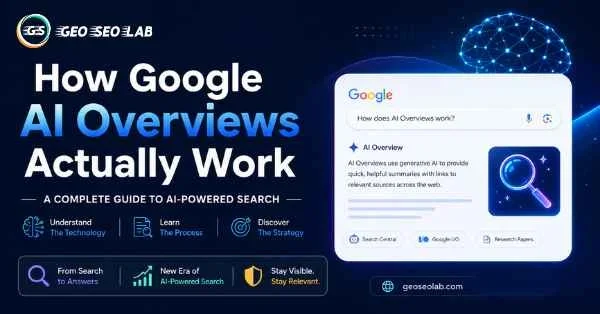
How Google AI Overviews Actually Work: A Complete Guide to AI-Powered Search
The Moment Search Changed — And Why Most Businesses Missed It
There wasn't one single announcement that marked the turning point. No press release declaring the ten-blue-links era over. The shift built up gradually instead — in how people phrased their searches, in what kind of answer they expected back, and in the quiet frustration of getting a list of pages to dig through instead of an actual answer to what felt like a simple question.
For most of commercial search's history, there was an unspoken deal between the engine and the user: the engine found relevant pages, and the user did everything after that — reading, comparing, synthesizing, deciding. Search's job stopped at the list.
That arrangement worked fine for a long time. But as search got woven into daily life — used constantly for specific, immediate questions about everything from technical glitches to medical symptoms to business decisions — its limits became harder to ignore. People weren't looking for a shelf of books to sort through. They wanted the kind of help a knowledgeable colleague gives you: someone who synthesizes what's relevant and explains it clearly, not a librarian pointing at a stack.
Google AI Overviews are one of Google's biggest swings at meeting that expectation. This guide walks through how they actually work, what they're trying to do, and what that means for anyone trying to stay visible in search.
Why AI Overviews Were More or less Inevitable
Two decades of the same trajectory. Google's early edge came from a genuinely clever insight — links between pages carry real signal about quality. PageRank turned that insight into an algorithm, and search results got dramatically better almost overnight. But PageRank was still, at its core, a keyword-and-link matching system. It could answer "which pages are authoritative for these words," not "what does this person actually need to understand."
That gap drove nearly every major search innovation since. Universal Search blended in images, maps, and video because people often wanted a specific media type, not just text. The Knowledge Graph built structured models of real-world entities so search could answer factual questions directly. RankBrain used machine learning to interpret queries it had never seen before. BERT and later language models let search process actual meaning instead of just matching strings.
Every one of these moved Google the same direction — from matching text to understanding meaning, from retrieving documents to grasping intent. AI Overviews aren't a detour from that path. They're what it looks like once language generation gets good enough to run at search scale.
Users changed how they asked, too. Early search users adapted to the technology's limits — typing "best running shoes" instead of "what running shoes work for someone with flat feet who runs on pavement," because that's what the engine could handle. As search improved, that habit reversed. Queries got longer, more conversational, more specific. Voice search accelerated the shift further, since speaking a question naturally sounds like talking to a person, not issuing a database command.
By the time AI Overviews launched, a large share of queries were already complex, multi-part questions that ten links handled clumsily at best. Someone asking "how do I fix my credit if I've had late payments and want a mortgage in eighteen months" doesn't need five generic articles. They need a synthesized, contextual answer — which is exactly what AI Overviews were built to provide.
What AI Overviews actually are — and aren't. A few corrections are worth making up front, since this feature gets mischaracterized constantly.
They're not a separate search engine running apart from Google Search. That misconception leads businesses to think they need a totally different playbook, which isn't what Google's own documentation suggests — AI Overviews sit directly on top of the same crawling, indexing, and ranking infrastructure that powers everything else.
They don't show up for every query. Google decides, query by query, whether a synthesized answer genuinely helps. Highly navigational searches ("Gmail login"), transactional ones ("buy Nike Air Max"), or ones needing very fresh, specific data are often better served by regular results. Overviews show up most for complex informational queries, multi-step explanations, comparisons, and educational topics where synthesis actually adds value.
They're not replacing traditional results, either. When an Overview appears, regular results usually still sit right below or beside it, and the links inside the Overview keep organic sources part of the picture.
What they actually are is a synthesis layer — Google's way of assembling a coherent explanation up front, before a user has to visit five different pages to build that understanding themselves.
What Actually Happens Between Question and Answer
Step one: figuring out what's actually being asked. Before any retrieval happens, the system has to interpret intent, which is trickier than it looks. Take "how should I handle employee performance issues?" That could come from a manager facing one specific situation, an HR person building a general policy, a first-time business owner, or someone checking legal compliance — four different needs behind identical words. Modern search weighs query specificity, the vocabulary chosen (often a proxy for background knowledge), typical intent for questions phrased this way, and session context. Get this step wrong and everything downstream inherits the mistake.
Step two: retrieval, but a different kind. For AI Overviews, retrieval isn't the same process that builds a ranked top-ten. It's a more targeted hunt for evidence to support a synthesized answer to the specific intent the system just interpreted. It still draws from Google's existing indexed web — which is why the same technical SEO fundamentals that support regular rankings also support Overview relevance. A page Google can't crawl or index can't contribute to either. Sources get weighed on relevance, on Google's broader read of their reliability, and on whether they add coverage the other retrieved sources don't already have. And it's adaptive — if the query turns out messier than first assumed, the system can go pull in more sources to cover angles it missed.
Step three: grounding. This is the mechanism connecting generated text back to the specific evidence retrieved — and it's what separates an Overview from a language model just riffing confidently on a topic. Without grounding, a model can produce fluent nonsense: outdated claims, subtly wrong mixed with right, plausible-sounding fabrication. Grounding anchors every generated statement to something actually retrieved, which is also why Overviews link back to sources — those links aren't decoration, they're part of the architecture. The practical takeaway for anyone publishing content: clear, specific, well-supported writing grounds cleanly. Vague or internally inconsistent content is much harder for a system to lean on.
Step four: turning evidence into an explanation. This is where the system synthesizes — pulling grounded evidence from multiple sources into one coherent explanation rather than reproducing any single one of them. That's the real value for users: instead of reconciling five differently-structured articles yourself, you get one integrated answer reflecting the rough consensus of credible sources, with genuine uncertainty flagged rather than papered over. Generation is also format-aware — numbered steps for a process question, parallel structure for a comparison, a clean definition-then-elaboration for a "what is X" query.
Why citations show up inconsistently. Sometimes an Overview cites heavily throughout; sometimes sources sit collected at the end; sometimes only specific claims get a link. This isn't random — it tracks things like how specific a claim is (specific facts get cited more than general background), how much sources agree (strong consensus needs less pointed citation than a claim resting on one source's unique evidence), and how much extra value the full source actually offers a curious reader. In short: citation behavior is a product decision about what helps users, not a ranking signal you can directly optimize for.
What This Means for Your Content Strategy
Start with what Google has actually said, not what's floating around as speculation. Google's documented position is straightforward: the same principles that always mattered for search — genuinely helpful content, written for people, demonstrating real expertise — still apply here. There's no separate "AI Overview algorithm" published anywhere, and no distinct technical checklist for getting synthesized. Which is actually good news: it means the investment already made in expertise, clarity, and technical accessibility keeps paying off. What's changed is the mechanism (synthesis instead of just listing) and, subtly, the bar for what "good content" means inside that mechanism.
Ranking rewards selection. Synthesis rewards contribution. Traditional ranking is about picking the best available document — a page can rank well by matching a keyword cluster, coming from an authoritative domain, and clearing basic quality signals, even without being especially illuminating on the topic. Synthesis asks a different question: what does this specific source add to the explanation being built? A page repeating what a hundred other pages already say adds almost nothing. A page that explains something with unusual clarity, covers an angle others skip, or brings original evidence to the table has real synthesis value. Researchers sometimes call this "information gain," and it's a genuinely higher bar than keyword coverage — a more honest one too.
Write to actually explain something, not to hit a keyword brief. A useful explanation of a complex topic defines it clearly for someone new to it, explains why it matters, walks through how it works at an appropriate depth, illustrates the abstract with something concrete, admits its own limits and exceptions, and connects to concepts the reader probably already knows. Compare that to a typical SEO brief obsessing over keyword density and heading counts for ranking's sake. Both matter, but they start from different questions. "What does this need to include to rank" and "what does someone who genuinely needs to understand this actually need to know" often overlap — but content built around the second question tends to satisfy the first as a side effect, while content built only around the first satisfies the second by accident, if at all.
Information nobody else has is worth more than another summary. For most topics businesses write about, hundreds of existing articles already cover the same ground — adding one more that says the same thing the same way barely registers. What actually moves the needle: original research using your own data, case studies documenting what really happened (including what didn't work), frameworks built from direct practice instead of assembled from other people's writing, and expert perspective earned through real experience rather than synthesized common knowledge. This is worth more for the same reason an expert witness carries more weight than a summary of published research — it comes from access nobody else has.
Technical SEO is still the floor, not a relic. A common and backwards assumption is that AI synthesis somehow bypasses technical fundamentals. It doesn't — Overviews are built entirely on top of indexed web content, and before synthesis can happen at all, that content has to be discoverable, crawlable, and indexed. Page speed, mobile experience, clean architecture, sensible internal linking, HTTPS — none of it got less important. If anything the bar rose, because whatever's competing for synthesis is drawn from the full pool of well-indexed content across every domain, not just yours.
Entity clarity: making sure systems know who's actually talking. Search increasingly evaluates not just what content says but who said it and why that matters — part of what Google's E-E-A-T guidance addresses. An article on clinical nutrition from a credentialed dietitian with a documented professional history reads very differently to these systems than the same words published anonymously. Practically, that means giving contributors real professional profiles — credentials, affiliations, published work — and giving the organization itself a clear, consistent identity across every place it shows up. This helps human readers decide whether to trust you, helps Google assess credibility, and helps AI systems decide how confidently to lean on you as a source.
The GEO SEO Lab AI Overview Readiness Framework
Think of Overview readiness as stacked layers, each one enabling the next.
- Technical accessibility is the foundation — if Google can't discover, crawl, and index your content, nothing else matters.
- Content clarity comes next — clearly structured, genuinely explanatory writing serves synthesis far better than surface-level, jargon-heavy coverage.
- Entity clarity is where you establish not just what your content says but who's saying it and why that's credible.
- Original knowledge contribution is where real differentiation happens — content that expands what's actually known, not just what's already said elsewhere.
- Digital trust sits at the top, where everything else converges. It builds slowly through consistent accuracy and genuine expertise, and it can't be manufactured through technical tricks — but once earned, it's one of the most durable advantages in search.
Myths That Are Wasting Real Budget
Myth: there's a hidden AI Overview algorithm waiting to be cracked. This belief drives huge amounts of experimentation that goes nowhere. There's no separate Overview ranking system to reverse-engineer — Overviews get built from content Google has already assessed as high quality through its existing evaluation infrastructure, which is documented extensively in the Search Quality Evaluator Guidelines. Time spent chasing a secret formula is time not spent on the content quality and credibility that actually move the needle.
Myth: AI-written content gets preferential AI Overview treatment. Some assume Google's systems favor content produced by similar technology. They don't. Evaluation looks at quality, accuracy, and helpfulness, not production method. Weak content generated by AI is still weak content. Excellent content written entirely by a human expert is still excellent content. The tool used to produce it is irrelevant to the outcome.
Myth: ranking #1 guarantees an Overview citation. The relationship is real but not one-to-one. Rankings reflect relevance and authority for a query; Overview synthesis reflects which available information best builds a complete explanation. A page can rank first as the single most relevant result and still not appear in an Overview if a different combination of sources covers the underlying intent more completely. Conversely, a lower-ranked page might get pulled in if it covers an angle the top results miss.
Myth: schema markup is a direct path to inclusion. Schema helps machines parse content types more reliably — Organization schema confirms basic business facts, Article schema clarifies authorship, FAQ schema flags question-and-answer structure. All genuinely useful. But schema communicates what's already there; it doesn't manufacture quality that isn't. Thin, generic content wrapped in comprehensive schema is just clearly-labeled thin content.
Where Search Is Headed
AI Mode and the shift toward conversation. Where Overviews synthesize a single query, AI Mode extends that into an ongoing, contextual conversation — users can ask follow-ups, refine their understanding, say "tell me more about the second point" without starting over. That changes what "useful content" means: material that anticipates the natural follow-up questions after an initial answer becomes more valuable than content narrowly tuned to one keyword. Practically, that means mapping out how a genuinely useful conversation about your topic would unfold, and covering that whole trajectory rather than just the single most-searched entry point.
Search is going multimodal. People already search by photographing a product, pointing a phone at foreign-language text, or showing a symptom or a piece of furniture and asking what it is. That raises the bar on what "content" even means — clearly labeled images, well-captioned video, diagrams that actually explain something. These aren't side projects bolted onto a text strategy anymore; they're becoming core to discoverability.
Organizations are becoming entities, not just collections of pages. Search keeps getting better at understanding who a business actually is — its expertise, products, history, customers — from evidence scattered across everywhere it shows up online. That makes consistency across every digital touchpoint matter more, makes the richness of an organization's documented relationships (to its people, its industry, its customers) matter more, and makes an accumulated track record of accuracy matter more. Organizations investing in a clear, consistent entity presence now are building an asset that gets more valuable as these systems keep improving.
Publishers still matter — maybe more than ever. AI Overviews and AI Mode are both generated from web content. Their accuracy depends entirely on the quality of what's actually out there to ground and inform them. A thin web makes for thin AI answers. That's a useful reframe: businesses producing genuinely valuable content aren't just building their own visibility — they're contributing to the infrastructure AI-assisted search actually runs on. It's a frame that rewards the right instincts: depth over volume, accuracy over clever phrasing, real expertise over competent imitation.
The Practical Checklist
Technical foundation. Audit crawl coverage to confirm important content is actually indexed. Check mobile performance, since most searches start there. Review site architecture and internal linking. Fix HTTPS gaps. Set up ongoing monitoring for crawl errors so problems get caught early.
Content strategy. Honestly test existing content against the information-gain bar — does each major piece add something not already widely available? Identify where your organization has genuinely differentiated expertise and go deeper there rather than staying at surface level. Build a pipeline for original research and documented experience. Review flagship content for whether it answers the full range of questions a genuinely curious reader would have.
Entity development. Audit organizational representation across platforms for consistency. Build out real professional profiles for anyone contributing content. Review product and service pages for completeness. Implement structured data carefully — inaccurate schema actively works against you.
Knowledge leadership. Identify where your organization can say something nobody else can. Commit to regularly publishing original research or documented case studies in that space. Make sure any frameworks you've developed are clearly attributed to you. Show up in industry conversations beyond your own site — conferences, communities, press.
Trust development. Check that what your content promises matches what your product or service actually delivers. Monitor and respond to reviews genuinely, not just the positive ones. Keep content accurate on an ongoing basis rather than publishing and forgetting it. Be transparent about sources, methods, and the limits of your own expertise.
Measurement priorities. Track branded search volume over time, since organic awareness tends to rise well before an Overview visibly cites you. Watch for your domain appearing in Overview source links for queries central to your business, even when referral traffic looks flat — Overview visibility often shows up as recognition rather than clicks. Keep an eye on how competitors are cited for the same queries, since that's often the clearest read on where your content is genuinely losing on information gain rather than on technical basics. And resist judging any of this on a weekly basis — Overview inclusion shifts with retrieval and synthesis changes on Google's end that have nothing to do with anything you did, so the useful signal is the trend over a quarter, not a single week's snapshot.
Conclusion: Who Actually Wins Here
There's a version of this story that treats AI Overviews as a technical puzzle — a new interface with a new checklist. That version sends people chasing formulas that don't exist.
The more accurate version is that Overviews are the visible surface of a deeper shift: search moving from finding pages to understanding topics, from retrieving documents to assembling evidence, from rewarding optimization to rewarding genuine contribution. That doesn't make SEO obsolete — it makes it more demanding. The technical work of staying accessible and well-structured is still necessary. It's just no longer sufficient on its own.
The organizations that do well here over the next decade will be the ones that took that demand seriously — investing in real expertise and making it visible, doing original research instead of summarizing other people's, documenting real experience honestly (mistakes included), and building credibility through years of consistent, accurate, expert-grounded work. Overviews reward that not because the system was built to prefer it, but because that work is genuinely worth including. That's about as durable a form of visibility as exists — built on substance, not on whatever interface Google happens to be running this year.
About GEO SEO Lab
GEO SEO Lab helps brands become discoverable, trusted, and recommended in the AI era. Traditional SEO alone is no longer enough — businesses now need visibility across AI search engines, LLMs, local search, reviews, and digital platforms. Our platform continuously monitors website health, AI visibility, content performance, competitor movements, local presence, and customer sentiment while providing actionable recommendations that drive real traffic, qualified leads, and measurable growth. Built specifically for modern businesses and MSMEs, GEO SEO Lab transforms complex digital marketing into a clear, intelligent growth system.
References and Further Reading
Google Search Central. Creating Helpful, Reliable, People-First Content. https://developers.google.com/search/docs/fundamentals/creating-helpful-content
Google Search Central. AI Features and AI Overviews in Google Search. https://developers.google.com/search/docs/appearance/ai-features
Google Search Central. Search Quality Evaluator Guidelines. https://developers.google.com/search/blog
Google I/O. AI in Google Search & Search Innovation Sessions. https://io.google/
Google Research. Research Publications on Information Retrieval, Search, and Large Language Models. https://research.google/
Google DeepMind. Research on Generative AI and Language Models. https://deepmind.google/research/
Google Search Central Blog. Official Updates on Google Search, AI Mode, and AI Overviews. https://developers.google.com/search/blog
Tags
Frequently Asked Questions
Find answers to common questions about this topic
About the Author

Anubhav
SEO Expert & Content Creator
Experienced digital marketing professional specializing in SEO strategies, content optimization, and data-driven marketing solutions. Passionate about helping businesses grow their online presence and achieve better search rankings.
Related Articles
View all posts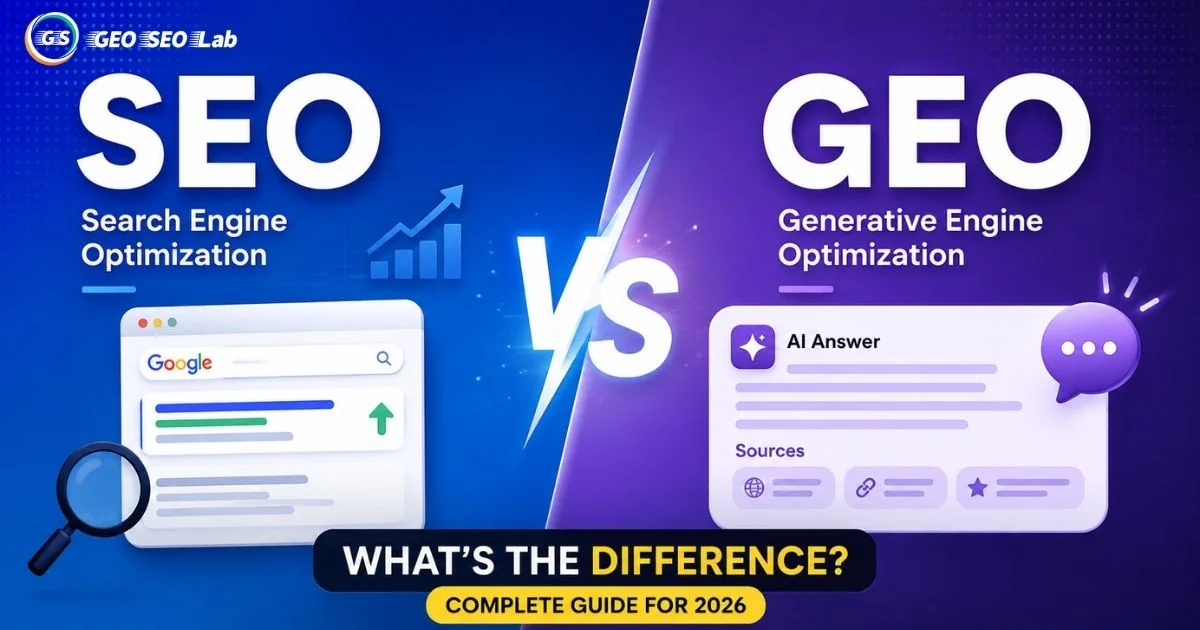
SEO vs GEO: What's the Difference? A Complete Guide for 2026
SEO vs GEO, What's the Difference, and Why Your Business Needs Both in 2026, Introduction For most of the last two decades, the goal of digital marketing c...
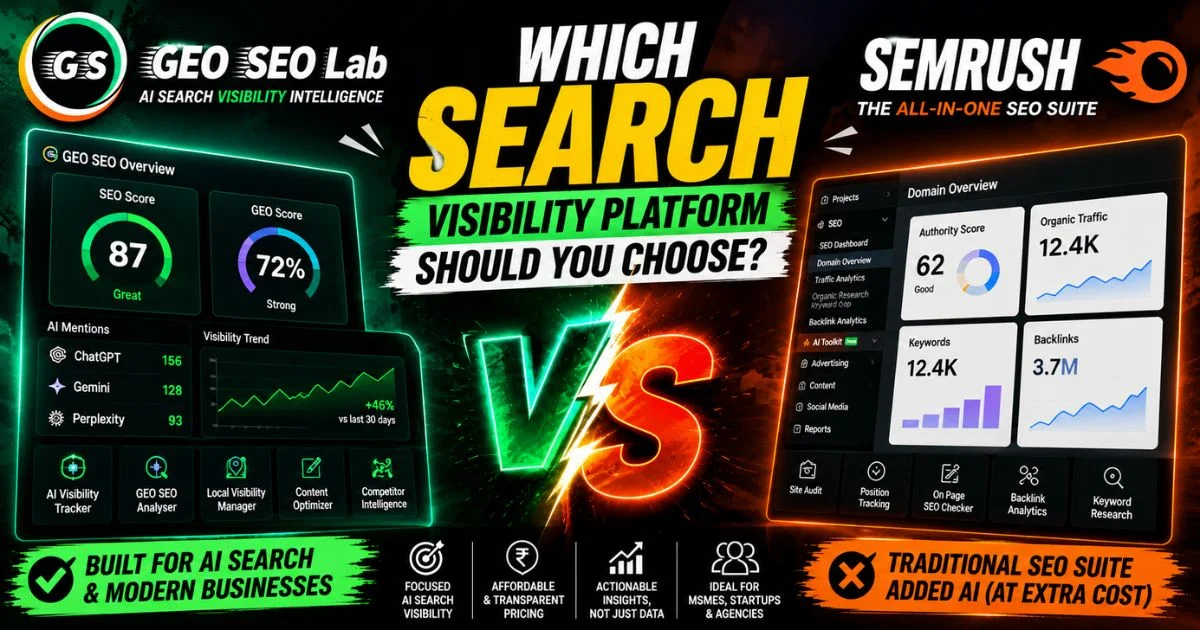
GEO SEO Lab vs Semrush: Which SEO & GEO Platform Is Best in 2026?
Picking a search visibility platform used to be a fairly narrow decision. You wanted rankings, backlinks, and maybe a competitor snapshot, and most of...
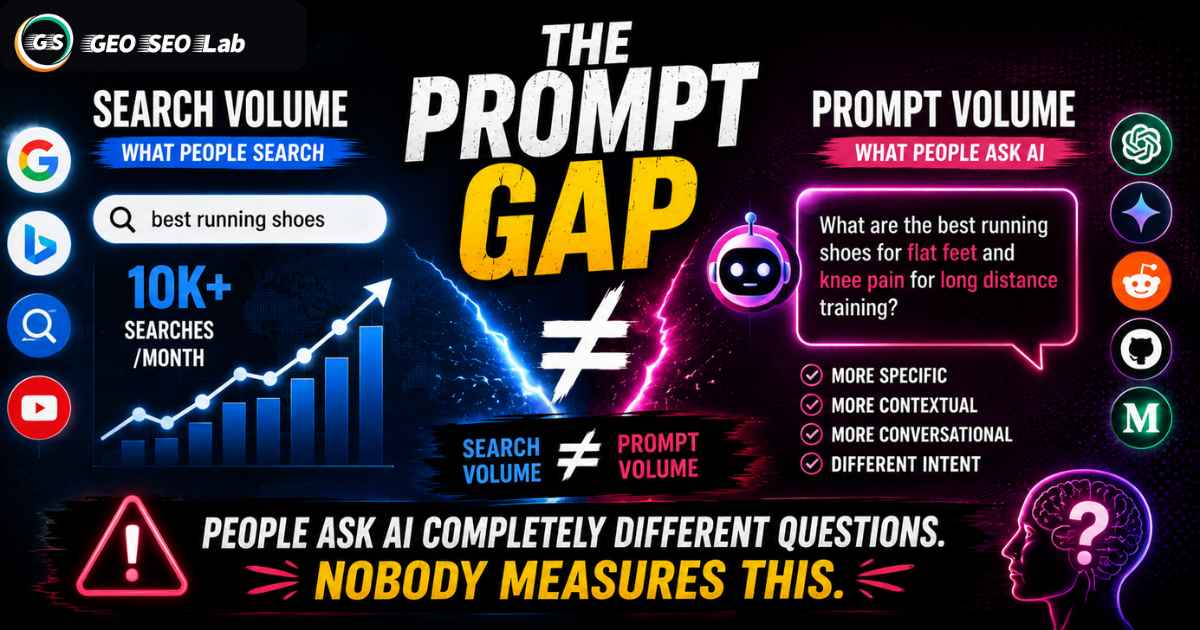
Why Does Search Volume Miss AI Search Prompts? The Prompt Gap
The Keyword Tool Everyone Trusts Is Quietly Going Blind Every marketing team has some version of the same ritual. Open a keyword research tool, type in...