Google's AI Search Is Becoming More Visual, More Connected, and Less Click-Driven
Search Is Quietly Turning Into Something Else: Inside Google's Push Toward Visual, Connected, AI-Driven DiscoveryWhat the AI Mode and AI Overviews Rol...
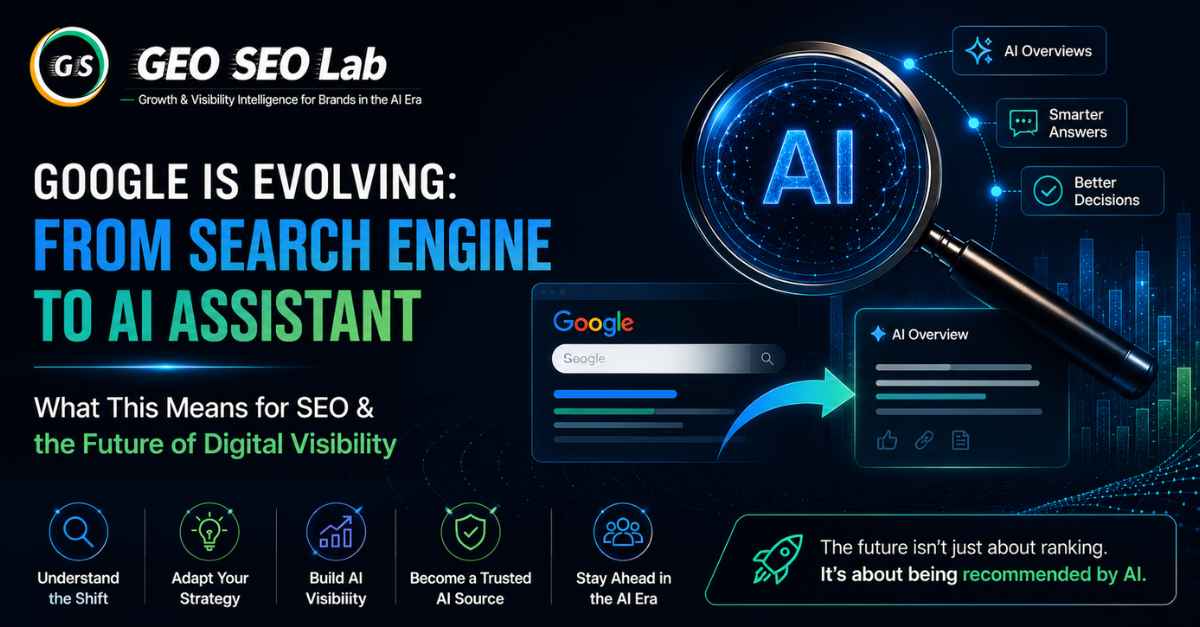
What the AI Mode and AI Overviews Rollout Really Signals for SEO, GEO, Publishers, and Brands
Something big is happening to Google Search, and it's not just another update cycle.
For roughly twenty-five years, the deal was simple: type in some words, get a page of ranked links, click one, find your answer. That single loop reshaped the entire internet — it's the reason SEO exists as a profession, and it's what most digital marketing budgets have been built around for a generation.
That loop is being rewritten.
Between the expansion of AI Mode, the growing sophistication of AI Overviews, new links into outside apps, and a steady stream of interface changes, one thing is becoming obvious: Google isn't content being "just" a search engine anymore. It's positioning itself as something closer to a reasoning layer sitting on top of the internet — one that reads your question, pulls together an answer from multiple places at once, hands you off to other tools when that's useful, and increasingly tries to help you finish whatever you were actually trying to do.
Taken one at a time, each of these updates looks minor. Stacked together, they tell a much bigger story about where discovery is heading.
For anyone whose livelihood depends on visibility — SEO specialists, publishers, brand marketers — this is a mixed bag. There's genuine upside here, but also a real need to rethink the scoreboard. Ranking #1 used to be the whole game. Increasingly, the actual goal is being the source an AI system is confident enough to lean on when it builds its answer.
This piece breaks down what's changed, why it's not just cosmetic, and what it means in practical terms for SEO and its newer cousin, GEO (Generative Engine Optimization).
A Fast Recap of How We Got Here
It's worth rewinding a bit, because today's shift makes more sense against the backdrop of search's earlier eras.
Era One: Human-Curated Directories
Long before ranking algorithms existed, the web was organized by people, not machines. Services like the old Yahoo Directory or DMOZ sorted sites into categories that users browsed by hand. There was no "asking a question" — you clicked your way through folders until you found what you needed.
Era Two: The Keyword-and-Ranking Model
Google's original leap was swapping manual curation for algorithmic ranking — weighing keywords, links, relevance, authority, and behavioral signals to sort the web automatically. That made search dramatically faster and infinitely more scalable, and it stayed the standard for roughly two decades.
The pattern was consistent:
Question → Search Google → Get Ranked Results → Click Through to a Site
Everyone measured the same things: rankings, organic traffic, click-through rate, session counts, conversions. SEO, as a discipline, essentially grew up optimizing for exactly this pipeline.
Era Three: AI Enters the Picture
Language models changed the math entirely. Rather than just fetching documents, an AI system can interpret intent, weigh several sources against each other, explain things in plain language, and keep a conversation going across multiple turns.
Instead of pushing you toward ten separate tabs, the system can now assemble one coherent answer on its own — while still pointing back to where that information came from. It's a genuine inflection point, arguably on par with the original ranking algorithm in terms of impact.
What Google Has Actually Rolled Out
The recent wave of changes breaks down into a handful of themes. None of them is revolutionary by itself — the story is in the combination.
AI Mode Keeps Getting More Capable
AI Mode is the conversational layer that lets people ask layered, multi-part questions and get back a synthesized answer instead of a list of results. It handles follow-up questions, holds onto context from earlier in the session, supports detailed comparisons, and reasons across multiple steps.
That's a real shift in what "using search" feels like — less like querying a database, more like working through a problem with something that talks back.
Outside Services Are Getting Wired In
Perhaps the most telling change is Google linking AI Search directly to external apps — names like Canva, Instacart, and YouTube Music have all shown up in this context.
It's easy to dismiss this as a convenience feature, but it points somewhere bigger: AI Search is starting to treat "answering your question" as step one, not the finish line. The system is beginning to help carry you into actually doing something — which lines up with a broader industry move toward assistants that don't stop at information.
AI Overviews Keep Getting More Substantial
Google continues tuning AI Overviews to include stronger context, clearer sourcing, tighter structure, and better links to the material behind the summary. This isn't really about shrinking the results page — it's about helping someone grasp a topic fast while still leaving a clear path to go deeper if they want to.
For anyone publishing content, that raises expectations: real expertise now counts for more than hitting the right keyword combination.
Top Stories Show Up More Often
Google has also started weaving Top Stories content more directly into AI-generated results. That matters a lot for fast-moving subjects — breaking news, financial markets, sports, elections — where yesterday's answer might already be stale. As AI Search leans harder on current events, staying fresh becomes a bigger competitive factor for publishers in these spaces.
Why These Aren't Just Feature Updates
It's tempting to treat each of these as its own isolated announcement. Looked at together, though, a few consistent threads show up.
Conversation is replacing the query box. People no longer need to craft a perfectly optimized string of keywords — plain, natural phrasing increasingly works just as well, if not better.
Context carries over. Rather than starting from zero every time, AI systems increasingly remember what you asked a moment ago and build on it.
Formats are blending together. Text, images, video, maps, product data, and structured information are getting folded into single unified responses instead of staying in separate lanes.
The endpoint is shifting from information to action. Search increasingly doesn't stop at "here's your answer" — it's starting to help you actually do the thing.
Responses are getting more personal. Future systems are expected to lean more heavily on someone's history, preferences, and situation — within reasonable privacy limits — instead of returning the same generic answer to everyone.
A Simple Way to Visualize the Arc
Traditional Search ➤ Information Retrieval ➤ AI-Generated Answers ➤ Ongoing AI Conversations ➤ AI-Assisted Actions ➤ Fully Autonomous Agents
Each step hands search a bigger responsibility. It began by helping people locate documents. Today it helps them make sense of information. Tomorrow, it's expected to help people actually get things done — with the AI doing more of the heavy lifting along the way.
Why This Actually Matters to You
Ranking well still counts — nobody's saying otherwise. But it's stopped being sufficient on its own. The sharper question now is whether your content is:
- Easy for an AI system to interpret correctly
- Genuinely well-organized, not just keyword-dense
- Trustworthy on its face
- Kept up to date
- Rich enough in context to stand on its own
- A good candidate to be pulled into a synthesized answer
- Actually useful enough to earn a place in that answer
Think of it less as SEO being replaced, and more as SEO's job description quietly getting longer.
From Finding Things to Deciding Things
Most coverage of these changes treats each feature as its own story — one write-up on AI Overviews, another on AI Mode, a third on the new integrations. Taken individually, that framing misses the actual shift underway.
Google isn't just layering AI on top of an existing search engine. It's rewriting what "search" is even for. The old version was built to help you find things. The version now taking shape is built to help you understand things, weigh your options, and — increasingly — get things done. That's not a minor distinction; it changes nearly everything about what digital visibility means.
The Old Journey vs. the New One
Classically, search worked as a gateway: ask a question, get ten links, visit a few sites, weigh what you found, and make the call yourself. Nearly all the evaluation work sat on your shoulders.
Question → Google → 10 Links → Visit Several Sites → Compare → Decide
AI-driven search compresses that whole sequence. Rather than sending you off to do the comparison work yourself, the system increasingly does a version of it before you ever see a result:
Question → AI Reads Your Intent → Gathers Multiple Sources → Synthesizes → Suggests an Answer → You Decide
The AI has effectively wedged itself in as a middle layer between you and the open web — arguably the single biggest change to how information gets discovered since Google's original ranking system launched.
The Questions People Ask Are Getting Bigger
Instead of "where do I find information about X," people increasingly ask things like:
- Which of these options is actually better?
- What should I buy here?
- Which tool actually fits my business?
- How do I solve this specific problem?
- Which provider should I go with?
None of that can be satisfied by simply returning a document. It requires actually weighing sources — checking accuracy, context, how current something is, whether independent sources agree, how credible each one is, and how genuinely practical the answer would be. The job has moved from ranking pages to constructing a dependable answer from scratch.
Clicks Are Becoming a Secondary Signal
For years, the industry's scoreboard ran almost entirely on clicks — better rankings drove more clicks, more clicks drove more traffic, more traffic drove more conversions.
AI Search complicates that math. Plenty of simple, informational questions can now get resolved without a single site visit. That doesn't mean traffic disappears — it means the reasons people click are changing. People still show up on websites for original research, detailed comparisons, actually completing a purchase, in-depth documentation, professional services, interactive tools, downloads, and community discussion.
Put simply: how much traffic you get may start mattering less than what kind of traffic you get.
A Second Way to Map This
Traditional Search ➤ Document Discovery ➤ Understanding Information ➤ Decision Support ➤ Getting Things Done ➤ Autonomous Agents
Organizations that only optimize for the "document discovery" stage risk getting left behind, since AI systems increasingly favor whatever actually helps someone decide.
Search as a Connected Web of Knowledge
Classic search evaluated individual pages in isolation. AI Search increasingly looks at how pages relate to each other — across websites, organizations, named experts, products, research, news coverage, reviews, and public data — treating the whole thing more like an interconnected graph than a stack of separate documents.
That's a big reason why brand consistency, structured data, and cross-source corroboration have become such a bigger deal. The web is gradually being read less as a pile of standalone pages and more as one connected knowledge system.
The App Integrations Are a Bigger Deal Than They Look
The third-party connections inside AI Mode might read as a small convenience at first glance. Strategically, they're more significant than that.
They mark a shift from:
"Find me information." to "Help me actually finish this."
Picture the old way of putting together, say, a social media graphic: search for inspiration, open Canva yourself, build it by hand.
Now picture the emerging version: ask for a graphic, get a template suggestion, and get carried straight into Canva to keep going — no separate search step needed in between.
The search session no longer has to end once information is found — it can extend directly into execution. This is the early shape of what a lot of researchers call "agentic search," where the AI stays with you through an entire workflow instead of stepping away after a single answer.
One Response, Many Formats
Search is also leaning harder into blending formats — text, images, video, voice, maps, shopping data, and structured data all showing up together inside a single response instead of staying siloed. For content creators, that means building knowledge across formats, not just relying on a single written page.
Freshness Isn't a Blanket Rule Anymore
Freshness used to get treated as a universal ranking booster — newer content was simply better, full stop. AI Search is getting more nuanced about that. Some information genuinely needs constant updates — breaking news, weather, markets, election results, live sports scores. Other material holds its value for years without changing — core scientific concepts, math, technical documentation, foundational educational content.
Modern AI systems are starting to tell these categories apart instead of applying one freshness standard to everything — which is good news for publishers, since it means updating what's genuinely time-sensitive without needing to constantly churn evergreen material that's still accurate.
What "Visibility" Actually Means Now
Old-school SEO had a single north star: rank higher. AI Search stretches that into several factors working together — how discoverable you are, how good your information actually is, how consistent your entity signals are, how credible your sources look, how much context you provide, how fresh things are, and how useful the whole package is to a real reader.
A page can rank perfectly well in traditional search and still get skipped over by an AI system if it lacks context or credibility. Meanwhile, a well-structured, trustworthy piece of content can end up feeding an AI-generated answer even when it isn't the single top-ranked result for that query. The center of gravity is shifting from "optimize to rank" toward "optimize to be understood."
Getting Ready for What Comes Next
AI Search has moved fast over the last couple of years, but it's still early. AI Mode, AI Overviews, multimodal capabilities, connected apps, conversational interfaces — these are opening chapters, not the finished product.
Big technology shifts tend to follow a similar arc: they start out imitating whatever came before them, then eventually unlock behavior that wasn't possible at all previously. That's roughly the path the internet took, the path smartphones took, the path cloud computing took — and it's the path AI-powered search appears to be on now. Organizations that start adapting early tend to be the ones still standing once things settle.
A Rough Sketch of the Next Five Years
Conversations, not queries. Instead of firing off isolated keyword searches, people will increasingly hold an ongoing back-and-forth — "find me three CRMs for healthcare clinics," then "compare pricing," then "which one plays nicely with HubSpot," then "build a migration checklist" — all inside one continuous thread rather than four separate searches.
Doing things, not just describing them. Today's systems mostly answer questions. Tomorrow's are expected to actually carry out tasks — scheduling, booking, drafting, comparing policies, planning trips, managing projects.
More personal responses. Expect systems that weigh someone's history, goals, location, and device context more heavily — which means brands need to think about serving a range of different user situations rather than assuming one universal path through search.
Entities keep overtaking keywords. Keywords aren't going away, but AI systems increasingly think in terms of connected entities — companies, products, authors, services, places, research — rather than isolated words. That rewards businesses for strengthening their footprint across many trusted sources instead of obsessing over keyword density on a single page.
Trust becomes genuine infrastructure. As AI-generated answers become more common, telling reliable information apart from noise gets more important, not less. Organizations that consistently produce accurate research, real expert insight, transparent methods, and original analysis will hold a real advantage — trust stops being just a branding nicety and starts functioning as a prerequisite for visibility.
What Different Teams Should Focus On
SEO teams — stretch your KPIs past keyword rankings, start tracking presence inside AI-generated answers wherever it's possible, tighten semantic structure and internal linking, and cover topics comprehensively instead of chasing one page at a time.
Content teams — put out genuine research and real expert perspective, keep evergreen material current, add clear definitions, comparisons, and FAQs, and write to actually be understood rather than to hit a target word count.
Local businesses — keep your details consistent everywhere they appear, strengthen local entity signals, encourage authentic customer reviews, and keep your Google Business Profile current.
Publishers — bring genuine added value instead of repackaging what's already out there; invest in original reporting, data work, and expert interviews; build real topical authority rather than chasing every passing trend.
Enterprises — build centralized knowledge repositories, standardize how the brand is described across departments, sharpen documentation quality, and treat knowledge management as a genuine strategic priority rather than an administrative afterthought.
Traps Worth Steering Clear Off
A lot of organizations are still running old-search assumptions on a system that no longer plays by those rules. A few recurring missteps:
- Chasing every new feature. Not every announcement demands a strategy overhaul — stick with fundamentals instead of reacting to each release.
- Measuring only traffic. Traffic still matters, but it's not the whole picture anymore. Track brand visibility, entity recognition, AI citations, engagement, and how well conversions actually hold up too.
- Publishing generic content. AI systems increasingly favor original insight, real expertise, and solid evidence — material that just restates what's already everywhere online tends to blend into the background.
- Neglecting the technical basics. Crawlability, structured data, internal linking, page speed, and accessibility still matter — technical SEO hasn't gone anywhere.
Where This Leaves Us
None of this means SEO is finished — it means SEO is entering its next phase. Classic SEO was about making a website discoverable. What people now call GEO is about making information understandable, trustworthy, and genuinely useful inside AI-driven experiences.
The organizations that come out ahead won't necessarily be the ones producing the most content. They'll be the ones building knowledge that AI systems can confidently interpret and point back to — pairing solid technical execution with editorial quality and real subject-matter depth.
The Core Takeaways
- AI Search is shifting from simple retrieval toward genuine assistance.
- Google's recent updates point toward more conversational, multimodal, and action-oriented experiences.
- Rankings still matter, but AI visibility now also hinges on trust, structure, context, and entity authority.
- Success should be measured beyond clicks — think AI mentions, citations, engagement, and conversion quality.
- Long-term advantage comes from building a solid knowledge ecosystem, not from producing more content for its own sake.
About GEO SEO Lab
GEO SEO Lab helps brands become discoverable, trusted, and recommended in the AI era. Traditional SEO alone is no longer enough — businesses now need visibility across AI search engines, LLMs, local search, reviews, and digital platforms. Our platform continuously monitors website health, AI visibility, content performance, competitor movements, local presence, and customer sentiment while providing actionable recommendations that drive real traffic, qualified leads, and measurable growth. Built specifically for modern businesses and MSMEs, GEO SEO Lab transforms complex digital marketing into a clear, intelligent growth system.
Tags
Frequently Asked Questions
Find answers to common questions about this topic
About the Author

Anubhav
SEO Expert & Content Creator
Experienced digital marketing professional specializing in SEO strategies, content optimization, and data-driven marketing solutions. Passionate about helping businesses grow their online presence and achieve better search rankings.
Related Articles
View all posts
SEO vs GEO: What's the Difference? A Complete Guide for 2026
SEO vs GEO, What's the Difference, and Why Your Business Needs Both in 2026, Introduction For most of the last two decades, the goal of digital marketing c...
GEO SEO Lab vs Semrush: Which SEO & GEO Platform Is Best in 2026?
Picking a search visibility platform used to be a fairly narrow decision. You wanted rankings, backlinks, and maybe a competitor snapshot, and most of...
Why Does Search Volume Miss AI Search Prompts? The Prompt Gap
The Keyword Tool Everyone Trusts Is Quietly Going Blind Every marketing team has some version of the same ritual. Open a keyword research tool, type in...