Google vs ChatGPT: Who Wins This Search?
Google vs ChatGPT: Who Wins This Search?We Ran the Exact Same Prompt Through Five Platforms. Here's What Each One Actually Showed Us.Category: AI Sear...
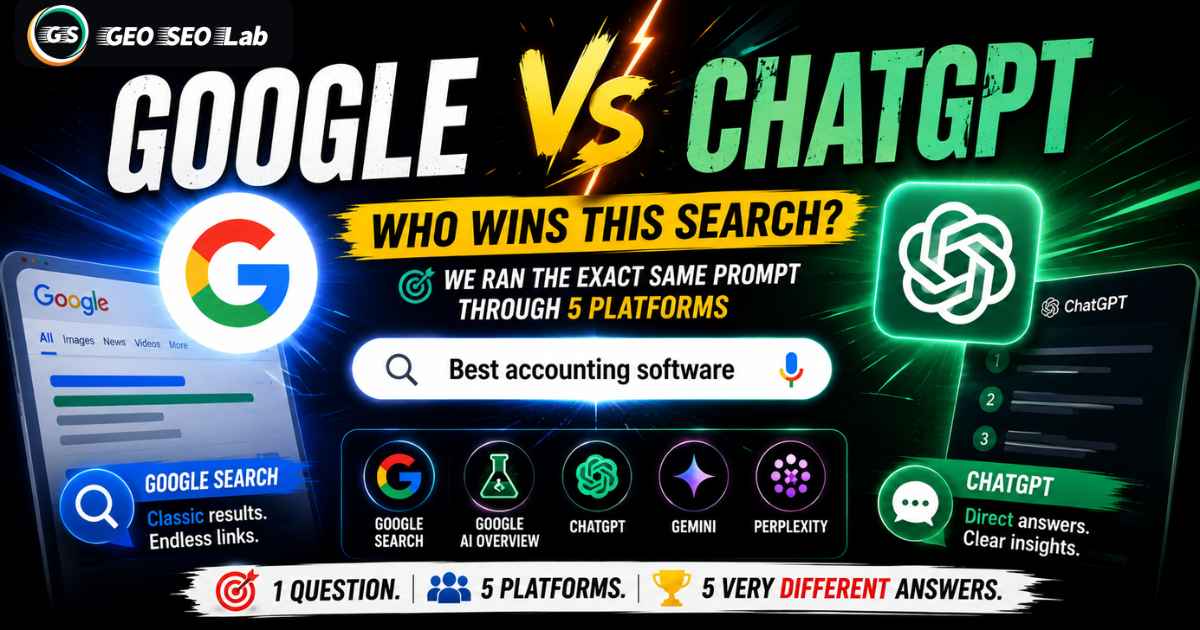
We picked a question almost every small business owner has typed somewhere at some point. "Best accounting software." Simple, high intent, genuinely commercial, and exactly the kind of query that used to send someone straight into a familiar ritual of scrolling through ten blue links and opening half of them in new tabs.
Then we asked that same question, in roughly the same phrasing, across five different places people now actually go looking for this kind of answer. Traditional Google Search. Google's AI Overview sitting right on top of those same results. ChatGPT. Gemini. Perplexity.
What came back wasn't five slightly different versions of the same list. It was five genuinely different experiences, built on five genuinely different assumptions about what a person actually wants when they ask this question, and honestly, watching them side by side taught us more about where search is actually headed than any single piece of research we've read this year.
This is the honest writeup of what we saw, platform by platform, and what it actually means for a business trying to show up favorably no matter which of these five doors a potential customer happens to walk through.
Why We Picked This Particular Question
"Best accounting software" isn't a random choice. It's a genuinely well trodden query with a mature, competitive content landscape behind it, full of detailed comparison articles from software review sites, accounting firms, and the software companies themselves, all fighting for the exact same intent. That makes it a fair, honest test case, since it's not some obscure niche topic where thin content might accidentally look impressive. This is a category where the competition for attention is fierce, the stakes for getting it wrong are real, since choosing the wrong accounting software can genuinely cost a small business money and headaches for years, and the existing body of published comparison content is deep enough that any AI system pulling from the open web has plenty of material to synthesize from.
It's also a query with a real, honest answer that keeps showing up consistently across the accounting and small business press. QuickBooks Online tends to come out as the default recommendation for most US small businesses, largely because of how deeply embedded it is in accountant and CPA workflows. Xero usually gets positioned as the strongest option for teams that need multiple users without paying per seat. FreshBooks consistently shows up as the pick for freelancers and service businesses built around invoicing. Wave and Zoho Books both get mentioned regularly as legitimate free options for very small operations. That existing, fairly consistent consensus gave us a genuine baseline to compare against, rather than judging each platform against nothing at all.
We also picked this question because it sits in that particular sweet spot where the answer genuinely matters to the person asking it. Nobody picks accounting software casually. It touches taxes, cash flow, and often an ongoing relationship with an accountant or bookkeeper who may already have their own strong preference. That stakes level felt important to preserve in the test, since a low stakes, trivial query might not reveal much about how these platforms actually handle a decision a person genuinely cares about getting right. A business choosing the wrong platform doesn't just waste a subscription fee. It can mean months of migration headaches, lost historical data, or an accountant who now has to relearn an entire workflow, which is exactly the kind of real world weight that makes a thoughtful, well reasoned answer actually matter.
What Traditional Google Search Actually Showed
Typing the query into Google the old fashioned way produced exactly what two decades of habit trained us to expect, a results page built almost entirely around comparison. Several of the top organic positions were occupied by detailed, article length breakdowns comparing QuickBooks, Xero, FreshBooks, and a handful of smaller names, each one clearly built by a content team that understood this query gets searched by people trying to make a real decision, not just people looking for a definition.
A few sponsored results sat above the organic listings, which is worth noting honestly, since paid placement still shapes what a lot of people see first even before any organic ranking comes into play. Below that, the organic results leaned heavily on established software review publications and specialized accounting and CPA focused sites, the kind of sources that have spent years building topical authority in this exact category.
What Google Search does well here, and still does better than any of the other four platforms we tested, is breadth. A person willing to actually click through several results can build a genuinely thorough, multi angle understanding of the category, reading one article's take on pricing, another's take on ease of use, and a third's take on accountant compatibility. The tradeoff, and it's a real one, is that this requires actual effort. Nobody gets handed a synthesized answer. They get handed a stack of options and have to do the comparing themselves, which is exactly the behavior AI powered alternatives are increasingly designed to shortcut.
What Google's AI Overview Added on Top of That
Sitting right above those same organic results, Google's AI Overview pulled together a genuinely useful synthesized summary, drawing visibly from several of the same comparison articles ranking just below it. It named QuickBooks as a strong default pick for most small businesses, mentioned Xero specifically for multi user needs, and flagged FreshBooks for freelancers, essentially compressing the consensus of several full length articles into a few tight paragraphs, with links back to a handful of the underlying sources for anyone who wanted to dig further.
This is where the difference between traditional search and AI powered search became genuinely visible in real time. A person who used to need to open three or four tabs to build this same basic picture could now get roughly the same starting point in a matter of seconds, without leaving the results page at all. The organic listings were still sitting right there below it for anyone who wanted more depth, but a real, honest question worth asking is how many people actually scroll past a summary that already answered their basic question well enough to feel satisfied.
What stood out to us most was how closely the AI Overview's synthesis matched the actual published consensus we'd already found through manual research. It wasn't inventing a novel opinion. It was accurately compressing what a handful of credible, well established sources already agreed on, which is exactly the kind of behavior that should make businesses take their existing comparison content more seriously rather than less, since that content is clearly part of what's feeding this exact summary.
What ChatGPT Gave Us
Asking ChatGPT the same question produced something noticeably more conversational, and noticeably more oriented toward asking us something back before committing to a single answer. Rather than an immediate list, the response opened by naming QuickBooks, Xero, and FreshBooks as the three names worth knowing, briefly explaining what each one is generally best suited for, and then asked a natural follow up question about our business size and whether we worked with an accountant who might already have a platform preference.
That follow up question turned out to matter more than it seemed at first. Answering it with a hypothetical scenario, a small five person service business already using Xero for time tracking, produced a noticeably more tailored response the second time around, one that leaned harder into Xero's collaboration features rather than repeating the same generic three name list. This is the conversational advantage that shows up consistently once you actually sit with these tools rather than just reading about them abstractly. A single static answer became a real, if brief, back and forth that ended somewhere more specific and more useful than where it started.
Where ChatGPT was noticeably weaker, at least in the session we ran, was in surfacing clear, visible source links the way Perplexity or Google's AI Overview did. The underlying knowledge felt broadly accurate and consistent with the published consensus, but a business or a curious reader wanting to verify exactly where a specific claim came from had a harder time tracing it back to a specific source directly inside the conversation itself.
What Gemini Showed Us
Gemini's response landed somewhere between ChatGPT's conversational style and Google AI Overview's tighter, more citation forward synthesis, which makes sense given how closely it's integrated with the broader Google ecosystem. It named the same core group of software, QuickBooks, Xero, FreshBooks, with Wave mentioned as a free option, and organized the answer into a genuinely clean, scannable structure that felt closer to reading a well built comparison page than reading a casual conversation.
One thing Gemini did that neither ChatGPT nor Perplexity did in our test was lean visibly into more current, dated specifics, referencing recent pricing changes for one of the platforms in a way that felt more current than what we saw elsewhere. That tracks with what we already understood conceptually about Gemini's tighter integration with live Google Search infrastructure, and it was genuinely useful to see that advantage show up concretely in an actual side by side comparison rather than just as an abstract talking point.
Gemini's answer also included direct links out to a couple of underlying sources, closer to Google's AI Overview behavior than to ChatGPT's more self contained, conversational style. For a business trying to understand how it might get cited, this pattern is worth paying attention to specifically, since it suggests Gemini's citation habits lean closer to Google Search's broader infrastructure than to a fully separate, independent retrieval system.
What Perplexity Did Differently
Perplexity was, without question, the most transparent of the five about exactly where its answer came from. The response named QuickBooks as the broad default recommendation, walked through Xero and FreshBooks as the two most common alternatives depending on business type, and every single claim in the response sat next to a small, clickable citation marker linking directly back to a specific source article.
This citation heavy approach is genuinely Perplexity's whole identity as a product, and testing it directly against the other four made that identity obvious in a way that's easy to acknowledge intellectually but genuinely clarifying to actually witness. For anyone who wants to verify a claim before trusting it, or anyone specifically trying to understand which sources are actually feeding a given AI generated answer, Perplexity made that process dramatically easier than any of the other four platforms we tested.
The tradeoff, if there is one, is that Perplexity's response felt slightly less conversational and slightly more like reading a well organized research brief than having an actual back and forth exchange. That's not necessarily a weakness, since plenty of people asking a genuinely important business decision question would rather have a carefully sourced brief than a casual conversation, but it's a real difference in tone worth naming honestly rather than pretending all five platforms are just skinning the same underlying experience differently.
So Who Actually Won
Here's the honest answer, and it's less satisfying than a clean, single winner, but it's also the more useful conclusion. Nobody won outright, because each platform was genuinely optimized for a slightly different version of what "winning" this particular question even means.
If the goal is comprehensive, self directed research where a person wants to build their own independent judgment by reading multiple full perspectives, traditional Google Search still offers more raw depth than any single AI generated answer, provided the person is willing to put in the actual effort to read several sources.
If the goal is a fast, accurate, well sourced starting point without needing to click anywhere at all, Google's AI Overview and Perplexity both performed strongly, for slightly different reasons. The AI Overview wins on convenience, sitting right where the person already is. Perplexity wins on transparency, making it easiest to actually verify what it just told you.
If the goal is a genuinely tailored recommendation that accounts for a specific, personal situation rather than a generic answer meant for everyone, ChatGPT's conversational follow up made it the strongest performer in our test, precisely because it was the platform most willing to ask a clarifying question before committing to an answer.
If the goal is a well organized, scannable answer with reasonably current specifics baked in, Gemini held its own comfortably against the other four, benefiting visibly from its tighter integration with Google's broader search infrastructure.
The Platform Fit Model
Put simply, the honest framework that emerged from actually running this test side by side isn't which platform is best in some abstract sense. It's matching platform to actual intent. Depth of independent research favors traditional search. Fast, sourced convenience favors AI Overview and Perplexity. Personalized, conversational guidance favors ChatGPT. Current, well organized synthesis favors Gemini. A business trying to show up well across all five needs to understand that it isn't really competing on one battlefield anymore. It's competing on five distinct ones simultaneously, each with a genuinely different set of rules for what earns a citation or a mention.
What This Means for How a Business Should Actually Show Up
Comprehensive, well structured comparison content still matters enormously, maybe more than ever. Every single one of the five platforms we tested, including the ones built to move away from traditional search entirely, ultimately drew on the same underlying body of comparison content published by software review sites and accounting focused publications. That content isn't becoming irrelevant. It's becoming the actual raw material every synthesis engine depends on.
Being specific about who a product is actually best for matters more than a vague, universal pitch. Every platform we tested naturally organized its answer around use case, freelancers versus teams versus businesses working closely with a CPA, rather than pretending one option was simply best for everyone. A business whose own content makes that same honest, specific distinction is giving every one of these five systems exactly the kind of clean, extractable claim it's looking for.
Citation friendly writing habits genuinely pay off across every platform, not just the obviously citation forward ones like Perplexity. Content that states a clear claim, attaches a specific reason, and stays honest about tradeoffs performed consistently well across all five systems in our test, because that's simply easier material for any of them to lift a clean, verifiable point from.
A conversational, follow up friendly platform like ChatGPT rewards content that anticipates the natural next question, not just the first one. Since ChatGPT visibly adjusted its answer once given more context, content that proactively addresses common follow ups, team size considerations, integration needs, accountant compatibility, gives that kind of conversational system more useful material to draw on when a real user provides similar context.
Freshness and specificity matter more for Gemini and Google's AI Overview than for the more conversational tools. Both leaned visibly on current, dated details in ways ChatGPT and Perplexity didn't emphasize as strongly in our test, which tracks with their tighter integration with live search infrastructure, and it's a useful reminder that keeping pricing and feature information genuinely current pays off disproportionately for anyone hoping to be cited by these two specifically.
The Five Way Comparison Framework
For any business wondering how to actually test its own visibility the way we tested this one, the practical version of this exercise is straightforward, even if it takes real time to do properly. Pick a genuinely high intent question a real customer would ask. Run it, honestly and without cherry picking, across traditional search, Google's AI Overview, ChatGPT, Gemini, and Perplexity. Note not just whether a business gets mentioned, but which platform mentioned it, in what context, and whether the mention read as a strong recommendation or a passing reference buried in a longer list. Repeat that same process across several different phrasings and over several different weeks, since a single test on a single day tells you far less than a pattern observed consistently over time. What we found running this exercise ourselves is that the businesses showing up favorably across all five platforms weren't doing anything exotic. They were simply the ones whose underlying content was specific, honest about tradeoffs, and genuinely useful regardless of which system happened to be reading it.
It's worth keeping a simple log while running this exercise, even an informal one, since the value compounds the longer it runs. A single week of testing tells you what's happening right now. A few months of testing, tracked consistently, starts telling you whether a business's visibility across these five platforms is actually improving, staying flat, or quietly slipping, which is a far more useful signal for deciding where to actually invest time and budget next.
Closing Thought
Running the same question through five different doors didn't reveal one clear winner, and honestly, we didn't expect it to. What it revealed instead is that the old idea of optimizing for a single search engine's ranking algorithm is already a genuinely outdated way to think about visibility. Five different systems, reading the same underlying web of content, produced five different experiences, each shaped by a different philosophy about what actually helps a person make a real decision. The businesses that show up well across all five aren't gaming any single one of them. They're simply publishing the kind of honest, specific, well organized content that happens to be useful no matter which door a customer walks through, which, when you actually sit with the results side by side like this, starts to feel less like a clever strategy and more like just doing the work properly in the first place.
We'll be honest that running this test changed how a few people on our own team think about their day to day work. It's one thing to read, abstractly, that AI search behaves differently across platforms. It's a genuinely different thing to sit five answers next to each other on the same screen and watch the differences show up in real time, in response to the exact same words. We'd encourage any team reading this to try the same exercise with a query that actually matters to their own business, rather than taking our word for how any of this plays out in their specific category. The differences are real, they're consistent enough to plan around, and they're a lot easier to internalize once you've actually seen them for yourself rather than just read about them secondhand.
Key Takeaways
- Traditional Google Search still offers the most depth for a person willing to do their own comparison across multiple full articles, but it demands the most effort from the person doing the searching.
- Google's AI Overview and Perplexity both delivered fast, well sourced answers, with the AI Overview winning on convenience and Perplexity winning clearly on citation transparency.
- ChatGPT stood out specifically for its willingness to ask a clarifying follow up question, producing a more genuinely tailored answer once given real context about the business asking.
- Gemini benefited visibly from its tighter integration with live Google Search infrastructure, surfacing more current, dated specifics than the other conversational tools in our test.
- No single platform won outright, because each one is genuinely optimized for a different version of what a good answer to the same question actually looks like.
About GEO SEO Lab
GEO SEO Lab helps brands become discoverable, trusted, and recommended in the AI era. Traditional SEO alone is no longer enough businesses now need visibility across AI search engines, LLMs, local search, reviews, and digital platforms. Our platform continuously monitors website health, AI visibility, content performance, competitor movements, local presence, and customer sentiment while providing actionable recommendations that drive real traffic, qualified leads, and measurable growth. Built specifically for modern businesses and MSMEs, GEO SEO Lab transforms complex digital marketing into a clear, intelligent growth system.
References and Further Reading
- Forbes Advisor, Best QuickBooks Alternatives, 2026 edition
- Industry comparison research on QuickBooks, Xero, FreshBooks, Wave, and Zoho Books for small business accounting, 2026
- GEO SEO Lab, We Deleted Google for 7 Days, Here's What Happened
- GEO SEO Lab, The New Rules of AI Visibility, why rankings alone won't win in 2026
- GEO SEO Lab, The AI Knowledge Advantage, why AI search rewards knowledge networks, not just content
Tags
Frequently Asked Questions
Find answers to common questions about this topic
About the Author

Anubhav
SEO Expert & Content Creator
Experienced digital marketing professional specializing in SEO strategies, content optimization, and data-driven marketing solutions. Passionate about helping businesses grow their online presence and achieve better search rankings.
Related Articles
View all posts
SEO vs GEO: What's the Difference? A Complete Guide for 2026
SEO vs GEO, What's the Difference, and Why Your Business Needs Both in 2026, Introduction For most of the last two decades, the goal of digital marketing c...
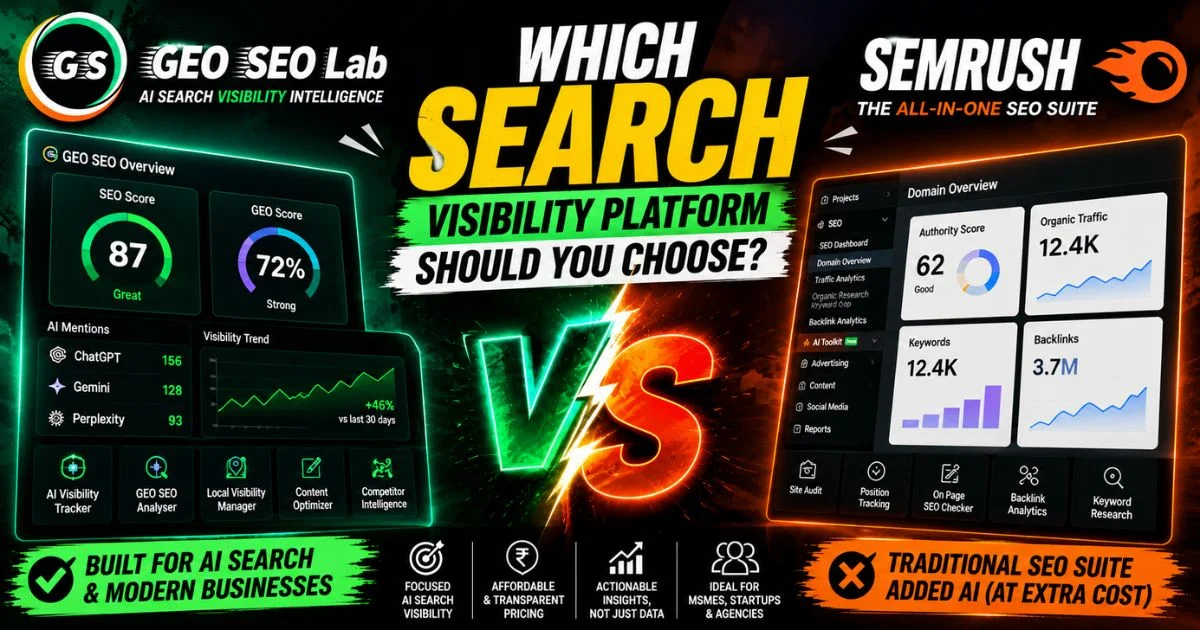
GEO SEO Lab vs Semrush: Which SEO & GEO Platform Is Best in 2026?
Picking a search visibility platform used to be a fairly narrow decision. You wanted rankings, backlinks, and maybe a competitor snapshot, and most of...
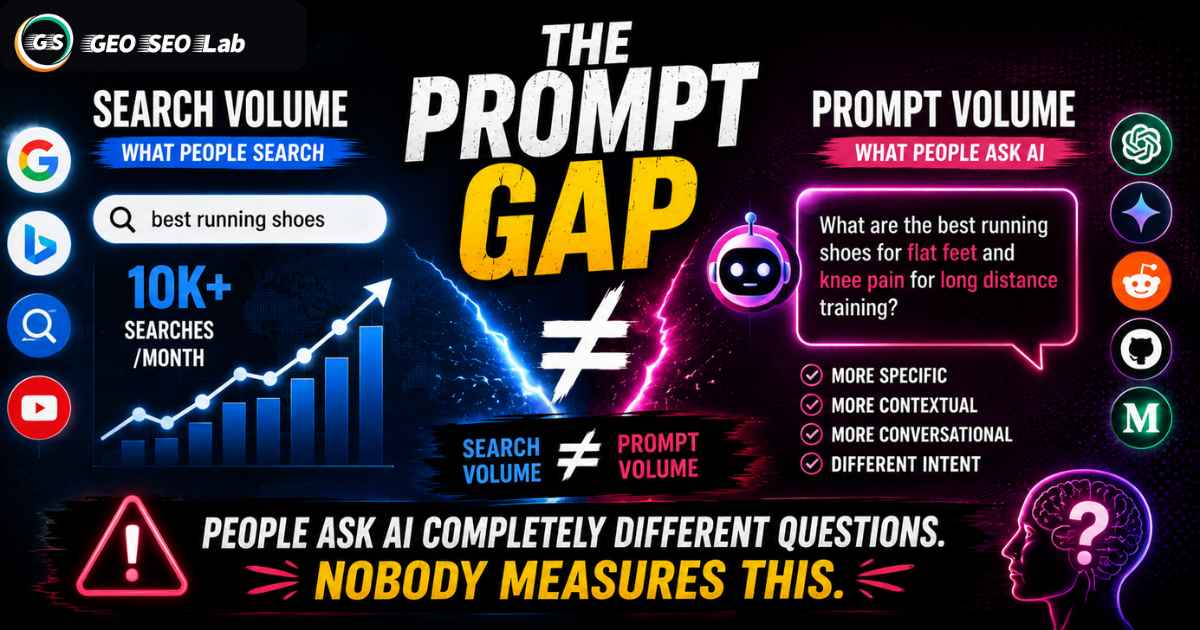
Why Does Search Volume Miss AI Search Prompts? The Prompt Gap
The Keyword Tool Everyone Trusts Is Quietly Going Blind Every marketing team has some version of the same ritual. Open a keyword research tool, type in...