Google Search Console's New Platform Data Changes How You Measure SEO in 2026
For as long as most SEO professionals have had a job title, Search Console has answered one question and one question only. How is our website doing i...
For as long as most SEO professionals have had a job title, Search Console has answered one question and one question only. How is our website doing in Google Search. Clicks, impressions, average position, all of it tied to pages a business actually owned and controlled. If your content lived somewhere else, a YouTube channel, an Instagram account, a TikTok profile, it simply didn't exist as far as Search Console was concerned. You could see how that content performed inside its own platform, likes, views, follower counts, but you had no reliable way to see whether it was actually showing up inside Google Search itself, and no way to connect that performance back to the same dashboard where the rest of your SEO reporting already lived.
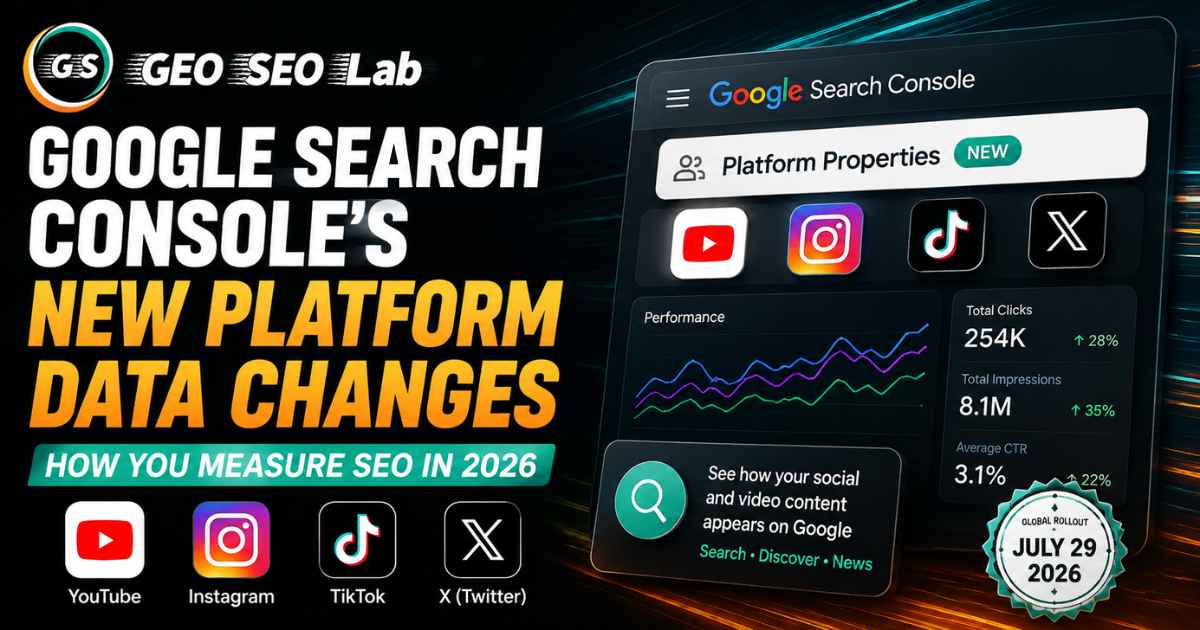
That changed this July. Google announced a genuinely new property type inside Search Console called platform properties, first introduced on July 7 and rolled out globally to every account by July 29. For the first time, a business can verify an Instagram, TikTok, X, or YouTube account directly inside Search Console and see, in the same tool used for years to track website performance, exactly how that social or video content is actually showing up across Google Search, Discover, and Google News.
This isn't a small, cosmetic dashboard update. It's Google quietly admitting something SEO professionals have known for a while but never had real data to prove, that a meaningful and growing share of what actually earns visibility inside Google's ecosystem now lives well outside the traditional website. This piece walks through exactly what changed, what platform properties actually show you, and why this update points toward a genuinely bigger shift in what SEO measurement is supposed to cover in the first place.
It's worth naming why this particular gap mattered so much for so long before Google finally closed it. A video team could tell you exactly how a YouTube upload performed inside YouTube's own dashboard. A social team could tell you exactly how an Instagram post performed inside Meta's own tools. What neither team could ever say with real confidence was how that same content was actually performing inside Google Search itself, the single largest source of discovery on the internet, because the tool built specifically to answer that question had simply never been extended to cover content living outside a verified website. That gap wasn't a minor inconvenience. It meant an entire category of genuinely valuable search performance data was functionally invisible to the people whose job was to actually understand and improve it.
What Changed in Search Console
The core change is straightforward to state and genuinely significant in what it implies. Search Console has always organized data around properties, a website's domain, or a specific set of URLs within that domain. Platform properties introduce a third option sitting alongside those two familiar formats, letting a business verify a social or video account instead of a website, and pull real Google Search performance data for the content published on that account.
Google's own Search Central Blog framed the update plainly on July 29, noting that the company had announced platform properties earlier in the month specifically to let people track how their social and video posts on Instagram, TikTok, X, and YouTube perform on Google Search, Discover, and Google News, and that as of that post, the feature was globally available to everyone rather than sitting in the staged, gradual rollout it launched under three weeks earlier.
The timeline itself is worth noting, because it moved unusually fast for a Search Console feature. Google announced platform properties on July 7, explicitly describing the rollout at launch as gradual, becoming available over the following weeks. By July 29, just twenty two days later, Google confirmed the rollout was complete and the feature had reached full global availability, a genuinely quick turnaround for a product update touching this many accounts.
Alongside the global rollout itself, Google published a new, dedicated guide specifically covering how to analyze social and video content performance using the new reports, aimed explicitly at content creators, social media managers, and SEO professionals alike, according to Google's own description of who the guide was built for.
What Are Platform Properties
A platform property, at its core, is a verified social or video account sitting inside Search Console, functioning much like a familiar domain or URL property, but built around an account you don't necessarily own a website for at all.
Setting one up follows a process that will feel familiar to anyone who has verified a website property before. A business opens the property selector inside Search Console, or the verification welcome page, picks one of the four currently supported platforms, Instagram, TikTok, X, or YouTube, and follows the prompts to securely authorize the connection to that specific account. If a business already has an existing Search profile with connected social accounts, those same accounts should already be available as platform properties without needing to go through verification again from scratch.
Once verified, a platform property gives access to three distinct report types, each built around a genuinely different job. A Performance report shows the familiar metrics website owners have relied on for years, clicks, impressions, and the actual queries driving traffic, applied for the first time to social and video content rather than webpages. An Insights report goes a step further, surfacing top performing query groups, along with which topics are trending up or trending down in terms of the search traffic they're sending to a given account's content. And an Achievements report tracks specific milestones reached across a rolling twenty eight day window, giving a lighter, more creator friendly way to see meaningful moments of growth without needing to dig through raw performance numbers manually.
It's worth being precise about what this data actually represents, since it's easy to misread at first glance. Platform properties show how an account's content is performing specifically within Google's own surfaces, Search, Discover, and Google News, not the platform's own native, in app engagement numbers. A TikTok video's in app view count and its Google Search visibility are two genuinely different things, and platform properties exist specifically to measure the second one, which almost nobody had reliable visibility into before this update.
Search vs Social vs Video Data
It helps to be clear about how these three kinds of data actually differ, because treating them as interchangeable versions of the same basic number misses exactly what makes this update valuable in the first place.
Search data, the kind Search Console has always reported on, reflects performance tied to owned, indexed web pages, built around the traditional model of a page being crawled, ranked, and clicked. Social data, the kind that's always lived inside a platform's own native analytics, reflects engagement happening entirely inside that platform's own ecosystem, likes, shares, comments, follower growth, largely disconnected from anything Google related at all. Video data occupies a genuinely interesting middle position, since video content, especially on YouTube, has always had some indexed presence in Google Search, but historically without the kind of dedicated, query level reporting that website owners have always taken for granted.
Platform properties don't replace any of these three. They add a fourth, previously missing layer, showing specifically how social and video content performs on Google's own surfaces, distinct from a platform's native engagement metrics and distinct from a business's own website performance. Google has been explicit about this boundary too, noting directly in its own documentation that these reports can add valuable context to creator and affiliate measurement, but they do not replace native platform analytics or conversion tracking. This is additive visibility, not a wholesale replacement for anything a team is already tracking elsewhere.
Why Google's Measurement Model Is Expanding
Stepping back from the feature itself, it's worth asking the more interesting question sitting underneath this whole update. Why is Google investing in this now, and what does it actually say about where search measurement is headed more broadly.
The honest answer connects directly to how people actually search today, which looks meaningfully different from how they searched even a few years ago. A growing share of real search behavior on Google now surfaces content that never lived on a traditional website at all, YouTube videos, Instagram posts, TikTok clips, all of it capable of ranking directly inside Google Search and Discover, sitting right alongside traditional web pages in ways that used to be considerably rarer. Google's own framing around the launch acknowledged this shift directly, noting that in an era when publishers reach their audiences through a genuinely diverse range of channels beyond a single website, the company wanted to help teams make the most of these new insights specifically because that diversity has become the norm rather than the exception.
This isn't happening in isolation either. Platform properties arrived as part of a genuinely busy stretch for Search Console during the first half of 2026, alongside the introduction of Search profiles in June and a separate set of new reports covering performance inside Google's AI powered search experiences. Taken together, this cluster of updates tells a fairly clear story on its own. Search Console shipped more new surface area in the first half of 2026 than in recent memory, and nearly all of it points away from the classic, website centric model the tool was originally built entirely around.
For SEO professionals, the practical implication is worth stating plainly. The old, comfortable boundary between SEO, social media management, and video strategy is becoming considerably blurrier at the measurement level, not just at the strategic level where marketers have already been saying this for years. Google itself is now building the infrastructure to measure across that boundary directly, which means teams that keep treating these as three separate disciplines with three separate dashboards are increasingly working with a fragmented, incomplete picture of their own real visibility.
How SEO Teams Should Change Reporting
Stop treating website performance as the entire SEO story in any regular reporting cycle. A monthly or quarterly report built purely around domain level Search Console data is now missing a genuinely measurable slice of real Google visibility, specifically the social and video content that's increasingly earning search traffic in its own right, independent of anything happening on the main website at all.
Bring platform property data into the same reporting rhythm as website data, rather than treating it as a separate, occasional check. Since platform properties live inside the same tool SEO teams already check regularly, there's no real excuse for these numbers to sit in a completely separate workflow owned by a different team that rarely talks to SEO at all.
Reframe internal reporting language around visibility rather than rankings specifically. A report that only ever talks about page one rankings is describing a shrinking slice of what actually matters now. A report that talks about overall visibility across owned pages, video content, and social accounts gives leadership a genuinely more complete and more honest picture of where a business actually stands.
Use the Insights report specifically to catch content opportunities a purely website focused workflow would likely miss entirely. Trending up query groups inside a platform property often surface real, current demand for a specific topic well before that same demand would show up clearly inside traditional website level keyword research, simply because social and video content tends to respond to trending interest faster than a typical website content pipeline ever could.
Social SEO Metrics to Watch
Query level traffic to social content, not just platform level engagement. The real value platform properties unlock is seeing exactly which search queries are actually driving Google traffic to a specific Instagram or X post, a level of detail no platform's own native analytics has ever offered, since a platform's own dashboard was never built to show how Google itself is interpreting and surfacing that content.
Trending up versus trending down query groups over time. Watching which topics are gaining or losing search driven traction inside a social account's Insights report gives a genuinely early warning system for shifting audience interest, often surfacing before the same shift becomes obvious through engagement metrics alone.
Cross platform comparison for the same underlying topic or campaign. Since a business can now verify multiple platform properties side by side, comparing how the same core message performs across Instagram, TikTok, X, and YouTube specifically within Google Search becomes possible for the first time in one place, rather than requiring a team to manually stitch together data pulled from four completely separate native dashboards.
Video SEO Metrics to Watch
Search driven traffic to older video content that's regaining traction. Google's own guidance specifically calls out using platform property data to identify older videos that are unexpectedly regaining search visibility, a genuinely useful signal for deciding what to pin to a channel's main feed, or which topics might be worth revisiting with a fresh follow up piece.
Format level comparison between short form and full length video. Google's guidance explicitly mentions the ability to apply comparison mode specifically to contrast search traffic between short form clips and longer, full length videos, giving video teams a genuinely direct, data backed way to settle a debate that's historically been argued mostly on instinct and internal opinion.
The measurable impact of specific content changes, tracked through Search Console's annotation feature. Google's guidance highlights the ability to use annotations to track whether a specific external change, rewriting a YouTube title, adjusting a TikTok caption, actually affects search performance over time, turning what used to be a vague, hard to prove hunch into something a team can genuinely test and measure.
Playlist level performance for YouTube specifically. Since Google's guidance calls out the ability to evaluate video playlists directly through page filters, teams investing meaningfully in structured, organized YouTube content now have a genuine, direct way to see whether that structural investment is actually translating into real search visibility.
Building a Cross Platform Visibility Dashboard
Pulling this together into something genuinely useful for a leadership team requires more than just adding a few new tabs to an existing spreadsheet. It requires rethinking what the dashboard is actually supposed to answer in the first place.
A cross platform visibility dashboard should show, at a glance, total Google driven visibility across every owned surface, the main website, verified video accounts, and verified social accounts, side by side rather than buried in four separate tools nobody consistently checks together. It should highlight which specific content format, website page, video, or social post, is currently driving the strongest search performance for a given topic, since that comparison genuinely couldn't be made reliably before this update existed at all. And it should track trend direction as prominently as raw volume, since a moderate number that's clearly trending upward across social and video content often deserves more strategic attention right now than a large, flat number sitting on a website page that stopped growing months ago.
The Ecosystem Visibility Model
Put simply, the shift this update actually represents runs through a few connected layers. There's the content itself, spread across a website, video platforms, and social accounts. There's Google's own indexing and retrieval layer, increasingly treating all of that content as one interconnected pool of material worth surfacing, rather than privileging traditional web pages by default the way it once did. And there's the measurement layer, which for years lagged noticeably behind that underlying reality, only now catching up to actually reflect it. Platform properties close a real, meaningful part of that measurement gap, but the strategic mindset shift, treating an entire content ecosystem as one connected visibility story rather than three or four separate ones, is the larger, more durable change teams actually need to make internally, well beyond just turning on a new report inside an existing tool.
Common Measurement Mistakes
Treating platform property data as a replacement for native platform analytics. Google itself has been explicit that these reports add context to creator and affiliate measurement, not a substitute for the deeper engagement, audience, and conversion data every platform's own native analytics still provides more thoroughly.
Setting up platform properties once and never revisiting them regularly. Since this data lives inside the same familiar Search Console interface teams already check for website performance, the temptation to verify an account once, glance at it briefly, and quietly forget it exists is real, and it defeats the actual value of ongoing, connected reporting the update was designed to enable.
Confusing platform properties with the other recent Search Console additions. Search profiles, launched in June 2026, and the newer reporting covering performance inside Google's AI powered search experiences, are genuinely different features solving genuinely different problems, and conflating all three under one vague mental category of recent Search Console changes makes it considerably harder to actually use any of them well.
Ignoring the update entirely because a business doesn't currently run active social or video accounts. Even a business without a dedicated video or social strategy today is very likely to build one eventually, and understanding this reporting infrastructure now, before it's urgently needed, puts a team meaningfully ahead of the reactive scramble that tends to follow whenever a new channel suddenly becomes unavoidable.
The Future of Search Console
It's worth reading this update as one clear data point inside a larger, ongoing trajectory rather than a single, isolated feature. Search Console has quietly been expanding well beyond its original, narrowly website centric identity for the better part of a year now, adding Search profiles in June, new AI powered search performance reporting around the same period, and now platform properties covering social and video content directly.
The most reasonable expectation heading forward is that this expansion continues rather than stops here. As Google's own search results keep blending traditional web pages, video content, social posts, and AI generated summaries into one increasingly unified experience for the end user, it would be genuinely surprising if Search Console's own reporting didn't keep expanding to reflect that same blended reality, rather than staying frozen around the website only model it launched with well over a decade ago.
The Cross Platform Reporting Framework
For any team trying to actually operationalize this shift rather than just reading about it, a useful starting structure runs through three simple steps. First, verify every relevant platform property a business actually controls, website, YouTube, Instagram, TikTok, and X, rather than leaving valuable, already available data sitting unclaimed inside Search Console. Second, build one consolidated view that pulls performance, insights, and trend direction from every verified property into a single, regularly reviewed report, rather than letting each platform's data live in its own isolated silo the way it always has historically. Third, use the resulting trend data specifically to guide where new content investment actually goes next, treating a rising query group inside a video or social platform property with the same strategic weight a rising keyword inside traditional website data would have always received.
Closing Thought
For a long time, Search Console asked one question and one question only, how is your website doing in Google Search. Platform properties quietly widen that question into something considerably bigger and considerably more honest about how people actually search today, how is your entire content ecosystem doing in Google Search. That's not a small dashboard tweak. It's Google formally acknowledging, with real, measurable data now attached, something SEO professionals have increasingly known from lived experience for a while, that visibility stopped being a single website's job a long time ago, and the tools finally caught up to say so directly.
Key Takeaways
- Google introduced platform properties inside Search Console on July 7, 2026, and rolled the feature out to full global availability by July 29, letting businesses verify Instagram, TikTok, X, and YouTube accounts and see how that content performs on Google Search, Discover, and Google News.
- Platform properties offer three report types, Performance, Insights, and Achievements, giving query level detail on social and video content that native platform analytics has never provided.
- This data adds context to creator and affiliate measurement but does not replace native platform analytics or conversion tracking, according to Google's own guidance.
- The update arrived alongside other recent Search Console changes, including Search profiles and new AI powered search performance reporting, signaling a broader shift away from the tool's original, purely website centric design.
- SEO teams should treat this as an opportunity to build one connected visibility view across website, video, and social content, rather than continuing to manage each channel's performance data in a separate, disconnected silo.
About GEO SEO Lab
GEO SEO Lab is a research and strategy group focused on helping businesses understand and improve visibility across search and AI assisted discovery, including Google Search, Google AI Mode, ChatGPT, Gemini, Claude, Perplexity, and the broader ecosystem reshaping how people find and evaluate information. Our work spans Generative Engine Optimization, AI visibility strategy, entity optimization, and measurement research aimed at helping businesses understand their full content ecosystem, not just a single channel in isolation.
References and Further Reading
- Google Search Central Blog, Platform properties roll out globally, plus a new social and video performance guide, July 29, 2026
- Google Search Central Blog, original announcement of platform properties, July 7, 2026
- Search Engine Land, Google Search Console Platform properties are now globally live, July 2026
- Google Search Console Help, Platform properties setup and verification documentation
- GEO SEO Lab, The New Rules of AI Visibility, why rankings alone won't win in 2026
Tags
Frequently Asked Questions
Find answers to common questions about this topic
About the Author

Anubhav
SEO Expert & Content Creator
Experienced digital marketing professional specializing in SEO strategies, content optimization, and data-driven marketing solutions. Passionate about helping businesses grow their online presence and achieve better search rankings.
Related Articles
View all posts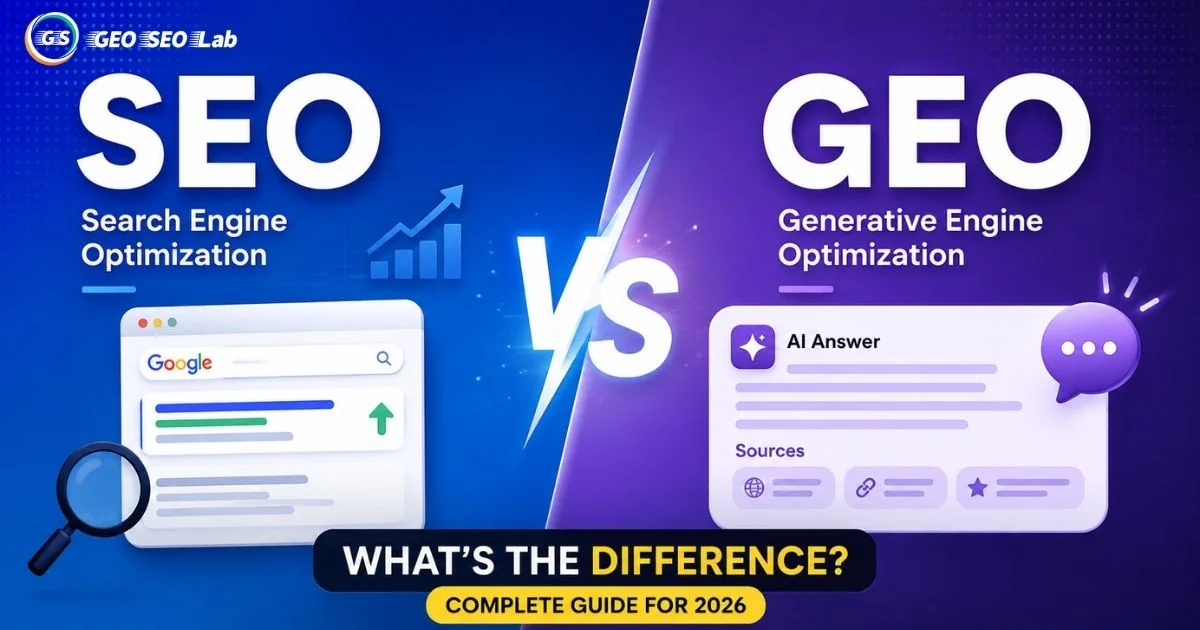
SEO vs GEO: What's the Difference? A Complete Guide for 2026
SEO vs GEO, What's the Difference, and Why Your Business Needs Both in 2026, Introduction For most of the last two decades, the goal of digital marketing c...
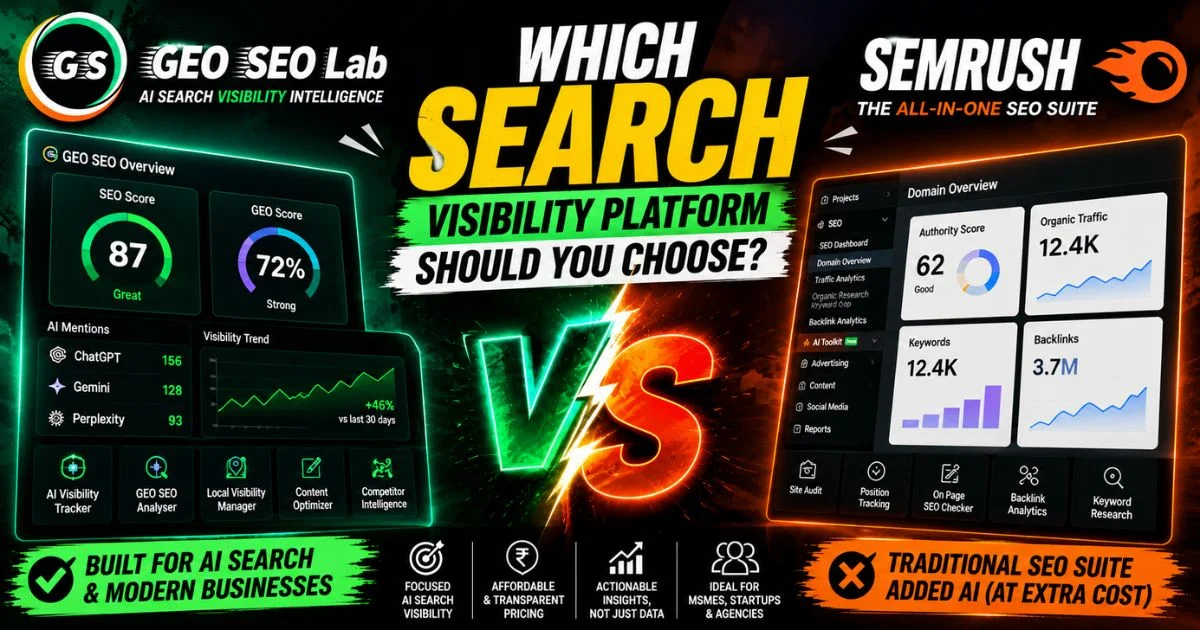
GEO SEO Lab vs Semrush: Which SEO & GEO Platform Is Best in 2026?
Picking a search visibility platform used to be a fairly narrow decision. You wanted rankings, backlinks, and maybe a competitor snapshot, and most of...
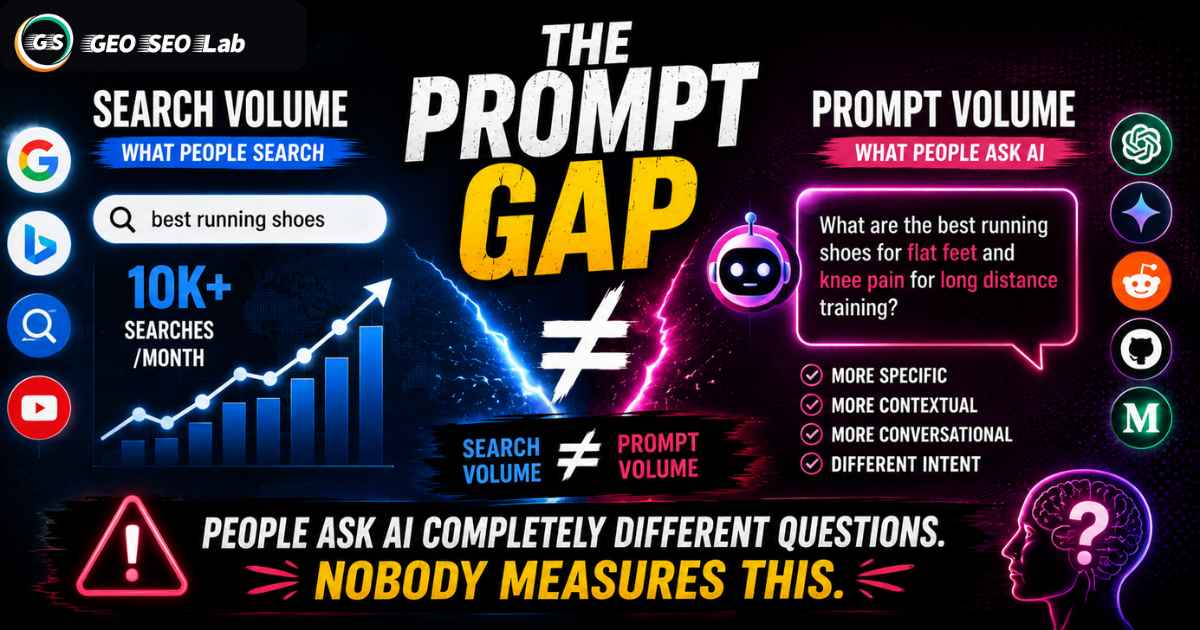
Why Does Search Volume Miss AI Search Prompts? The Prompt Gap
The Keyword Tool Everyone Trusts Is Quietly Going Blind Every marketing team has some version of the same ritual. Open a keyword research tool, type in...