Google Is No Longer Just Ranking Content
Google Is No Longer Just Ranking Content. It's Learning What You Prefer. A GEO SEO Lab Report Editorial Disclosure: This report introduces an original fram...
For twenty-five years, search worked on a fairly simple premise. Someone typed a query, Google's systems figured out the best pages for that query, and everyone who typed roughly the same words got roughly the same results. Rank number one meant something concrete and stable. It meant your page had earned the top spot for a specific search phrase, and that spot belonged to you regardless of who was doing the searching.
That premise is starting to erode, quietly and deliberately, and it's happening faster than most publishers and SEOs have registered.
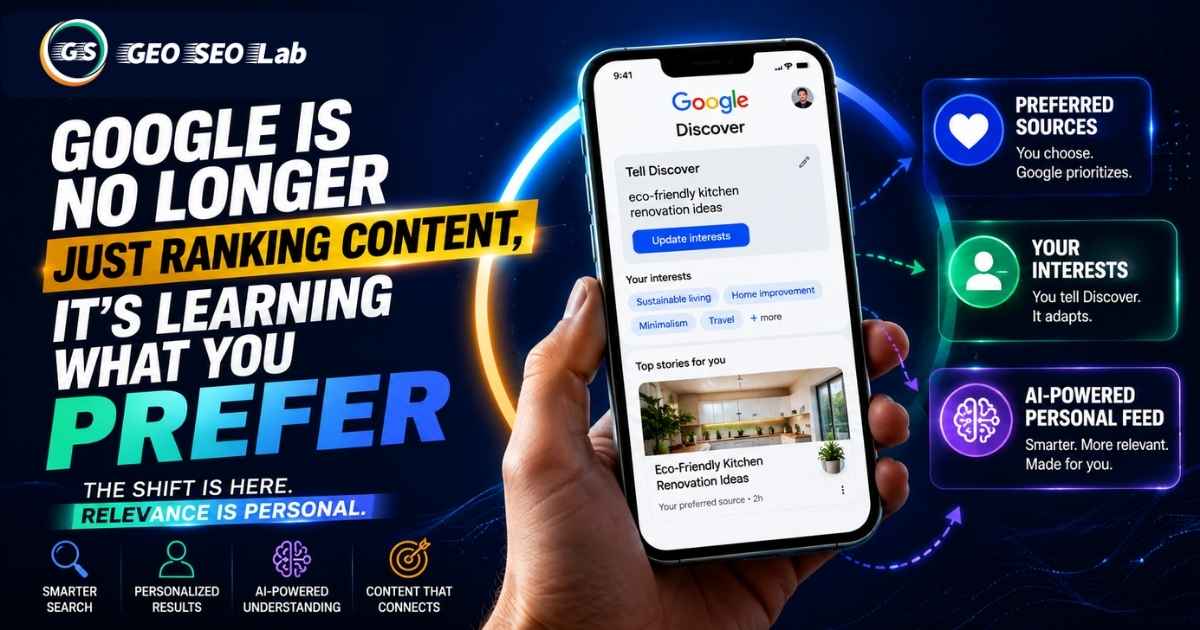
This week, Google rolled out a set of personalisation features that push well past the recommendation tweaks Discover has offered for years. Users can now describe their interests to Discover in plain, conversational language, typing something like "eco-friendly kitchen renovation ideas" directly into a menu, and watch the feed actually shift in response. At the same time, Google expanded its Preferred Sources feature, which lets readers explicitly name the publishers they trust, so that content from those chosen sources gets prioritised not just in Top Stories, where the feature started, but across Search, AI Overviews, and AI Mode as well. More than 600,000 unique sources have already been selected through this feature, and Google reports people are roughly twice as likely to click through to a source they've personally chosen.
Put those two changes together and something genuinely different starts to take shape. Instead of one query producing one ranking that every searcher sees, Google is steadily building toward a world where the same query can surface meaningfully different results depending on who's asking, what they've told Discover they care about, and which publishers they've explicitly said they trust. That's not a minor UX improvement. It's a structural shift in what "ranking well" actually means, and it raises a question worth sitting with directly: does being ranked number one still mean what it used to, if the number one spot itself is no longer the same for everyone?
This report walks through what Google actually changed, why it matters more than a typical feature rollout, and what a genuinely new discipline, one we're calling Preference SEO, looks like for publishers trying to stay visible in a search landscape that's increasingly personal rather than universal.
Google's Search Ranking Model Is Becoming More Personal
It's worth being precise about the timeline here, because this shift didn't happen overnight, even though this week's announcement is the moment it became impossible to ignore.
Preferred Sources actually began life as a Search Labs experiment back in June 2025, launching more broadly in the US and India that August, focused entirely on Top Stories. By December 2025, Google had expanded it to English worldwide, and by the end of April 2026, the feature was live globally across every supported language. Then, on May 27, 2026, Google extended Preferred Sources directly into AI Overviews and AI Mode, meaning a source a user had personally selected could now be labelled and prioritised inside the AI-generated answers themselves, not just the traditional Top Stories carousel. And as of this week's announcement, Google confirmed that any website publishing fresh content is now eligible to appear as a preferred source inside these AI experiences, a meaningful expansion beyond the feature's original association with news publishers specifically.
That's a steady, deliberate build, not a sudden pivot. Each stage added a new surface where personal preference could shape what a user actually saw, moving from a narrow news carousel toward the core of Search itself. And this week's Discover update adds a genuinely new input entirely. Rather than relying purely on click history and implicit behavioural signals the way personalisation has traditionally worked, users can now open the three-dot menu on any Discover card and type, in their own words, what they want to see more or less of, something like requesting weekend road-trip content that specifically excludes camping. Discover remembers that request and adjusts the feed going forward, adding a genuinely conversational, explicit layer on top of the implicit signals Google was already collecting.
Taken together, these aren't cosmetic tweaks to a recommendation algorithm. They represent Google building real, explicit personalisation infrastructure that spans Discover, News, Top Stories, core Search, AI Overviews, and AI Mode simultaneously, all feeding from the same underlying signal: what a specific individual has told Google they actually want.
What Preferred Sources Actually Changes
The mechanics of Preferred Sources are worth understanding in some detail, because the feature's reach has expanded considerably since it first launched, and a lot of publishers still think of it as a minor news-industry perk rather than the broader visibility mechanism it's become.
A user can mark a website as a preferred source either by clicking a star icon next to a listing in Top Stories, or now, by clicking a new interactive Preferred Sources button that publishers can embed directly on their own pages. That button does two things at once. It adds the site as a preferred source in the user's Google experience, and it immediately returns that reader to exactly where they left off on the publisher's page, a small but meaningful bit of friction removal designed to make the whole loop feel effortless. Once a site has been selected, Google prioritises it for that specific user across Top Stories, Discover, core Search, AI Overviews, and AI Mode, and in the AI surfaces specifically, content from a preferred source can now display a distinct "preferred" badge that sets it apart from other cited links inside the same AI-generated answer.
The scale here deserves real attention. Google reported more than 345,000 unique sources selected through the feature as of late May, a number that had climbed past 600,000 by this week's announcement, more than doubling adoption in roughly three months. And the click-through impact isn't trivial either. Google states that people are roughly twice as likely to click through to a source they've personally designated as preferred, compared to a source surfaced through standard ranking alone. That's a substantial, structural advantage sitting entirely outside the traditional ranking factors publishers have spent years optimising around.
There's a genuinely important strategic layer buried in the timing of all this too. Small publishers have lost roughly 60% of their search traffic over the past two years, according to Chartbeat data published earlier this year, as AI Overviews and zero-click search behaviour have steadily eroded referral traffic across the industry. Preferred Sources arrives as one of the few mechanisms currently available that lets a publisher claw back some of that lost visibility, not by out-ranking competitors on a query-by-query basis, but by converting a reader into someone who's explicitly, permanently chosen to see that publisher's content going forward. It's a fundamentally different kind of asset than a ranking position, one that survives algorithm updates precisely because it's rooted in an individual reader's stated preference rather than a page's competitive standing against every other page targeting the same keyword.
Discover Is Becoming Conversational
The Discover update deserves its own examination, because it changes the actual mechanism through which Google learns what a person wants, adding a genuinely new input channel that's never existed at this level of directness before.
Discover has always personalised based on behavioural signals: what someone clicks, how long they linger, which topics they follow or explicitly hide. What's new is the option to simply describe an interest in natural language, using the three-dot menu on any Discover card to type out something specific, wanting more content about a particular hobby, or explicitly less content about a topic that keeps showing up unwanted. Google frames this as a real-time way to reshape the feed rather than waiting for enough behavioural data to accumulate before the algorithm catches up to a genuine shift in interest.
This matters for publishers because it means the signal driving Discover visibility is becoming considerably richer and more explicit than it used to be. A behavioural click pattern is a noisy, indirect proxy for what someone actually wants. A typed-out sentence describing exactly what a person is looking for is a direct, unambiguous statement of intent, and Google's systems can act on that statement immediately rather than inferring it slowly over dozens of future interactions. For a publisher, that means the traditional Discover optimization playbook, strong images, compelling headlines, broad topical relevance, now sits alongside a genuinely new question worth asking: is our content specific and well-differentiated enough to be the kind of thing someone would actually type a preference request for, rather than blending into a broad topical category a reader might just as easily get from five other publishers covering the same ground.
From Keyword Intent to Preference Intent
Traditional SEO has always operated on a foundational assumption that's worth stating plainly, because these new features are what actually break it. One query produces many users typing that same query, and those users see broadly similar rankings, differing only slightly based on location or minobehavioural personalisationon Google has quietly applied for years. That assumption made SEO a genuinely comparable, competitive discipline. If your page ranked third for a given term, that ranking meant roughly the same thing to nearly everyone searching that term.
Preference-driven discovery moves toward something structurally different. One user, over time, builds a specific preference profile, a set of explicitly named preferred sources, a history of typed-out interest statements, an accumulated pattern of what they've followed and hidden, and that profile increasingly shapes a genuinely personalised content universe unique to them. Two people typing the same query into Search could plausibly see meaningfully different results now, not because Google's core relevance ranking changed, but because one of them has explicitly named a publisher as preferred and the other hasn't.
That's a real shift from keyword intent toward what's better described as preference intent. Keyword intent asks what someone is trying to accomplish with this specific search. Preference intent asks, on top of that, who has this person already told Google they trust, and how does that trust modify what gets shown to them specifically. Both questions matter now, and a publisher optimising purely for the first while ignoring the second is missing an increasingly consequential half of the actual visibility equation.
Why "Rank Number One" May Become Less Useful as a Metric
This is the provocative question worth sitting with directly, because it cuts against two decades of SEO reporting built entirely around rank tracking. If Discover, News, Search, AI Overviews, and AI Mode are all increasingly shaped by individual preference signals, does a single, universal rank position still mean what it used to?
The honest answer is nuanced rather than a clean yes or no. Traditional query-based ranking hasn't disappeared, and it's not about to. Someone with no established preference profile, searching a genuinely new topic for the first time, still gets served results based largely on traditional relevance and authority signals, the ranking factors SEOs have optimised around for years. That baseline layer isn't going away.
What's genuinely changing is that this baseline layer is no longer the entire picture. Layered on top of it now sits a second, personalised layer that can meaningfully override or reshape what an individual actually sees, based on preferences they've explicitly stated. A publisher could theoretically rank fourth for a given query in the traditional sense, and still show up first, with a preferred badge attached, for every single user who's already named that publisher as trusted. Conversely, a publisher sitting at rank one traditionally could find itself pushed down the visual hierarchy for users who've explicitly preferred a competitor instead.
That means "rank number one" is becoming a genuinely incomplete metric on its own. It still matters enormously for capturing new, unestablished demand, the searches happening before any preference relationship exists. But it no longer tells the whole visibility story, and a publisher tracking rank position alone, without also tracking preferred source adoption and personalized visibility patterns, is measuring only part of what's actually determining whether real readers see their content.
The Rise of Preference SEO
This is where GEO SEO Lab's original framework comes into full view. We're calling this emerging discipline Preference SEO, and it sits as the next stage in a broader evolution that's worth mapping out explicitly, because understanding where it fits helps clarify what it actually demands.
Query SEO was the original discipline, optimising content to match and rank for specific search phrases, built around the one-query-many-similar-results assumption that held for most of Google's history. Entity SEO followed as Google's Knowledge Graph matured, shifting focus toward how clearly and consistently a brand or topic gets represented as a distinct, unambiguous entity across the web, rather than purely matching keyword phrases. Generative Engine Optimization emerged more recently, focused on earning citation and representation inside AI-generated answers, a discipline built around structure, evidence, and extractability rather than traditional ranking signals alone. Preference SEO is the next layer on top of all three, and it asks a genuinely different question than any of the previous stages: not just "can this content rank for a query" or "does this AI system trust this content enough to cite it," but "would a specific audience choose to keep coming back to this source repeatedly, deliberately, by name."
That last question is a meaningfully different optimization target. Query SEO and even GEO are fundamentally about winning a single moment, one query, one AI-generated answer, one visibility event. Preference SEO is about winning an ongoing relationship, becoming the kind of source a reader actively names rather than passively encounters. That shifts the practical work involved considerably. It's less about matching search intent precisely and more about building the kind of consistent, recognizable value and voice that makes someone want to click that Preferred Sources button in the first place, and then keep clicking through to that publisher specifically, again and again, without needing to re-search for it each time.
How Publishers Can Actually Become a Preferred Source
Given how directly this new visibility layer rewards explicit reader choice, it's worth getting practical about what actually drives someone to click that Preferred Sources button rather than simply reading an article and moving on without a second thought.
Embedding the interactive Preferred Sources button directly on-site is the most immediate, concrete step available, since Google has made the embed code accessible through its Search Central documentation specifically for this purpose. That button removes almost all friction from the preference-selection process, letting a reader mark a publisher as preferred without leaving the page they're already on, and immediately returning them to that exact spot afterwards. A publisher that hasn't implemented this button yet is leaving an easy, low-cost visibility mechanism sitting unused, one that Google itself is actively promoting to publishers through its own documentation.
Beyond the technical implementation, though, the harder and more important work is earning the kind of trust that makes someone want to click it. Consistency of voice and coverage matters here in a way it never quite did for pure query-based ranking. A reader names a preferred source because they've come to expect something specific and reliable from it, a particular angle, a particular depth of coverage, a particular reliability they've noticed across multiple visits. That's fundamentally a brand-building exercise more than a technical SEO exercise, and it rewards publishers with a genuinely differentiated point of view over publishers producing broadly interchangeable coverage of the same topics everyone else is already covering.
Original reporting and genuinely distinctive perspective matter more here too, not just for AI citation purposes as covered in earlier GEO SEO Lab research, but specifically because a reader has no real reason to name a publisher as preferred if that publisher's coverage reads identically to five competitors covering the same story. The publishers most likely to benefit from this shift are the ones with a genuinely recognizable identity, not the ones optimised purely for broad topical coverage designed to rank for the widest possible set of queries.
Brand Familiarity Versus Search Authority
This shift surfaces a genuinely important distinction that traditional SEO has always somewhat underweighted: the difference between search authority, the kind of domain-level trust that drives traditional ranking, and brand familiarity, the kind of recognition that drives someone to actually name a source as preferred.
These two things have always been related but distinct, and Preferred Sources makes that distinction concretely visible for the first time in a way traditional ranking never did. A publisher can carry genuine search authority, strong backlink profiles, solid domain-level trust signals, and still struggle to build the kind of memorable, recognizable brand identity that makes a reader think to name them specifically as a preferred source. Conversely, a smaller publisher or even an individual creator with a genuinely distinctive voice and a loyal following could build strong preference-based visibility despite carrying comparatively modest traditional search authority.
That reframes part of the competitive landscape in a way worth taking seriously. Under pure Query SEO, a well-funded competitor with deep backlink resources and years of accumulated domain authority holds a significant structural advantage that's genuinely hard for a smaller publisher to overcome. Under Preference SEO, that advantage narrows considerably, because the deciding factor isn't accumulated authority signals at all. It's whether an individual reader, in a specific moment, felt enough of a connection to a publisher's voice and value to explicitly choose it. That's a more level playing field in some genuine respects, and it's worth smaller, more specialised publishers paying close attention to, since it represents one of the more accessible visibility opportunities currently available against much larger, better-resourced competitors.
Measuring Personalised Visibility
None of this matters practically if a publisher has no way to actually measure it, and this is genuinely one of the harder open questions this shift raises, since the standard SEO measurement toolkit was built almost entirely around the one-query-one-ranking assumption that's now partially obsolete.
Rank tracking tools still have real value, but they're increasingly measuring only the baseline, non-personalised layer of visibility, the layer relevant to readers who haven't yet built any preference relationship with a given publisher. What those tools can't currently capture is the second layer: how often a publisher's content actually surfaces specifically because a reader has named them as preferred, and how much of a publisher's overall traffic is now flowing through that channel rather than through traditional query-matched ranking.
For now, the most direct proxy available to publishers is watching adoption of their own Preferred Sources button directly, tracking how many readers actually click it relative to overall traffic, alongside broader engagement metrics like returning visitor rate and direct or branded search volume, both of which tend to correlate with the kind of genuine reader loyalty that drives someone toward naming a source as preferred in the first place. None of these proxies perfectly isolate the preference layer the way a clean, dedicated reporting dashboard eventually might, but treating rank position as the sole measure of visibility going forward risks missing a meaningful and rapidly growing share of what's actually determining whether real readers encounter a publisher's content.
It's also worth watching for Google to eventually build clearer publisher-facing reporting around this specific feature, given how aggressively adoption has grown in just a few months. A metric moving from 345,000 to over 600,000 selected sources inside roughly three months is exactly the kind of rapid growth that tends to eventually earn its own dedicated analytics surface, and publishers paying attention early will be positioned to act on that reporting the moment it becomes available, rather than scrambling to catch up once competitors already have a head start.
The Future of Search Personalisation
It's worth stepping back and considering where this trajectory plausibly leads, while staying appropriately honest about how much genuinely remains uncertain rather than presenting speculation as settled fact.
The clear pattern across everything covered in this report is Google building a coherent, connected personalisation layer that spans nearly every discovery surface it operates: Discover, News, Top Stories, core Search, AI Overviews, and AI Mode, all increasingly informed by the same underlying signal of individual reader preference. That's a genuinely deliberate, coordinated product strategy rather than a series of unrelated feature launches, and the pace of expansion, from a narrow Top Stories experiment in mid-2025 to a global, cross-surface personalisation system just over a year later, suggests Google views this as a genuine strategic priority rather than a minor experimental feature.
The most reasonable expectation going forward is that this personalization layer continues deepening rather than reversing. More surfaces are likely to incorporate preference signals over time, not fewer. The explicit, conversational preference input Discover just introduced is likely to expand into other Google products eventually, given how directly it addresses a real limitation of purely behavioural personalisation. And the competitive gap between publishers who've built genuine reader loyalty and preference relationships, versus publishers relying purely on traditional ranking signals, seems likely to widen rather than narrow as this infrastructure matures further.
What remains genuinely uncertain is exactly how much weight preference signals will eventually carry relative to traditional relevance and authority signals, and whether Google will build the kind of transparent, publisher-facing reporting that would let publishers actually measure and optimise for this layer with real precision, rather than relying on rough proxies. Those are open questions worth watching closely rather than answering with false confidence. What's not particularly uncertain is the underlying direction. Search is becoming more personal, not less, and publishers who start treating reader preference as a genuine strategic asset now are likely to be considerably better positioned than those still measuring success purely through the lens of a single, universal ranking position.
Key Takeaways
- Google has expanded Preferred Sources, first launched as a Search Labs experiment in June 2025, into a global feature spanning Top Stories, Discover, core Search, AI Overviews, and AI Mode, with more than 600,000 unique sources selected as of this week's announcement.
- Users can now describe their interests to Discover in natural, conversational language through a new three-dot menu option, adding an explicit preference signal on top of Google's traditional behavioural personalisation.
- Google reports people are roughly twice as likely to click through to a source they've personally designated as preferred, representing a significant visibility advantage sitting outside traditional ranking factors.
- Traditional Query SEO assumes one query produces broadly similar rankings for every searcher. Preference-driven discovery increasingly produces a personalised content universe shaped by an individual's explicitly stated trust and interests.
- A new discipline, Preference SEO, sits as the next stage beyond Query SEO, Entity SEO, and GEO, focused on earning repeated, deliberate reader choice rather than winning a single ranking moment.
- Brand familiarity and reader loyalty increasingly matter alongside traditional search authority, creating a more accessible visibility opportunity for smaller, more distinctive publishers than pure ranking competition traditionally allowed.
- Measurement tooling for this personalised visibility layer remains genuinely underdeveloped, meaning publishers currently need to rely on proxy metrics like button adoption and returning visitor rate rather than a dedicated reporting dashboard.
About GEO SEO Lab
GEO SEO Lab researches the evolution of search and discovery across Google Search, Google Discover, Google AI Mode, ChatGPT, Gemini, Claude, Perplexity, and other AI-powered platforms. Our mission is to help publishers and marketers understand and adapt to structural shifts in how content gets discovered and trusted, combining current product research with original, practical frameworks for strategy and visibility measurement in an increasingly personalised and AI-shaped discovery landscape.
References
- Google, Personalise What You See on Google Search, News, Discover (Official Blog, August 2026)
- Search Engine Journal, Google Expands Personalisation Across Search, Discover & News
- Search Engine Roundtable, Google AI Mode & AI Overviews Gain Preferred Sources & New Carousel
- PPC Land, Google Brings Preferred Sources Into AI Overviews and AI Mode Today
- SEO Kreativ, Google Preferred Sources in AI Overviews & AI Mode
- Digital Applied, Google Preferred Sources: New Earned-Visibility Play
- Business Today, Google Adds Preferred Sources to Search, and Other Personalisation Features to Discover and News
- Techgenyz, Google Search, Discover and News Add Useful New Customisation Tools
- Phandroid, The Google App Now Lets You Block Topics That You Don't Like
Tags
Frequently Asked Questions
Find answers to common questions about this topic
About the Author

Anubhav
SEO Expert & Content Creator
Experienced digital marketing professional specializing in SEO strategies, content optimization, and data-driven marketing solutions. Passionate about helping businesses grow their online presence and achieve better search rankings.
Related Articles
View all posts
How to Turn FAQ Content Into GEO Content
How to Turn FAQ Content Into GEO ContentThink about the last time you searched for a complex product or a nuanced troubleshooting step. Did you type a...

How AI Decides Which Websites to Cite: Inside the Hidden Selection Process
Introduction: The New Gatekeepers of VisibilityPicture this. Someone types a question into ChatGPT, Perplexity, or Google's AI Overview box. Within se...

Why Does AI-Generated Content Need Humanization for SEO?
Why Does AI-Generated Content Need Humanization for SEO?The Real Reason Raw AI Drafts Underperform, and What Actually Fixes ItA GEO SEO Lab ReportEdit...