Google Is Building an Autopilot for Advertising
Google Is Building an Autopilot for AdvertisingWhat Happens to the PPC Manager?A GEO SEO Lab ReportEditorial Disclosure: This report introduces an ori...
There's a particular kind of quiet that settles over a PPC team when they realize a tool they've relied on for years just changed jobs on them without asking. That's roughly what's happening with Google AI Max right now, and most advertisers haven't fully clocked it yet.
Google just rolled out a fresh batch of AI Max testing and planning tools, letting advertisers run multi-campaign A/B tests on budgets and ROI targets, test AI Max experiments while keeping brand and location controls switched on, and use an expanded Performance Planner that forecasts the impact of a bidding or budget change and then applies it with a single click. On the surface, that reads like a routine product update, another line in a changelog most people will skim past.
Look a little closer, though, and it's really a signal about where the entire PPC discipline is heading. These aren't features that help a person choose better keywords or write sharper ad copy. They're features that help a person supervise, test, and validate what an AI system has already decided to do on its own. That's a genuinely different kind of work, and it's worth being honest about what it means for the humans whose job title still says "PPC Manager" but whose actual day-to-day is starting to look a lot more like managing a very capable, very fast, occasionally overconfident junior employee that never sleeps.
This report walks through exactly what Google shipped, why it matters more than a typical feature release, how the PPC manager's job has shifted from 2020 to 2026, and what a genuinely useful, forward-looking version of that role looks like now that campaign execution itself has been handed over to the machine.
What Google Actually Shipped, and Why It's Not Just Another Update
It helps to be precise about what changed, because the specifics matter more than the general "AI is taking over ads" headline that tends to follow announcements like this.
Starting in September, advertisers can test different budgets and ROI targets across multiple Search campaigns inside a single A/B test, building on the one-click AI Max experiments Google had already introduced. That's a real shift in testing granularity. Instead of running one experiment on one campaign and hoping the results generalize, advertisers can now see what happens to overall business performance when they scale spend or shift targets across several campaigns at once, closer to how a real budget decision actually gets made at the account level.
Google also removed a real obstacle that had been keeping some advertisers on the sidelines. AI Max experiments now support tests with brand and location controls enabled, meaning advertisers who depend on tighter guardrails, protecting brand terms, restricting geography, don't have to strip those controls away just to measure whether AI Max is actually helping. That matters more than it might initially sound like, because it means the choice is no longer "turn on AI Max and give up your safety net" or "keep your safety net and never really know what AI Max would have done." Advertisers can test with both at once.
Performance Planner picked up new capabilities too. It now forecasts how a change to bidding or budget targets could affect existing campaign performance before that change ever goes live, and once an advertiser likes what they see, they can apply Google's suggested changes directly with a single click, collapsing the gap between forecasting a decision and actually implementing it. That one-click application detail is worth sitting with, because it quietly represents a shrinking window for a human to actually intervene between "here's a suggestion" and "this is now live in your account."
None of this is happening in isolation either. AI Max officially moved out of beta earlier this year, and Google confirmed that many Search campaigns will migrate onto it automatically starting in September 2026, with Dynamic Search Ads campaigns scheduled for a similar automigration beginning in February 2027. Google has also been expanding AI Max into Shopping campaigns and travel-specific ad formats, adding an AI Brief tool meant to guide ad messaging and targeting, and rolling out mandatory text disclaimer support for regulated industries using Final URL expansion. Taken individually, each of these is a reasonable, fairly incremental product update. Taken together, they describe a platform steadily removing the manual steps that used to define the PPC job, one release at a time.
What AI Max Actually Is, in Plain Terms
Before going further, it's worth being clear about what AI Max actually is, because the term gets thrown around loosely and a lot of advertisers still aren't entirely sure where it sits relative to everything else in their account.
AI Max is not a new campaign type sitting alongside Search, Shopping, or Performance Max. It's an optimization layer applied on top of an existing Search campaign, meaning ads still run inside the familiar Search environment while Google's systems handle targeting expansion, ad copy generation, and landing page selection underneath the hood. Practically, that means AI Max can automatically expand keyword reach beyond what an advertiser explicitly targeted, generate ad copy pulled directly from a landing page's content, and choose which specific page on a website a given searcher actually lands on, all without a human writing that ad or picking that landing page manually.
That's a meaningfully bigger set of decisions than automated bidding alone used to hand over. Smart Bidding, which most advertisers have already lived with for years, mainly automated one decision: how much to bid on a given auction. AI Max reaches further into the account, touching which searches trigger an ad in the first place, what that ad actually says, and where the resulting click actually goes. Put those three together, targeting, messaging, and destination, and you're describing most of what used to be the core, hands-on work of running a PPC campaign.
It's worth noting AI Max does still offer more visibility than the fully automated end of Google's product lineup. Compared to Performance Max, which operates with considerably less transparency into search terms and landing pages, AI Max provides noticeably more reporting and control, including visibility into which search terms actually triggered ads and which landing pages got selected. That's a meaningful distinction for anyone weighing how much control they're actually giving up, and it's part of why this shift looks less like total abdication and more like a genuine renegotiation of where human judgment gets applied.
The PPC Manager's Job, 2020 Versus 2026
This is where the actual scale of the shift becomes clearest, and it's worth laying the two versions of the job side by side rather than describing the change abstractly.
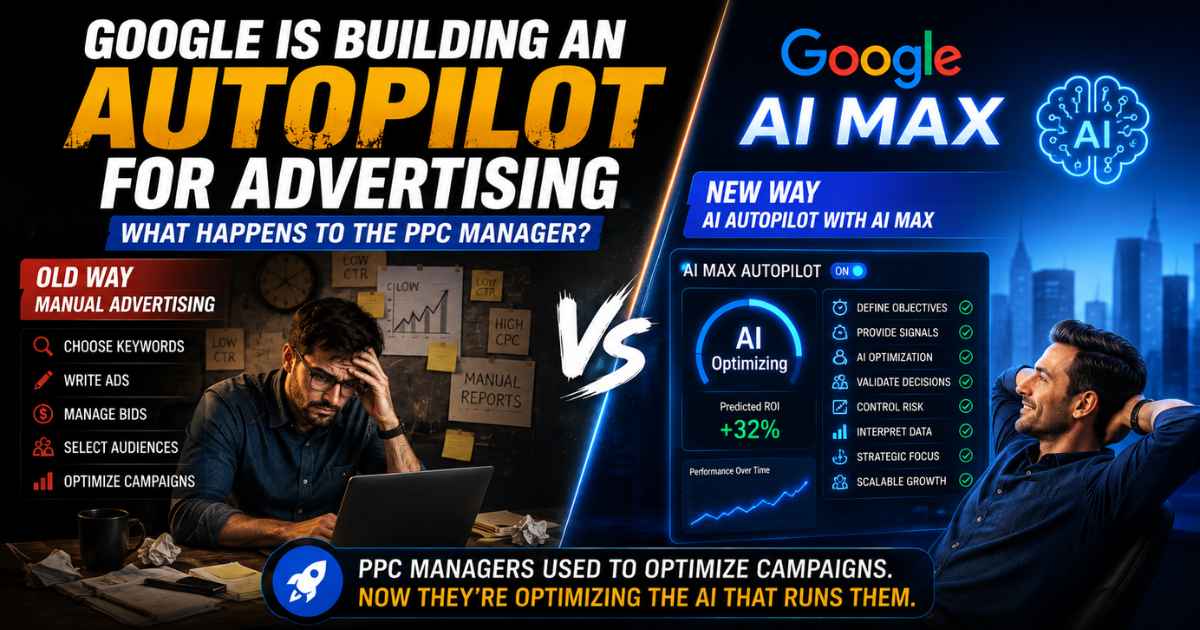
In 2020, a competent PPC manager's core responsibilities looked fairly hands-on and execution-heavy. Choosing keywords meant building out match types, researching search volume, and constructing tightly themed ad groups by hand. Writing ads meant crafting headline and description combinations, testing variations, and refining copy based on click-through performance over time. Managing bids meant setting and adjusting bid strategies, sometimes manually, sometimes through early automated bidding tools that still required close, frequent supervision. Selecting audiences meant building out remarketing lists, layering demographic and interest targeting, and deciding which audience segments deserved budget priority. Optimizing campaigns meant the ongoing, granular work of pausing underperforming keywords, adjusting budgets between campaigns, and running structured A/B tests on individual ad variations.
By 2026, with AI Max handling keyword expansion, ad generation, and landing page selection, and with tools like Smart Bidding Exploration, Promotion Mode, and Bidding Target Optimization increasingly automating budget pacing and seasonal adjustments, that same job looks genuinely different. Defining objectives has replaced choosing keywords, since the real work now is deciding what the campaign should actually accomplish, and translating that into the ROI targets and business goals the AI system optimizes toward. Providing signals has replaced writing ads by hand, since AI Max pulls copy directly from landing pages and briefs, meaning the human's real leverage sits in making sure the underlying signals, brand voice, offer details, landing page quality, feeding that generation process are accurate and well-structured. Validating AI decisions has replaced manually managing bids, since bidding now runs largely on automated systems, and the manager's job shifts to checking whether those systems' decisions actually make sense against real business outcomes. Controlling risk has replaced manually selecting audiences, since AI Max's expanded targeting reach means the manager's real job is setting and monitoring the guardrails, brand safety, negative keywords, geo restrictions, that keep that expanded reach from drifting somewhere costly. And interpreting business data has replaced granular campaign optimization, since the actual differentiating skill now is understanding what the resulting numbers mean for the broader business, not just adjusting bids inside the ads platform itself.
That's not a smaller job. In a lot of ways, it's a harder one, because it demands judgment and business context rather than platform mechanics, and platform mechanics were always the easier half to teach.
Introducing the Command Layer Model
This is where GEO SEO Lab's original framework comes in. We call it the Command Layer Model, and it's a way of organizing what's left of the PPC manager's job into five layers, each representing a distinct kind of judgment the AI system still can't reliably supply on its own.
The first layer is objective setting, translating a business goal into the specific targets an AI system can actually optimize against. The second layer is signal feeding, making sure the AI has accurate, well-structured input, brand guidelines, offer details, landing page quality, to work from. The third layer is decision validation, checking the AI's actual output against real business logic rather than assuming it's correct because it's automated. The fourth layer is risk control, setting and actively maintaining the guardrails that keep expanded automation from wandering somewhere the business doesn't want it going. The fifth layer is business interpretation, connecting campaign-level numbers back to what they actually mean for revenue, margin, and strategy, a layer that's always required a level of context no advertising platform, however sophisticated, can fully supply on its own.
None of these five layers involves the mechanical execution work that used to define the job. All five involve exactly the kind of judgment that becomes more valuable, not less, as the mechanical work gets automated away. Understanding these layers individually matters because each one requires a genuinely different skill set, and a PPC professional trying to stay relevant needs to deliberately build competence across all five, not just get comfortable clicking "apply" on Google's suggested changes.
Layer One, Objective Setting
Objective setting sounds simple until you actually try to do it well, and it's arguably the layer where the biggest gap now sits between advertisers who are thriving under this shift and advertisers who are quietly losing ground to it.
An AI system optimizing toward a target ROAS or target CPA will faithfully chase that number, but it has no independent way of knowing whether that number was ever the right target in the first place. Setting an ROI target too conservatively can leave real, profitable growth on the table, since the AI system will happily hold spend back to protect an efficiency number that was never actually the business's real constraint. Setting it too aggressively can flood a business with lower-quality leads or thin-margin conversions that technically hit the target number while quietly damaging the business behind it.
This is exactly the kind of judgment the new multi-campaign A/B testing tools are built to support, letting advertisers actually test different ROI targets across multiple campaigns and see the real business impact of scaling up before committing fully. But the tool only helps if the person running it understands the business well enough to interpret what "success" should genuinely look like, tying a Google Ads ROI target back to actual margin structure, customer lifetime value, and growth goals that live outside the ads platform entirely. That's not a skill Google's interface teaches. It's a skill that comes from genuinely understanding the business the campaigns are running for, which is precisely why this layer is becoming the most valuable, and the hardest to fake, of the five.
Layer Two, Signal Feeding
Signal feeding is the layer that most closely resembles the old creative and targeting work, but it's shifted from direct authorship to something closer to careful curation.
Since AI Max generates ad copy directly from landing page content and can be guided by tools like the new AI Brief feature, the actual quality of the resulting ads depends heavily on the quality of what's being fed in. A landing page with vague, generic copy produces vague, generic ads, because the AI system has nothing sharper to pull from. A landing page with clear, specific value propositions, honest details about pricing and fit, and genuinely differentiated messaging gives the AI system considerably better raw material to build from.
This reframes what used to be "writing ads" into something closer to "making sure the source material is strong enough that the AI's output is strong too." A PPC manager who used to spend hours crafting headline variations now needs to spend that time ensuring the landing pages, brand guidelines, and briefs the AI draws from are accurate, current, and genuinely reflective of what the business wants said. It's less glamorous than writing punchy ad copy by hand, but it's arguably more consequential, since a single weak signal can quietly degrade every ad the AI generates from it at scale, across every campaign pulling from that same source.
Layer Three, Decision Validation
Decision validation is where the newly expanded Performance Planner and multi-campaign testing tools do their most direct work, and it's the layer that most explicitly replaces what used to be manual bid management.
The core discipline here is treating every AI-generated suggestion as a hypothesis worth checking, not a verdict to accept automatically. Performance Planner can now forecast what a bidding or budget change might do to existing performance and apply it with one click, but "one click" cuts both ways. It makes it dramatically easier to implement a genuinely good suggestion quickly, and just as easily makes it possible to implement a bad one just as fast, if the person clicking that button hasn't actually scrutinized the forecast against real business context first.
This is also where a healthy skepticism about automation's actual limits earns its keep. Automation is not perfect, and negative keyword management remains an area where AI may expand match types in unexpected ways that a human needs to catch and correct. Brand protection similarly still requires active human oversight to ensure ads don't end up triggering on competitor terms an advertiser specifically wants excluded. The practical discipline here is straightforward even if it's easy to skip under time pressure: review AI-generated suggestions before applying them at scale, monitor early performance closely after any change goes live, and resist the pull toward treating "the AI suggested it" as equivalent to "it's definitely correct."
Layer Four, Risk Control
Risk control is the layer that's grown the most in importance as AI Max's reach has expanded, precisely because a wider automated net catches more of everything, the good traffic and the bad traffic alike.
Google's own recent support for brand and location controls inside AI Max experiments is a direct response to this exact concern, giving advertisers a way to test AI Max's impact without having to strip away the guardrails they depend on. That's a genuinely useful addition, but it only protects a business if someone's actually configuring and actively monitoring those controls rather than assuming the platform will handle brand safety automatically on its own.
There's a related concern worth naming plainly here too, because it doesn't get discussed nearly as often as it should. As AI Max expands keyword reach and targeting scope, it widens the pool of traffic a campaign can draw from, and a wider net inherently catches more of everything, including low-quality or invalid clicks that can quietly distort the performance data the automated bidding systems themselves are learning from. That creates a genuinely uncomfortable feedback loop worth taking seriously: if a chunk of the click data feeding an automated bidding system is contaminated by invalid traffic, the system's own decisions start compounding on a flawed foundation, and nobody notices until performance quietly erodes over weeks or months. This is exactly why risk control can't be a one-time setup task. It needs ongoing, active monitoring, checking search term reports, watching for anomalous traffic patterns, and reviewing negative keyword lists regularly, not a set-it-and-forget-it checkbox ticked once during initial campaign setup.
Regulated industries carry an even sharper version of this same concern. Sectors like healthcare, finance, and legal services face real constraints around generated claims and landing page selection that require strict, ongoing review, since an AI system generating ad copy or choosing a landing page without full awareness of regulatory requirements can create real compliance exposure a business genuinely can't afford to overlook. Google's addition of mandatory text disclaimer support inside AI Max is a direct acknowledgment of this exact risk, but a feature existing doesn't mean a business is automatically using it correctly, or that a human isn't still needed to confirm it's actually working as intended in every ad variation the system generates.
Layer Five, Business Interpretation
Business interpretation is the layer that was always the hardest to fully automate, and it remains that way even as everything sitting beneath it in the old workflow gets steadily handed over to AI systems.
A dashboard full of clicks, conversions, and cost-per-acquisition numbers doesn't mean much on its own without someone connecting it back to what actually matters to the business behind those campaigns. A drop in conversion volume might look alarming in isolation, but mean something completely different depending on whether it's paired with an increase in lead quality, a seasonal shift in demand, or a genuine problem with targeting that needs correcting. An AI system optimizing purely toward the metrics it's been given has no independent way of knowing which of those explanations is actually true, because that judgment depends on business context living entirely outside the advertising platform itself.
This is precisely the kind of gap flagged by B2B lead generation concerns specifically, where conversion volume may increase under expanded AI automation while lead quality quietly declines, unless offline outcomes get imported back into the platform so the system can actually learn from real business results rather than surface-level click and conversion counts alone. Making sure that offline data actually flows back into the system, and correctly interpreting what the resulting patterns mean for the business, is squarely a human responsibility, and it's arguably the single hardest layer of the five to fake convincingly, because it can't be learned from a platform's help documentation. It has to come from genuinely understanding the business the campaigns exist to support.
What This Actually Means for PPC Careers and Agencies
None of this points toward the PPC manager role disappearing. It points toward the role bifurcating fairly sharply between people who adapt to these five layers deliberately and people who keep trying to do 2020-style execution work inside a 2026 platform that's actively removed most of the manual levers that used to define that execution.
The professionals likely to struggle here are the ones whose actual expertise sits mostly in platform mechanics, knowing exactly how to structure match types, exactly how to build out granular ad group segmentation, exactly how to manually adjust bids based on hourly performance swings. A lot of that specific expertise is becoming considerably less valuable as the platform itself absorbs those decisions, in much the same way that deep expertise in manually setting individual keyword bids became less differentiating once Smart Bidding became the default years ago.
The professionals likely to thrive are the ones who can operate fluently across all five Command Layer Model layers at once, defining sharp, business-grounded objectives, feeding the AI system clean and specific signals, actually scrutinizing what it decides rather than rubber-stamping it, maintaining active, ongoing risk controls, and translating the resulting numbers into language a business owner or executive actually cares about. That's a genuinely different skill profile than the one that defined a great PPC manager five years ago, closer to a hybrid of strategist, analyst, and risk manager than to a hands-on campaign technician.
For agencies specifically, this shift changes the pitch. Selling "we'll manage your keywords and bids" is selling something the platform increasingly does on its own, essentially for free, inside every advertiser's account. Selling "we'll define the right objectives for your business, feed the AI clean signals, catch its mistakes before they get expensive, and translate the results into decisions you can actually act on" is selling exactly the layer of judgment that remains genuinely scarce, and genuinely hard to automate away, no matter how sophisticated Google's next AI Max update turns out to be.
Key Takeaways
- Google's new AI Max testing tools, multi-campaign A/B testing, brand and location control support inside experiments, and an expanded Performance Planner with one-click implementation, mark a real acceleration toward automating campaign execution, not just bidding.
- AI Max is not a new campaign type. It's an optimization layer inside existing Search campaigns that automates keyword expansion, ad copy generation, and landing page selection, three decisions that used to define hands-on PPC work.
- The PPC manager's job has shifted from execution tasks, choosing keywords, writing ads, managing bids, toward judgment tasks, defining objectives, feeding accurate signals, validating AI decisions, controlling risk, and interpreting business data.
- Wider automated targeting reach means wider exposure to invalid or low-quality traffic, making active, ongoing risk monitoring more important, not less, even as manual campaign management shrinks.
- Regulated industries face real compliance exposure from AI-generated ad copy and automated landing page selection, requiring deliberate human review even with new disclaimer support built into the platform.
- The professionals and agencies likely to thrive under this shift are the ones building genuine expertise in business context, risk management, and validation, not the ones still competing on platform mechanics the AI system now handles on its own.
About GEO SEO Lab
GEO SEO Lab researches the evolution of search, discovery, and digital advertising across Google Search, Google Ads, AI-powered search platforms, and the broader ecosystem reshaping how marketing work actually gets done. Our mission is helping businesses and marketing professionals understand what's genuinely changing beneath product announcements, combining current industry research with original, practical frameworks for adapting strategy and skill sets to an increasingly automated marketing landscape.
References
- Search Engine Land, Google Adds New AI Max Testing and Planning Tools
- Google Ads & Commerce Blog, Make AI Max Work for Your Business With New Testing and Planning Tools
- Google Ads & Commerce Blog, Steer Performance With New AI Max Features
- Groas.ai, Google AI Max: The 2026 Master Guide
- TechFusionGear, Google AI Max for Search Campaigns: 2026 Guide
- ClickGuardian, Google AI Max: What It Is, What Changes in September, and What It Means for Your Budget
- DMCockpit, Google Ads 2026: AI Max + Search Automation Playbook
- ROA Marketing, Google Ads Launches 3 Massive AI Bidding & Budgeting Updates
Tags
Frequently Asked Questions
Find answers to common questions about this topic
About the Author

Anubhav
SEO Expert & Content Creator
Experienced digital marketing professional specializing in SEO strategies, content optimization, and data-driven marketing solutions. Passionate about helping businesses grow their online presence and achieve better search rankings.
Related Articles
View all posts
How to Turn FAQ Content Into GEO Content
How to Turn FAQ Content Into GEO ContentThink about the last time you searched for a complex product or a nuanced troubleshooting step. Did you type a...

How AI Decides Which Websites to Cite: Inside the Hidden Selection Process
Introduction: The New Gatekeepers of VisibilityPicture this. Someone types a question into ChatGPT, Perplexity, or Google's AI Overview box. Within se...

Why Does AI-Generated Content Need Humanization for SEO?
Why Does AI-Generated Content Need Humanization for SEO?The Real Reason Raw AI Drafts Underperform, and What Actually Fixes ItA GEO SEO Lab ReportEdit...