The Future of Local Search in the AI Era: How Google Maps, AI Overviews, and AI Assistants Are Redefining Local Discovery
The Future of Local Search in the AI Era: How Google Maps, AI Overviews, and AI Assistants Are Redefining Local Discovery...
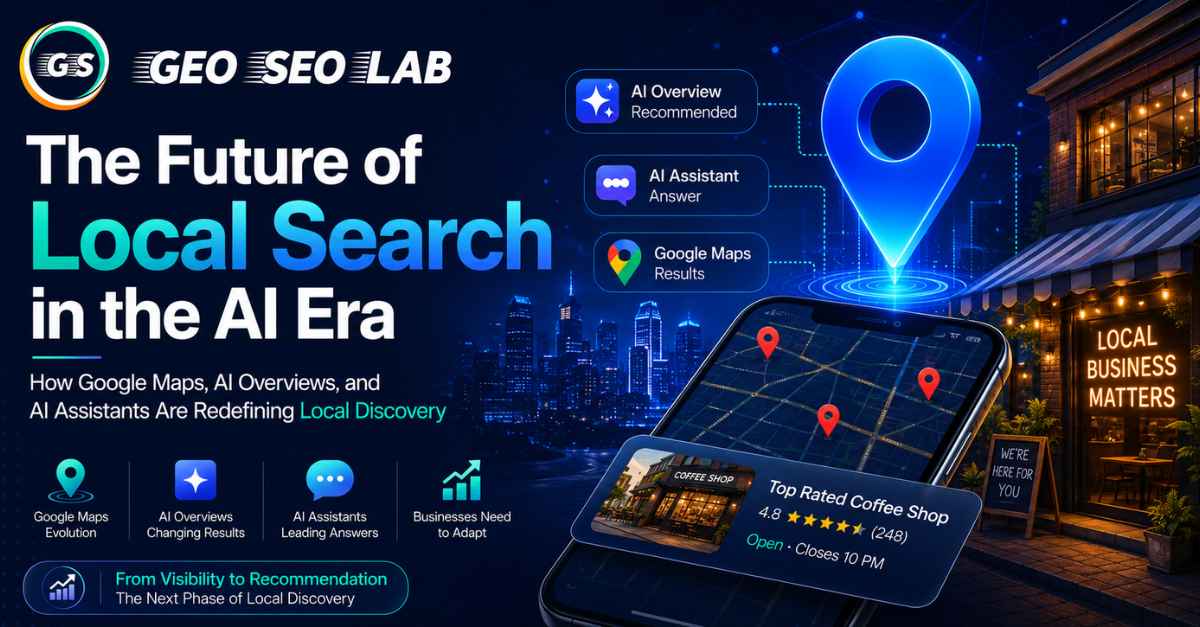
The Conversation That Is Replacing the Search
A few years back, a typical local search went something like this: someone opened Google on their phone, typed "dentist near me," scanned the map pack, compared star ratings and distances, maybe clicked a website or two, and picked one.
That still happens. But increasingly, something else is happening alongside it.
The same person, with a more specific need, might now ask: "Which dentist near me is good with anxious patients and does implants?" A new parent might ask which pediatric clinic other parents actually recommend for newborns. Someone new to a city might ask which orthopedic practice has the best reputation for sports injuries downtown.
These aren't searches in the old sense. They're questions — conversational, specific, loaded with intent, assuming the system can actually understand context and hand back a considered answer instead of a list of nearby options.
That behavioral shift is driving one of the biggest changes local businesses have faced since Maps first launched. And most of them aren't ready for it.
This piece covers what's actually changing in local search, why it matters more than most local SEO conversations admit, and what businesses need to do to stay visible — and genuinely trusted — as AI increasingly sits between customers and the businesses they choose.
Local Search Is Entering Its Biggest Shift Yet
How local discovery used to work. For over a decade, Google Maps ran on a simple model: gather structured facts about a business — location, hours, category, price, photos, reviews — and present them so people could compare easily. Google surfaced the options; the customer did the deciding. That trained businesses to think about visibility mainly in terms of the map pack — complete your profile, collect reviews, keep hours accurate. It also trained customers to type compressed, keyword-style queries and evaluate the results themselves.
AI is changing both halves of that arrangement. On the user side, people no longer have to simplify what they actually want to know into a keyword — they can just ask it. On Google's side, synthesis means the system can now do more of the evaluating itself instead of just listing. Put together, local discovery is turning from a browsing activity into something closer to a consultation. People are asking for recommendations, not options — and the businesses that make it into those AI-generated recommendations are winning on dimensions a standard local SEO audit was never built to measure.
Being present isn't the same as being recommended. Presence means showing up when someone searches your category near your location — the classic three-pack, the map pin, the organic listing. Being recommended means an AI system identifies you specifically as a credible answer to a real question, which needs something more: information about your business that's thorough, consistent, and credible enough for the system to vouch for you confidently.
Take someone asking an AI assistant which dermatology clinic nearby is best for treating eczema in children. The system isn't just locating nearby dermatologists — it's trying to work out which one has the clearest evidence of relevant expertise, positive experiences specifically with pediatric cases, and credible professional background. A clinic that's perfectly optimized for classic local search but has generic service copy, no educational content, and no visible specialist expertise can be completely absent from that answer, even while sitting at the top of the map pack for "dermatologist near me."
The transition looks gradual because the metrics lag behind it. Your Maps ranking might look fine. Your local traffic hasn't cratered. Review count is climbing. Meanwhile, your most discerning potential customers — the ones asking specific, complex questions rather than "near me" — are quietly getting their answers from AI instead of the map pack. Those tend to be your more valuable customers too, since they're making more considered decisions. That creates a lag between when this actually starts mattering and when it shows up in your reporting. By the time it's visible in your traffic numbers, competitors who moved early will have built an advantage that's hard to close.
From location to confidence. A location-based answer tells someone where something is: "there are three orthopedic clinics within two kilometers." That's what classic local search optimized for, and it's still useful. A confidence-based answer tells someone which one is actually worth choosing, and why — "based on reviews and specialist credentials, this clinic seems particularly well-regarded for knee replacements." The inputs behind a location answer are mostly logistical: address, category, proximity. The inputs behind a confidence answer are richer: detailed services, specialist credentials, substantive reviews, educational content, consistency across sources, and independent third-party recognition. Businesses that only invested in the first kind of input are visible but not confidently recommended. The ones that invest in both become the default answer.
How AI Systems Actually Read a Local Business
A business is more than its listing. The most consequential mistake in local SEO right now is treating a Google Business Profile as a finish line rather than a starting point. A completed profile tells Google where you are, what category you're in, when you're open, and what people have said about you in aggregate. What it can't do is explain why you're the right answer to a specific, nuanced question — why one dental clinic's approach to anxious patients is genuinely different, or why a restaurant's "locally sourced" claim is backed by actual farm relationships rather than marketing copy. That richer context has to be built across the whole digital footprint: website, educational content, specialist profiles, review substance, and real community involvement. AI systems pull from all of it at once, and businesses that've invested broadly build a far deeper evidence base than ones that only filled out a profile.
From listings to entities. Classic local search evaluates a listing: does it match the query's location and category? AI-assisted local search increasingly evaluates the entity: what is this business, what does it actually specialize in, who works there, what do customers consistently say, how does it connect to everything else the system knows — nearby landmarks, professional bodies, the specific people on staff? That requires coherence across every place your information lives. If your website's service descriptions don't match your Business Profile, if the names in your reviews don't map to identifiable, credentialed staff, if your marketing claims aren't backed by content that demonstrates real depth — that inconsistency creates ambiguity, and ambiguity kills confident recommendations. A system that isn't sure what you actually do can list you, but it can't vouch for you. Consistency across independent sources is what lets it vouch.
Reviews as evidence, not just star ratings. Classic local SEO treated reviews as a score to maximize. AI systems can do something considerably richer with the actual text — pulling out recurring themes across dozens or hundreds of reviews. If fifty patients all mention that a particular physician takes real time explaining results, that's substantive evidence about how that physician practices, not just an opinion. "Great service, highly recommend" contributes a rating. "Dr. Patel spent twenty minutes walking me through my MRI and I finally understood my own injury" contributes evidence. Businesses can't script reviews, but they can create the conditions for specific ones — delivering genuinely good experiences, prompting customers to reflect on what specifically stood out, and focusing hard on whatever actually differentiates the business, since that tends to surface naturally in the language customers use afterward.
Local content that actually demonstrates expertise. Generic blog posts repurposed from national sources barely differentiate anything. What does is genuinely local, genuinely expert content — a pediatric clinic writing a real guide to managing childhood asthma given the specific seasonal triggers in its city, a law firm walking clients through the actual local court process they'll encounter, a restaurant explaining its relationships with specific regional farms and how that shapes the menu. This is harder to produce — it needs real subject knowledge and real local context, and it can't be outsourced to a generalist writer — but it's exactly the kind of distinctive evidence an AI system can point to when explaining why a business is a credible answer.
Building Local AI Visibility in Practice
Start with the actual question, not the keyword. Before touching schema or service page structure, spend real time understanding what your most valuable potential customers are genuinely wrestling with. A dental practice's best prospective patients aren't typing "dentist near me" — they're asking how to know if a dentist will be gentle with their kid, or which practices handle complex restorative work. Understanding these questions deeply — ideally from actual conversations with current patients about how they decided — lets you build a digital presence that answers them directly: service pages addressing specific patient anxieties, content that helps people evaluate practices for their own needs, practitioner profiles that speak to the exact credentials patients are actually weighing.
Make your Business Profile do more work. Most businesses fill in the basics and then let the profile go static — the equivalent of registering a business and never touching its reputation again. The business description deserves real thought instead of a restated name and category; a strong one explains specifically what makes the practice different, in language that's accurate and useful to someone deciding. Service descriptions should go beyond one-liners — enough detail that a prospective customer understands what's involved, who it's for, and what to expect. The Q&A section, chronically ignored by businesses and heavily used by customers, is worth monitoring closely and answering proactively, since the questions there usually reveal exactly what people are uncertain about. And photos matter more than most businesses assume — current, specific, varied photos consistently outperform stale generic ones, and they also show AI systems (and human researchers) what the actual environment, team, and experience look like.
Build practitioner profiles that establish real expertise. In professional services, the practitioner is often the actual reason someone chooses you. "MD, Internal Medicine, 15 years" lists credentials without establishing anything specific. A profile that explains focus areas, the patient populations someone has real experience with, relevant certifications, and a genuine statement of approach communicates something far more useful — and creates a distinct person-entity that can be associated with specific specializations, which helps the business surface for specialty-specific questions. Practitioners publishing under their own name — articles, talks, professional community contributions — build individual authority that reflects back on the whole organization.
Build knowledge hubs, not isolated pages. Organizing content into interconnected clusters builds a much richer picture than scattered unrelated pages. A physical therapy practice might build a cluster around knee rehab — an overview page linked to specific pages on post-surgical recovery, sports injuries, age-related conditions, and prevention, each connected to the relevant physiotherapist's profile and any patient outcomes tied to those conditions. Every piece reinforces the others, communicating genuine depth rather than a single generic "Physical Therapy" service line. The same logic works for a restaurant's farm-to-table story or a law firm's employment-law practice area — the cluster demonstrates something a page of generic service copy never could.
Genuine community presence is an authority signal too. When a healthcare practice sponsors a health fair or runs school workshops, or earns real regional press coverage — not through a press release about an award, but through community contribution a journalist actually found worth covering — it builds recognition that lives outside its own website entirely. That independent validation matters for AI visibility the same way editorial citations matter more broadly. It can't be manufactured through PR alone; it has to come from actually showing up in the community, but the businesses that do this consistently build stronger local authority than those confined to owned channels.
Structured data is a supporting layer, not a shortcut. Local business schema, service schema, and review markup all help systems parse what's already true about a business more reliably — confirming hours, categories, service names, and aggregate ratings in a machine-readable way. That's worth doing carefully. But it's worth being honest about what schema can and can't do: it clarifies existing information, it doesn't generate credibility that isn't there yet. A business with thin service pages and a bare-bones review history gains little from wrapping that thin content in comprehensive markup — the markup just makes the thinness easier to detect quickly. Schema earns its keep once the underlying content and reputation are already substantive.
Measuring Local AI Visibility, and Building for the Long Run
Conventional metrics tell an incomplete story. Map pack rank, profile impressions, call volume, direction requests, review averages — all still genuinely useful, but none of them show how you're doing in the AI-mediated conversations increasingly shaping your more discerning customers' decisions. Picture this: rankings stable for months, impressions steady, and yet one of your best eventual customers arrived after an AI assistant recommended you by name in response to a complex question. That journey leaves no trace in your normal analytics — it just shows up as direct or branded traffic, with the AI's role invisible. That's not a dashboard misconfiguration; it's a structural gap between measuring the end of a journey and seeing the middle of it. Watching branded search volume growth, direct traffic trends, and whether inbound calls reference specific services by name (suggesting the caller already did some AI-assisted homework) helps close that gap, even without perfect attribution.
The GEO SEO Lab Local AI Visibility Maturity Model
Local AI visibility isn't binary — it develops in recognizable stages.
- Level One — Digital Presence. Basic infrastructure exists (website, Business Profile, contact info), but nothing communicates why the business is worth choosing over the next one.
- Level Two — Local Foundation. Profile is complete and accurate, service pages exist, some reviews are in place, information is consistent across platforms. Discoverable, but lacking the depth of evidence that produces a confident AI recommendation.
- Level Three — Growing Local Visibility. Real educational content answers real questions, practitioner profiles establish actual expertise, service descriptions are specific, some genuine community presence exists. The business is starting to be an answer, not just an option.
- Level Four — Established Local Expert. Recognized authority in its market, original resources referenced by peers, identifiable specialist practitioners, some independent media coverage, and a review profile that consistently reflects the same strengths. Substantial evidence for an AI system to recommend confidently.
- Level Five — Trusted Local Authority. Genuinely embedded in the area's knowledge infrastructure. Sought out by name, referred by peers and professionals, contacted by local media for expert comment, involved in professional or educational initiatives. High-confidence AI territory.
Most local businesses sit at Level One or Two today. Getting to Level Three usually takes twelve to eighteen months of consistent effort. Four and five take years to build — but the resulting advantage is hard to buy your way past.
A focused scorecard, rather than dozens of scattered metrics. For Business Profile health: completeness, photo recency and variety, posting frequency, Q&A completeness, and factual accuracy. For content: how many substantive, locally specific resources you've published, whether any competitor could have written the same thing from another city, and whether practitioners are publishing under their own names. For entity consistency: agreement on name, address, phone, and description across every platform. For reputation: review recency and specificity (not just volume), response quality, and whether the same themes recur across many reviews. For local authority: genuine editorial coverage, documented community involvement, professional memberships, and recognized certifications. For AI visibility specifically: how often you actually turn up when relevant questions are tested across major AI platforms, branded search growth, and whether inbound inquiries suggest customers already did some AI-assisted research before calling.
Common mistakes worth naming. Treating the Business Profile as a one-time task instead of an ongoing one is probably the most widespread — profiles need fresh photos, new services added as they're offered, and regular posts, not a single setup session years ago. Chasing review volume over substance produces ratings that look fine but contribute less than a smaller set of genuinely specific reviews. Publishing generic content that any similar business in any city could have written adds volume with no differentiation. Skipping community presence because it's hard to attribute to a specific marketing outcome is a costly long-term error — it's exactly the kind of independent, third-party recognition no amount of owned-channel work can replace. And keeping practitioners anonymous on an "Our Team" page, rather than genuinely visible as individuals, leaves one of the most powerful differentiators in professional services completely undeveloped.
Looking Forward: Local Search Through 2030
A few developments look increasingly likely from here. Recommendation systems will keep getting more contextually sophisticated — better at understanding a specific person's situation, constraints, and preferences, and matching those against businesses with the evidence to support a confident recommendation in that exact scenario. Review analysis will keep getting more nuanced, weighting recurring, specific, experience-based language over generic positive scores — which raises the value of authentic detail and lowers the value of empty five-star ratings. The links between local entities and broader knowledge ecosystems will deepen too — a physician tied to a hospital system with published research and university affiliations builds a richer entity profile than one that exists only in a purely local digital context. And as AI tools make generic content trivially easy to produce at scale, the specific, hard-won local expertise that only comes from direct experience in a real market becomes proportionally more valuable, not less.
Conclusion: The Local Business That Earns Its Recommendation
The real question here isn't "how do we rank higher on Google Maps." It's harder than that: if an AI assistant were asked by your ideal customer to recommend the best option in your category, would it choose you — and could it actually explain why?
Answering that honestly means looking past whether your profile is complete, toward whether the full picture your digital presence paints — the content you've published, your practitioners' visible expertise, the specificity of your reviews, your consistency everywhere you show up, the community presence you've actually built — makes a genuinely convincing case. For most local businesses, there are real gaps in that picture, not because of a lack of effort, but because the bar for local visibility has moved and yesterday's adequate investment isn't today's.
The businesses closing those gaps now — building real expertise assets, making practitioners genuinely visible, publishing content that reflects actual local knowledge, earning real community recognition — are building an advantage that compounds for years. Being nearby is still necessary. It's no longer sufficient. The future belongs to the businesses that give AI systems, and the customers they serve, a real reason to choose them — not just a reason to list them.
About GEO SEO Lab
GEO SEO Lab helps brands become discoverable, trusted, and recommended in the AI era. Traditional SEO alone is no longer enough — businesses now need visibility across AI search engines, LLMs, local search, reviews, and digital platforms. Our platform continuously monitors website health, AI visibility, content performance, competitor movements, local presence, and customer sentiment while providing actionable recommendations that drive real traffic, qualified leads, and measurable growth. Built specifically for modern businesses and MSMEs, GEO SEO Lab transforms complex digital marketing into a clear, intelligent growth system.
Tags
Frequently Asked Questions
Find answers to common questions about this topic
About the Author

Anubhav
SEO Expert & Content Creator
Experienced digital marketing professional specializing in SEO strategies, content optimization, and data-driven marketing solutions. Passionate about helping businesses grow their online presence and achieve better search rankings.
Related Articles
View all posts
SEO vs GEO: What's the Difference? A Complete Guide for 2026
SEO vs GEO, What's the Difference, and Why Your Business Needs Both in 2026, Introduction For most of the last two decades, the goal of digital marketing c...
GEO SEO Lab vs Semrush: Which SEO & GEO Platform Is Best in 2026?
Picking a search visibility platform used to be a fairly narrow decision. You wanted rankings, backlinks, and maybe a competitor snapshot, and most of...
Why Does Search Volume Miss AI Search Prompts? The Prompt Gap
The Keyword Tool Everyone Trusts Is Quietly Going Blind Every marketing team has some version of the same ritual. Open a keyword research tool, type in...