From Search Ads to AI Ads
Every major advertising platform in history has followed roughly the same arc. A new place where attention gathers shows up, gets popular fast, and ev...
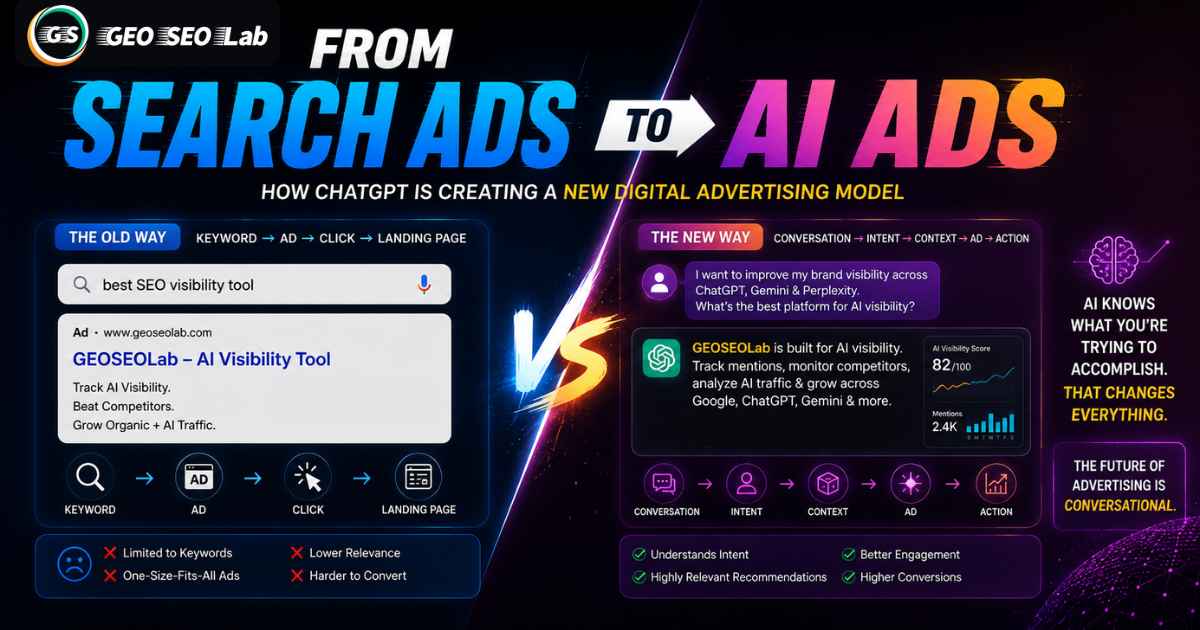
Every major advertising platform in history has followed roughly the same arc. A new place where attention gathers shows up, gets popular fast, and eventually someone figures out how to sell access to that attention. Search did it with keywords. Social did it with the feed. Now it's happening again, except this time the platform isn't a page or a scroll. It's a conversation.
OpenAI began testing ads inside ChatGPT on February 9, 2026, starting with a limited rollout to logged in adult users on the Free and Go tiers in the United States. Within six weeks, the pilot was already generating an annualized $100 million in revenue with more than 600 participating advertisers. By the middle of the year, ChatGPT had crossed 900 million weekly active users, with reports suggesting OpenAI expects billions in advertising revenue within the next few years as the program keeps expanding into new markets and new formats.
That's the headline everyone already knows. What's more interesting, and what most of the current coverage is missing, is what's actually happening underneath that headline. Early independent analysis of ads appearing inside ChatGPT has found that these ads behave meaningfully differently from the search ads marketers have spent two decades mastering. At the same time, measurement infrastructure is being built around this new channel faster than almost anyone predicted, with AppsFlyer announcing a direct conversion measurement integration for ChatGPT Ads in early August, following a similar integration from Adjust just weeks earlier.
Put those two threads together and the real question stops being whether advertising inside AI is coming. It's already here. The real question is what happens to an entire discipline built around keywords and click through rates once the platform doing the targeting understands an entire conversation instead of a handful of typed words.
Search Advertising Is Entering Its AI Era
For most of digital advertising's history, the fundamental unit of targeting was the keyword. A person typed a short phrase into a search box, an auction ran behind the scenes in milliseconds, and an ad got matched to that phrase based on relevance, bid, and quality score. That system built an entire industry, and it worked because the keyword, however compressed and imperfect, was still the clearest signal of intent search engines had ever had access to.
ChatGPT ads work from a fundamentally different starting point. Instead of a short, compressed phrase, the system has access to an actual conversation, often a genuinely detailed one. OpenAI's own ad guidance points out that a typical search query runs three to four words, while a ChatGPT prompt is often closer to a full paragraph. Someone shopping for running shoes on Google might type something like "running shoes flat feet." That same person talking to ChatGPT might explain that they're training for their first half marathon, run three times a week, have flat feet, and want something comfortable under a specific budget. That's not a keyword anymore. That's context, and it's exactly the kind of information advertisers have always wished they had and almost never actually got.
This is the real shift underneath the ChatGPT ads headline. It's not simply that a new company launched an ad product. It's that advertising is being forced to adapt to a genuinely different kind of interface, one built around ongoing conversation rather than a single, isolated search action.
What Makes AI Ads Different?
A few concrete differences separate ads inside ChatGPT from the search ads marketers already know well.
The format itself is native to the conversation, not bolted onto a results page. Ads appear as clearly labeled sponsored cards sitting below ChatGPT's own response, never inside the answer itself. OpenAI has been explicit that ads do not influence what ChatGPT actually says, keeping a firm separation between the organic answer and any sponsored content sitting beneath it. That separation matters enormously for trust, and OpenAI has repeatedly framed it as a core design principle rather than a minor detail.
Targeting draws on relevance and intent signals from the conversation itself, not just a matched keyword. According to OpenAI's own help documentation, the ad system weighs the context and intent of the current conversation, the advertiser's landing page and provided context hints, and, when personalization is enabled, broader signals from a user's ChatGPT activity. That's a meaningfully richer set of inputs than a search engine matching a bid to a typed phrase.
Ads can trigger after a single high intent prompt, not only after a long back and forth. This is worth naming clearly, because it corrects a common misconception. A person doesn't need to have an extended conversation before an ad shows up. A single, sufficiently specific question can be enough, which means the format sits closer to search advertising than pure conversational advertising in at least this one respect, even while differing sharply in others.
Early independent analysis suggests these ads are already behaving differently in practice than traditional search ads do. Reporting on early academic and independent research into ChatGPT advertising has pointed to a real, measurable divergence in how these ads perform and appear compared with the search ad patterns marketers have spent years optimizing around, with one widely cited early analysis examining thousands of ads across well over a hundred advertisers to document exactly this kind of behavioral difference. The specific numbers from any single study should be read as early and directional rather than final, since this is a genuinely new field of study, but the broader pattern, that AI advertising doesn't simply mirror search advertising with a new coat of paint, is becoming difficult to dispute.
Keyword Intent vs Conversational Intent
It's worth sitting with the difference between these two kinds of intent for a moment, because it's easy to state abstractly and much more useful once you actually compare them side by side.
Keyword intent is compressed by necessity. A person searching "best crm small business" isn't actually thinking in exactly those four words. They're thinking about a real, messy situation, probably involving a specific team size, a specific budget, maybe a specific frustration with whatever system they're currently using, none of which made it into the search box because a search box never rewarded that extra detail with a better result. The keyword was always a rough approximation of a fuller question, shaped entirely by the limitations of the interface receiving it.
Conversational intent doesn't have that same compression problem. When a person explains their actual situation to ChatGPT, in a full sentence or a short paragraph, the system receives something much closer to the real question sitting in their head. That has direct implications for advertising, since an ad matched against a fuller, more honest expression of intent has a much better chance of actually being relevant than an ad matched against four compressed keywords that were only ever a rough proxy for what the person actually wanted.
This distinction changes the entire calculus of ad targeting. Traditional search advertising has always had to guess at the fuller context behind a keyword, using signals like location, device, time of day, and past behavior to fill in gaps the keyword itself couldn't express. Conversational advertising has a real chance to skip most of that guessing entirely, because a meaningful share of that context has already been volunteered directly by the person doing the asking.
Why Context Changes Ad Targeting
Context doesn't just make targeting more accurate. It changes what kinds of ads even make sense to show in the first place.
A search engine matching a keyword to an ad is fundamentally making a probabilistic bet, since the keyword alone rarely reveals where someone actually is in their decision process. Are they just starting to research, or are they three days away from buying? A four word keyword search genuinely can't tell you that reliably. A full conversation often can, sometimes explicitly, sometimes through the specificity and tone of the questions being asked.
This means conversational advertising has a real opportunity to match ads not just to a topic, but to an actual stage of decision making. Someone early in a research conversation, asking broad, exploratory questions, is a genuinely different advertising opportunity than someone deep into a specific comparison, weighing two named options against each other. Search advertising has always struggled to reliably tell these two situations apart from a keyword alone. A conversational system, watching the shape and specificity of an actual exchange unfold, has considerably more to work with.
There's a real tension worth naming honestly here too. The same richness that makes conversational targeting more accurate also raises real questions about privacy and trust, which is exactly why OpenAI has been so publicly insistent on keeping individual conversations private from advertisers, sharing only aggregate performance data rather than the actual content of what anyone typed. Getting that balance right, delivering genuinely more relevant ads without making people feel like their private conversation is being mined for commercial gain, is probably the single hardest design problem this entire new advertising category has to solve, and it's one that will likely keep evolving as the format matures.
The New AI Advertising Funnel
The Conversational Advertising Funnel
Traditional search advertising has always run through a fairly rigid sequence. Someone thinks of a keyword, types it in, sees an ad, clicks it, and lands on a page built to convert that specific click. Each step in that chain is a fairly hard, visible transition, and marketers have spent two decades optimizing each individual step in isolation.
The emerging AI advertising funnel looks different in structure, even though it's still working toward a similar ultimate goal. It runs closer to conversation leading to genuine intent, intent developing further through additional context volunteered naturally as the exchange continues, an ad being matched against that accumulated context rather than a single static phrase, and action following from a moment where the person is already partway through an actual decision process rather than arriving cold. The transition points in this funnel are softer and less visible than the old model's hard clicks, which is exactly why measuring it properly is turning out to be one of the genuinely hard problems this new channel has to solve.
This isn't a small structural difference. A funnel built around a single click and a single landing page assumes a person's decision essentially starts at that click. A funnel built around an evolving conversation assumes the decision was already forming well before any ad appeared, which means the ad's job shifts from initiating interest to reinforcing and directing interest that already exists. That's a genuinely different creative and strategic challenge than anything search advertising ever demanded.
Attribution Inside Conversational Interfaces
This is where the practical, unglamorous infrastructure work is happening right now, and it's arguably more important to the future of this channel than any single ad format decision.
Traditional search advertising built attribution around a relatively clean chain of events. Click an ad, land on a page, complete a conversion, and a fairly direct line connects all three. Conversational advertising complicates that chain considerably. A person might see an ad inside ChatGPT, not click anything at all in that moment, and instead go complete the actual purchase somewhere else entirely, hours or days later, with no obvious digital trail connecting the two events for a marketer trying to prove the ad actually worked.
This is exactly the gap AppsFlyer and Adjust have moved to fill. AppsFlyer's integration with ChatGPT Ads, announced in early August 2026, lets advertisers attribute app installs, in app events like purchases and subscriptions, and website conversions back to specific ChatGPT ad campaigns, tying performance data into the same measurement systems advertisers already use for channels like Meta, TikTok, and Google. Grubhub, an early adopter of the integration, has publicly described the value of finally being able to see app installs and in app orders connected back to its ChatGPT ad spend with the same reliability it already gets from other channels. Adjust rolled out a comparable integration around the same period, and OpenAI itself launched a Conversions API and pixel alongside its self serve Ads Manager back in May, specifically to give advertisers a way to send conversion signals back into the platform for optimization.
The significance of this measurement push shouldn't be understated. A genuinely new advertising channel rarely earns serious, sustained budget until marketers can measure it with the same confidence they measure their existing channels. The fact that neutral, third party measurement infrastructure arrived this early in ChatGPT's advertising history, within roughly six months of the initial pilot launching, is a real signal that OpenAI understands this and is actively working to remove the single biggest obstacle standing between early experimentation and genuine, sustained ad budget commitment.
Organic AI Visibility vs Paid AI Visibility
Anyone who has spent time thinking about Generative Engine Optimization will notice an obvious tension sitting underneath this entire advertising shift. If a business can already work to earn a favorable, organic mention inside an AI generated answer, what happens once that same business can simply pay to sit right beneath that answer as a labeled sponsored card instead?
The honest answer is that these two things are not really competing for the same territory, at least not yet. OpenAI has been consistent that ads sit clearly separated from ChatGPT's actual response and do not influence what that response says. That means a business's organic AI visibility, whether or not it gets mentioned favorably inside the actual synthesized answer, remains governed by the same principles that have always mattered, genuine expertise, entity consistency, and credible, well sourced content. Paid visibility through ChatGPT Ads is a separate, additive layer sitting beneath that organic answer, not a replacement for earning a place inside it.
That said, the two channels will almost certainly start to interact strategically over time, even if they remain technically separate. A business that has already built strong organic AI visibility, showing up reliably and favorably inside ChatGPT's actual answers to relevant questions, is arriving at any paid advertising conversation from a position of established trust that a business starting from zero organic presence doesn't have. It's reasonable to expect that businesses treating organic AI visibility and paid AI advertising as one coordinated strategy, rather than two disconnected budget lines, will end up with a meaningfully stronger overall presence than those treating them as unrelated efforts running in parallel.
Will AI Recommendations and Ads Collide?
This is the genuinely uncomfortable question sitting underneath all of this, and it's worth asking directly rather than avoiding it. If an AI assistant is capable of giving someone an honest, unbiased recommendation, and that same assistant's parent company is also selling ad placements to businesses in that exact category, how confident can anyone actually be that the two stay cleanly separated over time, especially as advertising revenue becomes a larger and larger part of the underlying business model.
OpenAI's current public position is firm on this point. The company has repeatedly stated that ads do not influence ChatGPT's actual answers, that answer independence is one of its core advertising principles, and that early results show no measurable impact on consumer trust metrics as the ad program has scaled. Those are meaningful commitments, and there's no current public evidence contradicting them.
At the same time, it would be naive to pretend this tension simply disappears because a company states a principle publicly. Every previous advertising platform in history has faced some version of this exact pressure, the tension between serving genuinely useful, unbiased results and serving the advertisers who increasingly fund the platform's existence, and that tension has shaped every major platform's evolution over time in ways that weren't always obvious at launch. The honest, responsible position for marketers and researchers alike is to take OpenAI's current commitments seriously while also watching closely, over years rather than months, whether that separation actually holds as the advertising business grows into a larger and larger share of the company's overall revenue.
New KPIs for AI Advertising
Marketers used to a search advertising world built around click through rate, cost per click, and conversion rate need a genuinely expanded scorecard for a channel where the customer journey looks meaningfully different.
Conversation to ad relevance quality matters in a way it never quite did for keyword matching, since a poorly matched ad inside a genuinely helpful conversation risks damaging trust in a way a mismatched search ad rarely did, given how disposable a single search result always felt by comparison.
Assisted, delayed conversions deserve real, deliberate tracking rather than being treated as noise, since a meaningful share of the value from an ad seen mid conversation may not show up as an immediate click at all, instead surfacing later as a direct visit, a branded search, or an app install tracked through exactly the kind of measurement integration AppsFlyer and Adjust now provide.
App specific outcomes matter more here than they historically did in pure search advertising, given how much of ChatGPT's own usage happens through its app and how naturally conversational discovery seems to lead into app install behavior, which is precisely why mobile measurement infrastructure was among the very first serious measurement gaps OpenAI moved to close.
Trust and dismissal signals, tracking how often users actively dismiss or ignore a given ad versus engaging with it, are likely to matter considerably more in a conversational context than they ever did on a traditional results page, since a person's tolerance for anything that feels intrusive inside a genuinely helpful conversation is almost certainly lower than their tolerance for an ignorable ad sitting beside a list of search results they were already scanning past anyway.
The AI Ad Readiness Model
Put simply, a business preparing to actually compete in this new channel needs readiness across a few connected layers. Genuine organic AI visibility forms the foundation, since a business with no established trust inside AI generated answers is starting any paid effort from a considerably weaker position. Clean, reliable measurement infrastructure comes next, connecting ad spend to real outcomes through the kind of integrations AppsFlyer and Adjust now provide, rather than flying blind on a genuinely new channel. Creative built specifically for a conversational context, tight, relevant, and clearly additive to whatever the person was already asking about, matters more here than creative simply repurposed from an existing search campaign. And ongoing, close attention to how the boundary between organic recommendation and paid placement actually holds up over time rounds out the model, since this is a genuinely new kind of platform risk that didn't really exist in the same form for traditional search advertising.
What Marketers Should Prepare for Next
Treat this as a genuinely new discipline, not a search campaign wearing a different skin. The targeting logic, the funnel shape, and the measurement challenges are different enough that simply porting over an existing search strategy is likely to underperform relative to building something specifically designed for how conversational context actually works.
Start building organic AI visibility now, regardless of paid advertising plans. Since organic and paid AI presence are likely to reinforce each other strategically over time, waiting until a paid ChatGPT campaign is already live to start thinking about organic visibility is starting from behind unnecessarily.
Get measurement infrastructure connected early, even at small scale. The AppsFlyer and Adjust integrations exist specifically to solve the attribution problem this channel creates, and businesses that connect early are positioned to learn what's actually working considerably faster than those waiting for the channel to mature before investing any real measurement effort.
Write ad creative that assumes real context, not a blank slate. Since ads in this channel are matched against genuine conversational intent rather than a bare keyword, creative that speaks directly to the kind of specific situation a person has likely just described performs meaningfully better than generic messaging built for a much colder, less informed audience.
Watch the organic and paid boundary closely, and keep watching it. This is a genuinely new kind of platform trust question, and the businesses paying close attention to how it evolves, rather than assuming today's stated principles are permanent and unchanging, will be better positioned to adapt if and when that boundary shifts.
Closing Thought
Every major advertising platform in history looked, in its earliest months, like a rough, unfinished version of what it eventually became. Search ads started as simple text links next to organic results and grew into one of the most sophisticated auction systems ever built. Social ads started as basic sponsored posts and grew into an entire discipline built around audience modeling and creative testing at massive scale. ChatGPT advertising is sitting at that exact same early moment right now, rough around the edges, still building its own measurement infrastructure in real time, but already showing clear signs of becoming something genuinely different from the search advertising model it superficially resembles. The marketers who start taking that difference seriously now, rather than waiting for it to become obvious to everyone, are the ones most likely to actually understand this channel by the time everyone else finally catches up.
Key Takeaways
- OpenAI launched ChatGPT advertising in February 2026 and reached roughly 600 advertisers and $100 million in annualized revenue within six weeks, growing to hundreds of millions of weekly active users being served ads by mid year.
- Early independent analysis suggests ChatGPT ads already behave differently from traditional search ads, driven largely by the shift from short, compressed keywords to full, context rich conversational intent.
- Ad targeting inside ChatGPT draws on the context and intent of an entire conversation rather than a single matched keyword, which changes not just accuracy but the entire logic of what kind of ad makes sense to show and when.
- Measurement infrastructure is arriving unusually fast for a new channel, with AppsFlyer and Adjust both launching conversion attribution integrations for ChatGPT Ads within roughly six months of the platform's initial launch.
- Organic AI visibility and paid AI advertising remain structurally separate for now, but businesses treating them as one coordinated strategy are likely to end up with a stronger overall presence than those treating them as unrelated efforts.
About GEO SEO Lab
GEO SEO Lab is a research and strategy group focused on helping businesses understand and improve visibility across AI assisted search and discovery, including Google Search, Google AI Mode, ChatGPT, Gemini, Claude, Perplexity, and the broader ecosystem reshaping how people find, evaluate, and now increasingly encounter paid content inside AI conversations. Our work spans Generative Engine Optimization, AI visibility strategy, entity optimization, and emerging AI advertising research aimed at helping businesses understand both the organic and paid sides of AI driven discovery.
References and Further Reading
- OpenAI, Testing Ads in ChatGPT, official product updates, 2026
- OpenAI Help Center, Ads in ChatGPT, targeting and format documentation
- AppsFlyer, ChatGPT Ads integration announcement and setup documentation, August 2026
- PPC Land, ChatGPT Ads gains app attribution as AppsFlyer and Adjust go live, August 2026
- Pacvue, ChatGPT Ads in 2026, Early Results, Best Practices, and How to Get Started
- GEO SEO Lab, The New Rules of AI Visibility, why rankings alone won't win in 2026
Tags
Frequently Asked Questions
Find answers to common questions about this topic
About the Author

Anubhav
SEO Expert & Content Creator
Experienced digital marketing professional specializing in SEO strategies, content optimization, and data-driven marketing solutions. Passionate about helping businesses grow their online presence and achieve better search rankings.
Related Articles
View all posts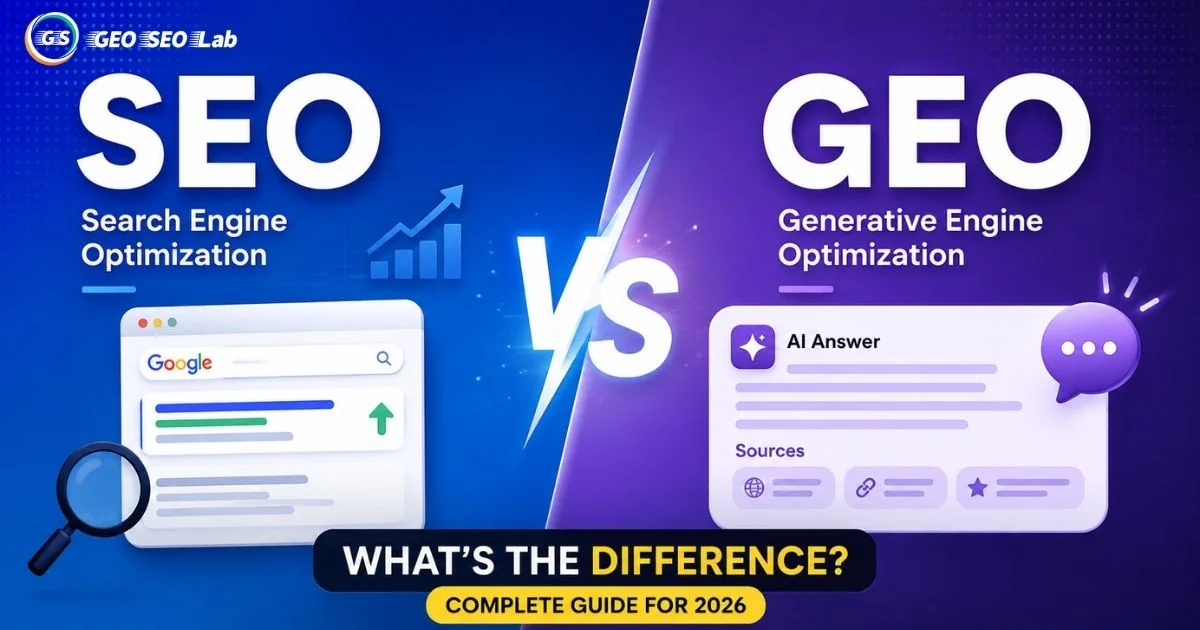
SEO vs GEO: What's the Difference? A Complete Guide for 2026
SEO vs GEO, What's the Difference, and Why Your Business Needs Both in 2026, Introduction For most of the last two decades, the goal of digital marketing c...
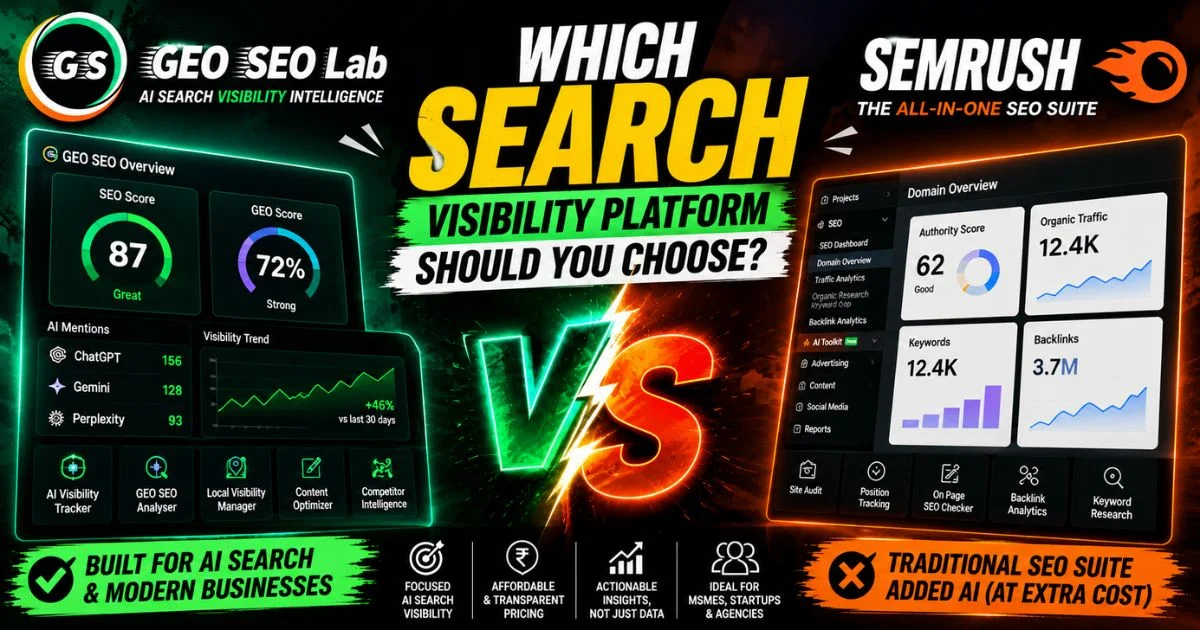
GEO SEO Lab vs Semrush: Which SEO & GEO Platform Is Best in 2026?
Picking a search visibility platform used to be a fairly narrow decision. You wanted rankings, backlinks, and maybe a competitor snapshot, and most of...
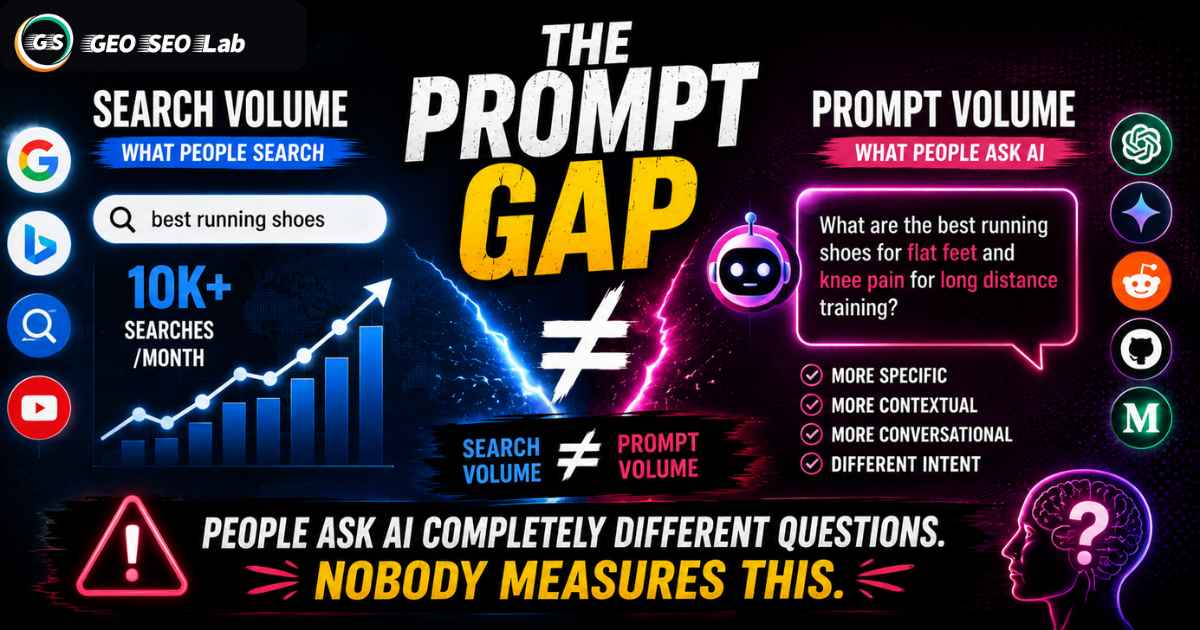
Why Does Search Volume Miss AI Search Prompts? The Prompt Gap
The Keyword Tool Everyone Trusts Is Quietly Going Blind Every marketing team has some version of the same ritual. Open a keyword research tool, type in...