SEO vs GEO: What's the Difference? A Complete Guide for 2026
SEO vs GEO, What's the Difference, and Why Your Business Needs Both in 2026, Introduction For most of the last two decades, the goal of digital marketing c...
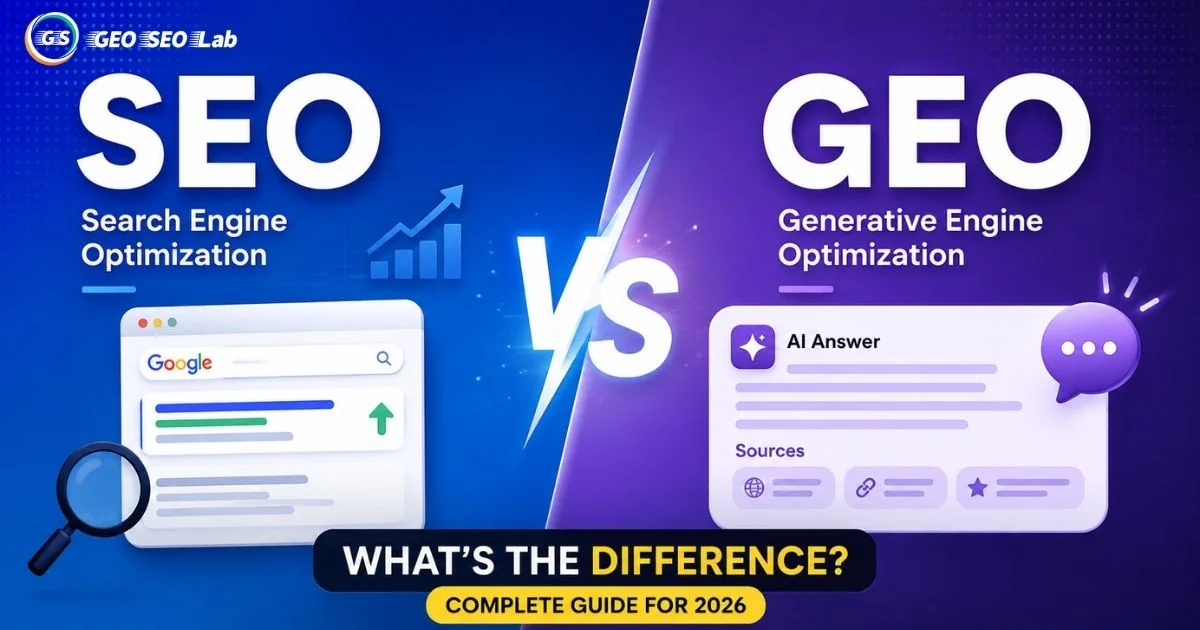
For most of the last two decades, SEO had one clear objective: help websites rank higher in Google Search. But search is changing. People can now ask questions through AI-powered experiences such as Google AI Overviews, Google AI Mode, ChatGPT, and Perplexity, where they may receive a synthesised answer instead of a traditional list of links. That single objective shaped how businesses built websites, wrote content, chased backlinks, and measured success. It worked, largely because search itself worked the same way for everyone. Type a query, get a list of links, click one, done.
That single objective isn't quite enough anymore, and it's worth being honest about why. People are increasingly asking questions directly inside AI-powered experiences, Google AI Overviews, Google AI Mode, ChatGPT, Perplexity, and a growing list of other generative tools, and instead of walking away with ten blue links to sift through, they're often getting a synthesized answer that may or may not point back to a specific website. That shift has given rise to a newer discipline people are calling GEO, short for Generative Engine Optimisation, and it's sparked a genuinely important question worth answering clearly rather than vaguely.
So what actually separates SEO from GEO? The short version is this. SEO helps your website become visible inside traditional search results. GEO focuses on increasing the odds that your brand or your content actually gets discovered, understood, and referenced inside an AI-generated answer. Neither one replaces the other, and treating them as competing strategies is probably the single biggest mistake a business can make heading into 2027. The stronger approach, and the one this report walks through in detail, is building a real SEO foundation first, then layering GEO on top of it, because the strongest players in 2026 aren't picking a side. They're building both at once.
SEO vs GEO: Key Differences
The easiest way to understand SEO vs GEO is to compare their goals, visibility channels, content approach, and measurement.
SEO stands for Search Engine Optimisation. SEO focuses on traditional search engines and organic search results. It aims to help relevant pages rank for searches by improving technical performance, content quality, relevance, authority, and usability. It optimises actual pages for ranking and discovery, and keywords still carry genuine weight in how that optimisation gets planned. Technical SEO, crawlability, indexing, page speed, structured data, and trust remain essential groundwork. Backlinks and domain authority continue to matter. The whole discipline targets specific queries and the search results those queries return, and success gets measured through fairly familiar numbers: rankings, impressions, clicks, and conversions.
GEO stands for Generative Engine Optimisation. It focuses on improving how a brand, website, product, or body of information can be discovered, understood, and potentially referenced by generative AI systems. The goal shifts toward earning visibility or citation inside an AI-generated answer, which means optimising information itself for retrieval, understanding, and potential citation rather than optimising a page purely for ranking. Topics, entities, context, and clearly stated answers matter more here than isolated keyword targeting. Technical SEO still forms the foundation underneath GEO too, since none of this works if a page can't be crawled and indexed in the first place. Authority still matters, but it broadens out to include mentions, citations, and trustworthy sourcing beyond a page's own domain. GEO targets actual questions and full conversations rather than isolated search queries, and measuring success increasingly means tracking AI visibility, brand mentions, citation frequency, referral traffic coming from AI tools, and the conversions that follow.
The part worth underlining here is that these two disciplines overlap heavily rather than sitting in separate lanes. Google's own current guidance says plainly that its generative AI search features are rooted in core Search systems, and that standard SEO best practices continue to apply. That single sentence probably does more to clear up confusion around this topic than almost anything else circulating online right now.
What is SEO ?
SEO, or Search Engine Optimization, is the process of improving a website and its content so search engines can discover, understand, and potentially rank its pages for relevant searches.
For example, imagine you run a digital marketing agency and want to rank for ‘best SEO agency for startups.’ A traditional SEO strategy would optimize a relevant page around search intent, useful content, technical performance, internal linking, authority, and other relevant ranking considerations. That discipline spans a genuinely wide range of work: keyword research, search intent analysis, content optimisation, technical SEO, internal linking, website architecture, page experience, structured data, link building, digital PR, local SEO, image and video optimisation, and regular analysis through tools like Search Console.
Google itself describes SEO fairly simply, as improving a site so that search engines can better understand it and people can find relevant content through Search. The traditional SEO journey, stripped down to its basics, looks roughly like this: a user searches, the search engine discovers the relevant pages sitting out there on the web, those pages get evaluated against everything the engine knows about quality and relevance, results get ranked accordingly, and the user clicks whichever result actually answers their question. The entire objective of SEO work is making your page a genuinely strong candidate somewhere inside that evaluation and ranking process.
What is GEO ?
Generative Engine Optimization (GEO) refers to strategies designed to improve how information about a brand, website, product, service, or area of expertise can be discovered and understood by generative AI systems.
The key difference is the type of visibility being pursued. SEO primarily focuses on ranking and organic search visibility, while GEO focuses on whether information can become part of an AI-generated response. Instead of asking "how do I rank number one," GEO asks a fundamentally different question: how do I become a source an AI system can confidently rely on when it's answering questions about my particular topic? Picture someone asking an AI search system, "What are the best SEO agencies for startups in India? The system probably isn't going to hand back ten blue links the way Google traditionally has. It's more likely to generate an actual answer, naming a handful of recommended companies, explaining why, comparing them against each other, and citing sources and links as supporting evidence throughout.
That changes what your actual challenge looks like. You're no longer solely trying to rank a webpage. You're trying to make sure your brand and your underlying information are discoverable and trustworthy enough that an AI system genuinely wants to include you when it's building that answer.
SEO vs GEO: What Is the Difference?
The biggest SEO vs GEO difference is where and how visibility happens.
SEO asks whether a webpage can appear prominently in traditional search results. GEO asks whether relevant information about a brand or topic can be retrieved and represented in an AI-generated answer. GEO is asking something adjacent but distinct: can your information actually become part of an AI-generated answer when someone asks a relevant question. That's a real shift, moving from pure ranking toward something closer to answer inclusion.
It would be a mistake to read that shift as "rankings no longer matter," though, because Google's own documentation is fairly explicit on this point. AI Overviews and AI Mode use relevant web content and Google's core Search systems to actually retrieve information, and pages generally still need to be indexed and eligible to appear in normal Google Search before they can even be considered as supporting links inside these AI experiences. So the real relationship isn't SEO getting replaced by GEO. It's closer to a chain: SEO builds discoverability, discoverability enables retrieval, and retrieval is what makes AI visibility possible in the first place.
Is GEO Actually Replacing SEO?
No, and this is probably the single biggest misconception floating around this whole topic right now.
GEO is better understood as an evolution of search optimisation rather than a wholesale replacement for it. Google's current guidance is especially direct here too, stating there are no additional technical requirements needed to appear in AI Overviews or AI Mode beyond the standard eligibility for Google Search itself, and that existing SEO fundamentals remain genuinely useful. That means none of the following should get abandoned in favour of some newer, shinier GEO strategy: technical SEO, crawlability, indexing, internal linking, search intent research, quality content, page experience, structured data, or digital authority. The smarter move is building GEO directly on top of those existing foundations rather than treating it as a separate, parallel track.
How SEO and GEO Actually Work Together
SEO and GEO work best as connected parts of the same search strategy rather than as competing disciplines.
The first layer is SEO, and its job is making your website genuinely discoverable, crawlable, indexable, understandable, and useful. The second layer is GEO, and its job is making your actual information clear, authoritative, contextual, evidence-based, and easy for a system to retrieve and represent accurately. Put those two layers together,r and you get something considerably more powerful than either one alone: SEO plus content quality plus authority plus entity understanding plus GEO, working as one connected strategy rather than as separate, competing initiatives pulling budget in different directions.
This is where GEO SEO Lab's original framework comes in. We call it the Three-Layer Discovery Model, and it extends this same idea one step further by naming a third layer that both SEO and GEO ultimately depend on: brand authority, the accumulated trust and recognition a business builds beyond its own website entirely, through reviews, press coverage, community presence, and third-party mentions. SEO forms the base layer, making a site genuinely findable and indexable. GEO sits above it, making the actual information trustworthy and citable once an AI system finds it. Brand authority sits above both, reinforcing why a system, or a human reader, should trust that information in the first place. None of the three layers functions particularly well in isolation, and businesses that treat them as three unrelated checklists tend to underperform businesses that treat them as one connected system.
SEO vs GEO, the Keyword Strategy Difference
This is another genuine, practical difference worth walking through carefully, because it changes how content actually gets planned.
Traditional SEO has historically leaned heavily on keywords. Take "best CRM for startups" as an example. A page gets built and optimized specifically around that target phrase and its close relatives, structured to optimise exactly what someone typing those words is probably looking for.
GEO asks for broader thinking than that. An actual AI user might phrase the same underlying need very differently, something like "which CRM should a ten-person SaaS startup choose if it needs automation but has a limited budget." That's not one clean keyword anymore. It's a genuinely layered question, packed with context, constraints, and specific entities all bundled together. GEO-friendly content needs to be built to answer that fuller kind of question directly, covering what something is, why it matters, how it works, who it's actually for, when it applies, which option fits a given situation, how it compares against alternatives, and under what specific conditions any of that changes. None of this means keywords are suddenly irrelevant. It means context now sits right alongside keywords as something content planning genuinely has to account for.
SEO vs GEO, the Content Strategy Difference
Traditional SEO content planning often starts from a fairly narrow question: what keyword should we target. A genuinely stronger modern approach flips that question around and starts instead with what the actual reader needs to know, and that shift matters even more once GEO enters the picture, because AI systems need content they can actually understand and lean on as real evidence.
Certain content formats end up carrying particular weight under this approach. Clear definitions that answer a direct "what is this" question. Honest comparisons that walk through the actual differences between two options rather than favoring one blindly. Step-by-step guides that genuinely walk a reader through a process, favouring research answering a genuinely specific question nobody else has bothered to measure. Data-driven analysis built on real numbers rather than vague impressions. Expert commentary offering a genuine point of view rather than a neutral summary. Real case studies documenting an actual outcome rather than a hypothetical one.
Google's own recent generative-AI guidance backs this pattern up directly, specifically emphasizing valuable, unique, non-commodity content over simply producing a larger voluemphasising. That's a meaningful signal worth taking seriously, since it suggests the reward structure genuinely favors depth and originality over sheer output.
Does GEO Require Special Schema?
No, an unfounded particular misconception deserves to be addressed directly, because it's spreading fast and it's genuinely misleading businesses into wasting money.
There is currently no special "GEO schema" out there that guarantees visibility inside Google AI Overviews or AI Mode. Google has been explicit about this specific point, stating there's no special schema.org structured data required for its AI search features, and that existing SEO fundamentals remain what actually matters. So it's worth staying genuinely sceptical of anyone selling a supposed magic "AI Search Schema," or claiming that a single piece of markup will guarantee ChatGPT, Gemini, or Google's own AI systems start citing your website. GEO is a considerably broader discipline than a code snippet, and treating it as a quick technical fix misses almost everything that actually matters about earning genuine AI visibility.
Does AI-Generated Content Help GEO?
Not automatically, and this is another area worth being genuinely careful about.
Simply using AI to generate content doesn't automatically make that content more visible inside AI search. In fact, Google has warned specifically against publishing large volumes of unoriginal content primarily aimed at manipulating rankings, and its spam policies apply just as much to generative AI responses as they do to traditional search results. The better mental model here is treating AI as assistance rather than as a wholesale content-generation machine. Using AI for research, brainstorming, outlining, content analysis, data organization, editing, and spotting genuine content gaps is genuinely useful. What still needs to come from an actual human, or from genuine, verified information, is original research, first-hand experience, real expert opinions, unique examples, original data, real analytical thinking, and honest, real-world case studies. That combination, AI-assisted rather than AI-generated at scale, is what actually creates content worth an AI system citing in the first place.
How to Create GEO-Friendly Content
There's no single universal formula guaranteeing an AI citation, and anyone claiming otherwise is oversimplifying a genuinely complex, evolving system. What a strong GEO strategy generally focuses on instead is making information easy to discover, easy to understand, easy to verify, and properly contextualized.
Answering the actual question directly, right up front, matters enormously; bury a definition beneath eight hundred words of scene-setting introduction. If someone's asking "what is GEO," give them a clear, direct answer near the top of the page, then build out the explanation from there.
Building genuine topical depth matters just as much. Publishing one standalone article about GEO and calling it done leaves real coverage gaps. A genuinely strong topical footprint connects several related pieces covering what GEO actually is, how it compares to SEO, how it relates to AEO, how GEO actually works in practice, what a real GEO strategy looks like, which tools support it, how it gets measured, and how it connects into the broader world of AI search optimization and AI citations.
Demonstrating genuine expertise throughout matters too, since both AI systems and traditional search engines are ultimately looking for reliable information they can trust. That means leaning on author expertise, original research, credible references and statistics, real case studies, honest first-hand observations, and a clearly stated methodology wherever data gets presented.
Clear structure deserves real attention as well, since making important information easy to identify helps everyone reading it, human or machine. Descriptive headings, short paragraphs, genuine lists, comparison tables, clear definitions, concrete examples, and FAQs all make information considerably easier to process and extract accurately, and good structure that genuinely serves human readers tends to serve automated systems well too, almost as a byproduct.
Building authority beyond your own website rounds this out, and it's an area a lot of businesses genuinely underinvest in. Your website isn't the only place your brand's reputation actually lives. Industry publications, expert interviews, digital PR coverage, genuine reviews, active community participation, podcast appearances, research citations, professional profiles, and relevant third-party mentions all contribute meaningfully to how trustworthy an AI system, or a human reader, perceives your brand to be. Recent research into GEO also suggests something worth keeping in mind here: AI search systems can behave genuinely differently from traditional search, including real differences in which kinds of sources they lean on and how consistently they surface any given source over time.
SEO vs GEO vs AEO
One more term worth clarifying, since it comes up constantly in this same conversation: AEO, or Answer Engine Optimisation.
These three terms, SEO, GEO, and AEO, get used somewhat interchangeably in casual conversation, but they're not always defined identically depending on who's using them. A genuinely simple way to separate them: SEO's primary objective is improving visibility inside traditional search engines. AEO's primary objective is optimising content specifically for direct-answer formats. GEO's primary objective is improving visibility inside broader generative AI experiences.
There's real, substantial overlap across all three, and honestly, getting overly precious about the exact terminology tends to be less useful for a business than simply focusing on the actual underlying objective shared by all of them: creating information that both search engines and AI systems can genuinely discover, understand, and trust, while making sure that same information stays genuinely useful for actual human readers throughout.
SEO vs GEO, Which One Should Your Business Actually Focus On
For the overwhelming majority of businesses, the honest answer is both, and treating this as an either-or decision tends to backfire.
If a website already has weak technical SEO, poor indexing, thin content, or minimal accumulated authority, jumping straight into GEO tactics without fixing that foundation first is unlikely to solve the underlying problem. A sensible, sequenced approach looks something like this in practice.
Start by building a genuinely strong SEO foundation, making sure a website is crawlable, indexable, fast enough to load, mobile-friendly, properly internally linked, well structured, and genuinely useful to an actual visitor. From there, build real topical authority, creating comprehensive, connected content around a business's core subject areas rather than scattered, disconnected pages. Layer in genuinely differentiated content next, resisting the temptation to simply rewrite whatever the current top ten results already say, and adding something a reader or an AI system genuinely couldn't get anywhere else. Build brand authority alongside all of that, earning real mentions, references, links, and recognition that exist beyond a business's own website entirely. Then optimize specifically for AI discovery, making content direct, well structured, evidence-based, context-rich, and clearly organized around real entities rather than vague generalities. And finally, measure both channels properly rather than defaulting back to whichever set of numbers feels most familiar.
On the SEO side, that measurement should still track rankings, impressions, clicks, organic traffic, click-through rate, and conversions. On the GEO side, it needs to expand to cover brand mentions, actual AI citations, AI-generated referral traffic, visibility across a genuinely relevant set of prompts, referral conversions specifically originating from AI tools, and overall share of voice across AI-generated answers in a given category. It's also worth knowing that Google announced dedicated generative-AI performance reporting inside Search Console back in June 2026, initially rolling that new reporting out to a subset of sites, a genuine signal that measurement infrastructure for this exact gap is actively being built out, even if it's not yet universally available.
The Future of Search: SEO and GEO Working Together
This is genuinely where the whole conversation gets interesting, and it's worth sitting with directly rather than rushing past it.
The future of this discipline isn't SEO or GEO competing against each other for budget and attention. It's SEO plus GEO plus brand authority, working together as one coherent system. Search itself is becoming genuinely multimodal and conversational in a way it simply wasn't a few years ago. A single person's research journey today might realistically involve searching Google, reading through an AI Overview, asking AI Mode a genuine follow-up question, opening one of the cited websites, asking ChatGPT for alternative options entirely, comparing a handful of products directly, visiting a company's actual website, and finally converting somewhere along that path.
That means the old, familiar customer journey- Google search leading straight to a website leading straight to a conversion- isn't the only path anymore, and in a lot of categories, it's no longer even the primary one. It can now look considerably more layered: search leads to an AI-generated answer, which leads to cited sources, which leads to genuine brand discovery, which eventually leads back to a company's own website, and only then to an actual conversion. Businesses genuinely need to optimise not just for where they rank on a results page, but for how their information gets discovered and represented across this entire, considerably wider search ecosystem. Google itself describes AI Overviews and AI Mode as experiences specifically designed to surface supporting links and help users explore information across a genuinely wider range of websites, not as a mechanism built to replace those websites entirely.
The Bottom Line on SEO vs GEO
SEO is not dead. GEO is not a replacement for SEO. Both statements are worth saying plainly, because a lot of noise online right now suggests otherwise, usually from people with something to sell.
SEO remains the genuine foundation for making a website discoverable and eligible within search in the first place. GEO extends that same underlying conversation into a world where users increasingly interact directly with AI-generated answers rather than exclusively working through a traditional list of search results. The actual winning strategy was never about choosing one discipline over the other. It's about deliberately building a website and a brand capable of succeeding across both, at the same time, as one connected effort rather than two separate initiatives competing for attention.
In one sentence: SEO helps people actually find your website, while GEO aims to make your underlying information useful enough that AI-powered search experiences can discover it, understand it, and potentially reference it directly. Businesses that start deliberately building both capabilities now, rather than waiting for the picture to become even clearer, are going to be considerably better positioned as search keeps moving further away from simple lists of links and further toward genuinely conversational, AI-assisted discovery.
Key Takeaways
- SEO focuses on visibility inside traditional search results, while GEO focuses on visibility and citation inside AI-generated answers, and the two disciplines overlap heavily rather than competing directly.
- Google's own guidance confirms AI Overviews and AI Mode are rooted in core Search systems, meaning pages generally still need to be indexed and eligible for standard Google Search before they can appear as supporting links inside AI experiences.
- There's no special "GEO schema" or magic markup that guarantees AI citation. Google has explicitly said no special structured data is required beyond standard SEO fundamentals.
- Using AI to generate content doesn't automatically improve GEO performance, and large volumes of unoriginal, AI-generated content can violate Google's spam policies just as easily as low-quality traditional content can.
- A genuinely strong approach builds SEO fundamentals first, layers topical authority and differentiated content next, then extends deliberately into GEO and broader brand authority, rather than treating any one of these as a standalone fix.
- Google introduced dedicated generative-AI performance reporting inside Search Console in June 2026, signalling that measurement infrastructure for this exact SEO and GEO gap is actively developing.
- The future of search optimisation versus GEO. It's SEO plus GEO plus brand authority, functioning together as one coherent, connected discovery strategy.
About GEO SEO Lab
GEO SEO Lab researches the evolution of search and discovery across Google Search, Google AI Mode, ChatGPT, Gemini, Claude, Perplexity, and other AI-powered platforms. Our mission is to help businesses understand and act on the real relationship between SEO and GEO, combining current Google guidance and independent research with original, practical frameworks for building visibility that holds up across both traditional and AI-driven search.
References
- Google Search Central, official documentation on AI Overviews and AI Mode eligibility requirements
- Google Search Central, official guidance on generative AI content and spam policies
- Google Search Central, official guidance on structured data requirements for AI search features
- Google, official Search Console announcement on generative-AI performance reporting, June 2026
- GEO SEO Lab, internal research on GEO-friendly content structure and AI citation patterns
All claims attributed to Google reflect publicly available documentation and product guidance current as of mid-2026. Since Google's AI search features continue evolving, readers are encouraged to confirm current requirements directly through Google Search Central before making significant strategic decisions.
Tags
Frequently Asked Questions
Find answers to common questions about this topic
About the Author

Anubhav
SEO Expert & Content Creator
Experienced digital marketing professional specializing in SEO strategies, content optimization, and data-driven marketing solutions. Passionate about helping businesses grow their online presence and achieve better search rankings.
Related Articles
View all posts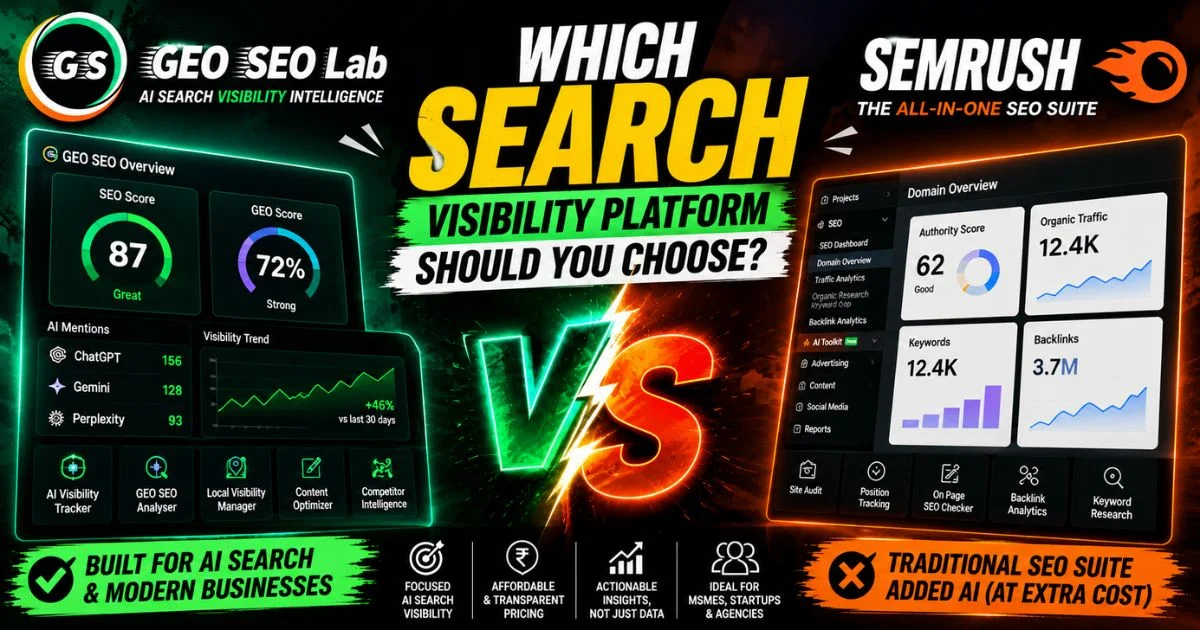
GEO SEO Lab vs Semrush: Which SEO & GEO Platform Is Best in 2026?
Picking a search visibility platform used to be a fairly narrow decision. You wanted rankings, backlinks, and maybe a competitor snapshot, and most of...
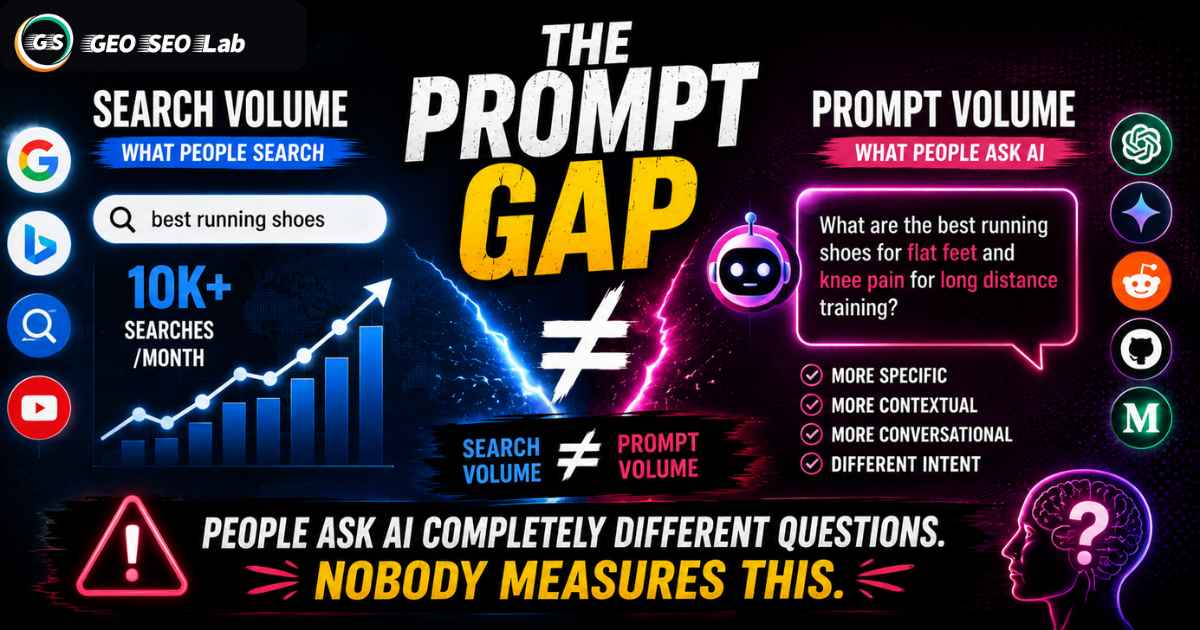
Why Does Search Volume Miss AI Search Prompts? The Prompt Gap
The Keyword Tool Everyone Trusts Is Quietly Going Blind Every marketing team has some version of the same ritual. Open a keyword research tool, type in...
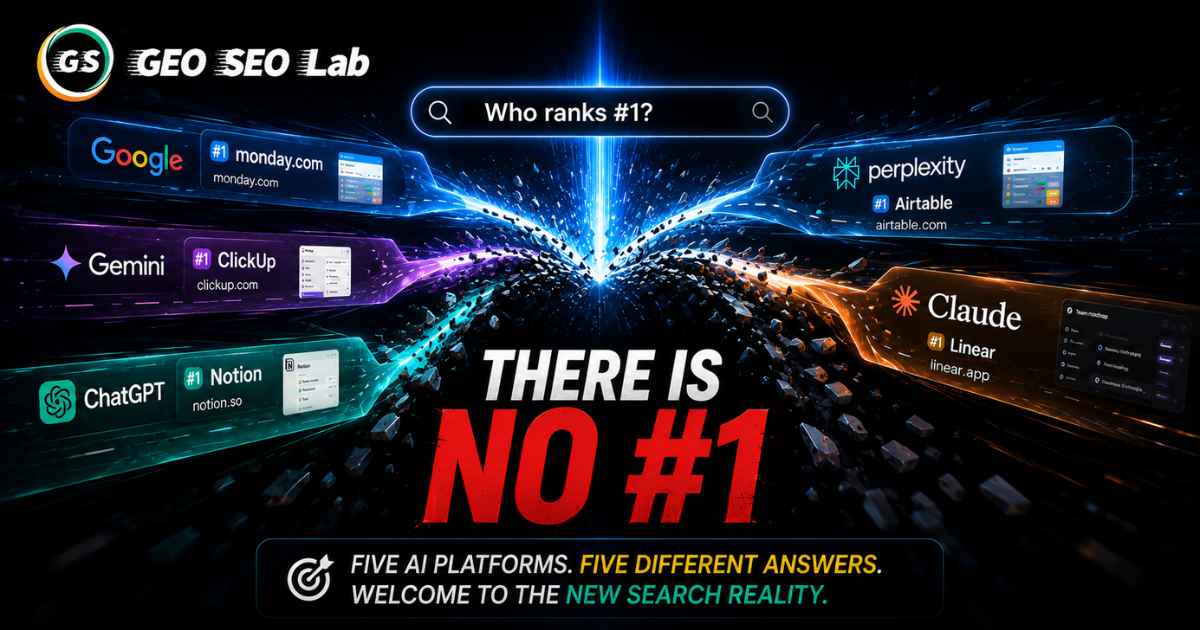
There Is No Number One Position in AI Search
There Is No Number One Position in AI Search: Why Google, Gemini, ChatGPT and Perplexity See Different WinnersCategory: AI Search Research & GEO Strat...