The Prompt Gap: Why Search Volume No Longer Tells You What People Are Actually Asking
The Keyword Tool Everyone Trusts Is Quietly Going BlindEvery marketing team has some version of the same ritual. Open a keyword research tool, type in...
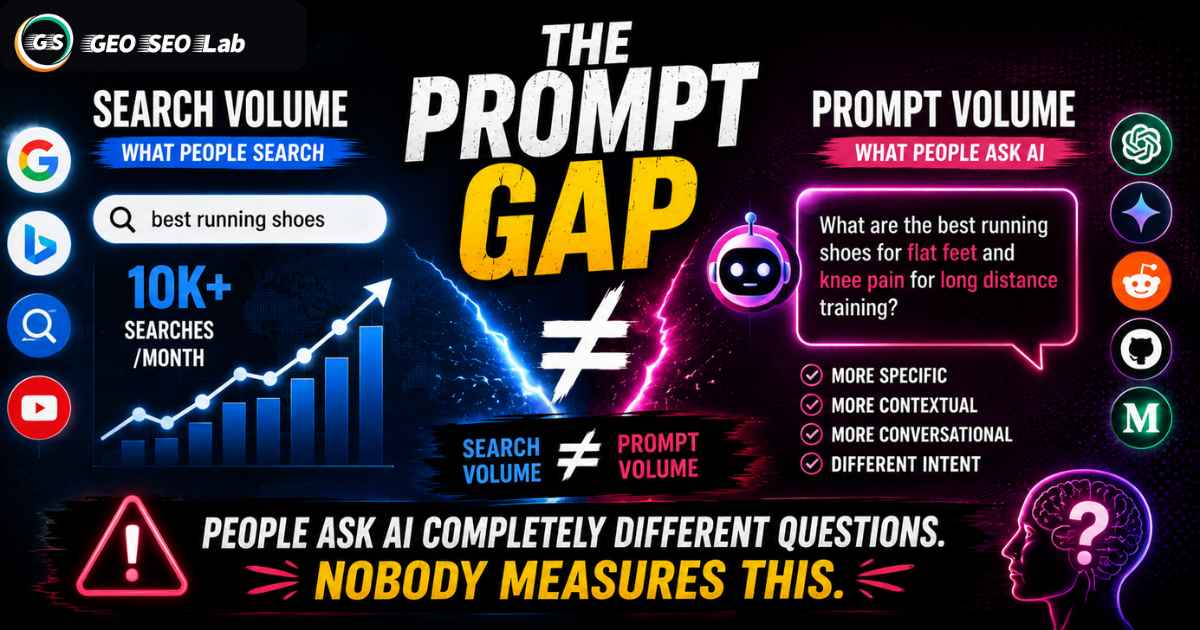
The Keyword Tool Everyone Trusts Is Quietly Going Blind
Every marketing team has some version of the same ritual. Open a keyword research tool, type in a topic, and get back a tidy list of phrases with monthly search volumes attached. Sort by volume, build content around the biggest numbers, track rankings, report progress. It's a habit so deeply ingrained in digital marketing that most people never stop to ask whether the underlying premise still holds.
Here's the premise, stated plainly. Search volume is supposed to represent demand. If ten thousand people type a phrase into Google every month, that number is treated as a reasonably honest signal of how many people actually want an answer to that question. For twenty years, that assumption was close enough to true to build entire careers and entire agencies around it.
It's no longer close enough to true, and almost nobody is tracking the reason why.
People don't ask AI assistants the same things they type into a search box. They don't even ask in the same shape. A person who would have typed "best crm small business" into Google now asks ChatGPT something closer to "we're a ten person marketing agency switching off spreadsheets, what CRM should we actually use and how much should we expect to pay." Same underlying need. Completely different question, completely different phrasing, completely different amount of context volunteered up front. And here's the uncomfortable part: none of that second conversation shows up in a keyword tool. It's not indexed, not tracked, not counted anywhere a typical marketing team can see.
That's the prompt gap. Search volume measures what people type into a search box. It says nothing about what people are actually asking AI assistants, which is often a genuinely different question, asked in a genuinely different way, at a genuinely different scale that's growing every quarter. This piece is about naming that gap clearly, explaining why it matters more than most marketing teams currently realize, and offering a practical way to start closing it.
This isn't a small technical footnote for analysts to argue about. It's a genuinely large blind spot sitting underneath most of the marketing industry's core planning process. Budgets get set based on estimated search demand. Content calendars get built around keyword volume. Entire categories get labeled as small or saturated based on a number that increasingly represents only part of the real picture. If a meaningful and growing share of real demand has quietly moved somewhere that number can't see, every decision built on top of it inherits that same blind spot, usually without anyone in the room realizing it.
Why Search Queries and AI Prompts Are Not the Same Thing
It helps to actually sit with the mechanical difference between typing into a search box and talking to an AI assistant, because the difference runs deeper than most people assume.
Search queries were shaped by the box, not by the question. For two decades, people learned, mostly without realizing they were learning it, to compress a real question down into three or four keywords, because that's what search engines could reliably parse. Nobody actually thinks in the phrase "best running shoes flat feet." That's a translation, a workaround, a way of communicating with a system that couldn't handle a real sentence. The actual question in someone's head was closer to "I have flat feet and I run mostly on pavement, what kind of shoes should I be looking for and do I need to see a podiatrist first." The keyword was never the real question. It was the nearest approximation a search box would accept.
AI prompts let people finally ask the real question. Once a person realizes an AI assistant can actually parse a full sentence, understand context, and hold a conversation, the incentive to compress disappears almost immediately. People start typing, or speaking, the question that was actually in their head the whole time, often with real context attached that they never would have bothered including in a search box, because a search box never rewarded that extra detail with a better answer.
This means a huge amount of real demand was always invisible to keyword tools, and still is. The gap between "best running shoes flat feet" and the fuller question sitting behind it wasn't created by AI. It's always existed. What's changed is that AI finally gives people a place to ask the fuller version, which means that fuller version is now happening at real scale, constantly, completely outside anything a keyword research tool was ever built to see.
Prompts also chain together in ways search queries almost never did. A single AI conversation about choosing a CRM might start broad, narrow down to two specific options, ask about integrations, ask about pricing tiers, and ask for a migration checklist, all inside one continuous exchange. A keyword tool sees, at best, a handful of disconnected phrases that vaguely relate to that topic. It has no way to represent the actual shape of that conversation, the order the questions came in, or the fact that they were all part of one person's single decision making process.
And prompts increasingly carry emotional and situational context that keywords never captured. People tell AI assistants things they'd never type into Google. Budget constraints. Anxiety about making the wrong choice. Specific past experiences that are shaping the decision. A parent asking about a medical symptom for their child sounds nothing like the clipped, anonymous phrasing that same parent would have typed into a search box out of habit. That context matters enormously for what actually gets recommended, and it's completely absent from every search volume report ever generated.
People also ask AI assistants questions they would never have bothered searching for at all. A search box has an implicit cost, the effort of phrasing a question into a keyword, scanning results, and clicking through, that quietly discouraged a lot of smaller, more marginal questions from ever being asked in the first place. A conversational interface lowers that cost dramatically, which means a genuine share of prompt volume represents demand that simply didn't exist as measurable search behavior before, not because people didn't have the question, but because search never made it worth asking.
Why Nobody Is Actually Measuring This Yet
If the gap is this real, the obvious question is why marketing teams aren't already tracking it properly. The honest answer is that the infrastructure for measuring it barely exists yet, and what does exist is genuinely difficult to build.
AI conversations are mostly private, by design. Search engines built an entire industry on the fact that queries, in aggregate, could be observed, tracked, and reported. AI conversations happen inside a private exchange between one person and one assistant, and there's no equivalent to a public, aggregated search console showing what millions of people are actually asking. Some of that data exists somewhere, inside the AI companies themselves, but it isn't being surfaced to marketers in anything close to the way search volume data has been for two decades.
The tools marketers already own weren't built for this. Every keyword research platform in wide use today was architected around indexing search engine query data. Retrofitting that same infrastructure to capture and categorize AI prompt behavior is a genuinely different technical problem, not a small feature update, and the tools that do this well are still early and immature compared with how mature keyword research tooling became over twenty years.
Prompt phrasing varies enormously, which makes it hard to group into clean categories. Search behavior converged, over years, into a relatively small set of predictable phrasings for any given topic, which is exactly what made keyword tools useful in the first place. AI prompts haven't converged the same way, and may never converge the same way, since the entire point of a conversational interface is that people don't need to phrase things the same way to get a good answer. That makes prompt behavior much harder to bucket into the tidy volume numbers marketers are used to relying on.
Most marketing teams simply haven't started looking yet. This is the least technical reason, and maybe the most important one. A huge share of marketing organizations are still measuring success almost entirely through the traditional funnel, rank position, organic sessions, click through rate, because that's the funnel every reporting habit, every dashboard, and every internal review process was built around. Recognizing that a genuinely different, largely invisible layer of demand exists requires actively going looking for it, and most teams simply haven't been prompted to look yet, which is itself a fairly ironic sentence to have to write.
There's also a simple incentive problem sitting underneath all of this. Keyword volume is comfortable precisely because it's familiar, quantifiable, and easy to defend in a budget meeting. Telling a leadership team that a meaningful and growing share of real demand exists in a place nobody can currently measure with any real precision is a genuinely harder conversation to have than pointing at a clean, familiar chart showing search volume trending up or down. That discomfort doesn't make the gap any less real. It just makes it easier to keep ignoring, at least until a competitor starts capturing that invisible demand and the difference becomes impossible to explain away.
Why This Gap Actually Matters, Beyond Being an Interesting Observation
It would be easy to read all of this as an academic curiosity, interesting to think about but not urgent to act on. That would be a mistake, for a few concrete reasons.
Content built around keyword volume is increasingly answering a question nobody's actually asking anymore, at least not in that exact shape. A business that builds a page tightly optimized around a three word keyword phrase, while ignoring the fuller, more contextual version of that same question people are now asking AI assistants, is optimizing for a shrinking slice of real demand while missing a growing one entirely.
AI systems reward content that answers the fuller question, not just the compressed keyword. This connects directly to how synthesis actually works. An AI system trying to answer someone's real, detailed, context rich question needs source content that addresses that fuller question specifically. A page built purely around ranking for a short keyword phrase, without covering the natural follow up questions and context a real prompt would include, gives a synthesizing system much less useful material to draw from.
Competitive advantage is opening up specifically in this blind spot. Precisely because most businesses are still building content strategy entirely around keyword volume, the businesses that start deliberately researching and answering the fuller, more conversational version of their audience's real questions are working with meaningfully less competition right now than they'd face fighting over the same old keyword rankings everyone else is still chasing.
Budget conversations are still anchored entirely to a shrinking metric. A lot of internal marketing reporting still treats search volume as the primary proxy for market demand. If a meaningful and growing share of real demand is happening through AI prompts that never show up in that number, businesses relying purely on search volume to size an opportunity or justify an investment are working from an increasingly incomplete picture of how big their actual addressable audience really is.
Category size estimates built on search volume alone are quietly becoming less reliable over time. A business deciding whether a market is worth entering, or whether a specific product line is worth expanding, often leans on search volume as a rough proxy for how many people actually care about that topic. If a growing share of that same interest is now expressed through AI conversation instead, a market that looks small or flat by keyword volume alone might actually be considerably larger and more active than the traditional number suggests, simply because a real chunk of its demand has moved somewhere the old measurement never reaches.
The Prompt Gap Model
Put simply, the relationship this article describes runs through three layers that used to be much closer together than they are now. There's real underlying demand, the actual questions and needs people have, whatever specific words they eventually use to express them. There's search volume, the narrow, compressed, keyword shaped slice of that demand that happens to get typed into a search box and show up in a keyword tool. And there's prompt volume, the much fuller, more conversational, more context rich slice of that same underlying demand that's increasingly happening inside AI conversations instead, largely invisible to traditional measurement. Search volume used to be a reasonably close approximation of real underlying demand, because there wasn't really anywhere else for that demand to go. As AI conversation becomes a genuinely common way people ask real questions, search volume increasingly represents a shrinking, distorted slice of the whole picture, and the businesses still treating it as the whole picture are working from a map that's steadily falling out of date with the territory it's supposed to represent.
How to Actually Start Closing the Gap
Start collecting real prompt language directly from customers, rather than assuming keyword phrasing still represents how people actually ask. Customer support conversations, sales calls, and any place a business genuinely talks with real customers are full of the fuller, more natural phrasing people use when they're not compressing their question into a search box. Actively reviewing that language for patterns is one of the most underused, immediately available sources of real prompt insight most businesses already have sitting in their own systems, completely untapped.
Run systematic tests directly inside major AI platforms, asking the fuller version of the questions a keyword list only hints at. Rather than only checking whether a business shows up for a short keyword phrase, ask the more conversational, detailed version of that same question the way a real person actually would, across several different phrasings, and pay attention to what kind of answer actually comes back and whether the business gets mentioned at all.
Build content specifically around the fuller question, not just the compressed keyword sitting on top of it. A page targeting "best crm small business" should genuinely also address the fuller context a real prompt would include, team size, budget range, specific integration needs, migration concerns, rather than treating the short phrase as the entire scope of what needs answering.
Track branded search and direct traffic as a rough proxy for prompt driven awareness. Since AI recommendations frequently lead someone to search for a brand by name afterward, rather than clicking directly from inside the AI response, watching for unexplained movement in branded search is one of the few currently available signals that something is happening in that invisible layer, even without being able to see the actual prompt that caused it.
Treat this as an ongoing research practice, not a one time project. Prompt behavior is still actively evolving, and the fuller, more conversational way people ask AI assistants questions today will likely keep shifting as people get more comfortable with these tools and as the tools themselves keep changing what they're capable of understanding. A business that researches this once and stops is working from an increasingly outdated snapshot within a matter of months.
Loop this insight back into how content briefs actually get written. Most content briefs today are still built almost entirely around a target keyword, a rough word count, and a handful of related terms to include. A brief informed by real prompt research looks noticeably different, built instead around the actual fuller question a person is likely asking, the context they'd naturally bring with them, and the follow up questions a genuinely thorough answer would need to cover. That's a meaningfully different starting point for a writer, and it tends to produce content that holds up far better once it meets an AI system trying to extract something useful from it.
The Query to Prompt Translation Framework
For any existing keyword a business currently targets, it's worth deliberately working through the translation from compressed keyword to fuller, natural prompt. Take the keyword itself, then ask what real context a person actually has in their head when they'd type that phrase, what constraints or preferences they'd naturally mention if given the chance, what the obvious next question would be once they got an initial answer, and what tone or emotional context might actually be present in the real version of that question. Running a business's existing keyword list through that translation exercise, even informally, tends to reveal an enormous amount of content opportunity that a keyword volume number alone would never surface, simply because the compressed keyword was always hiding a richer, more specific question underneath it.
Closing Thought
Search volume didn't become useless. It's still a genuinely useful signal for the specific, narrow behavior it was always built to measure, people typing short phrases into a search box. What's changed is that this behavior no longer represents the whole picture of how people actually seek information, and the growing share it's missing is happening in a place most marketing teams aren't looking yet. The businesses that start paying real attention to the fuller, more honest version of the questions their audience is actually asking, wherever those questions are actually happening, are the ones building content and strategy around real, current demand. Everyone else is optimizing more and more precisely for a shrinking, increasingly outdated slice of it.
Key Takeaways
- Search volume measures compressed, keyword shaped queries, not the fuller, more natural questions people are increasingly asking AI assistants directly.
- People ask AI assistants differently than they search, with more context, more natural phrasing, and often an entirely different structure than a traditional keyword ever captured.
- This gap exists largely because AI conversations are private by design, existing tools weren't built to track them, and most marketing teams haven't started looking for this yet.
- Content and strategy built purely around keyword volume increasingly targets a shrinking, distorted slice of real demand, while a growing share happens somewhere keyword tools were never built to see.
- Closing the gap starts with real customer language, systematic testing across AI platforms, and treating this as an ongoing research practice rather than a one time audit.
About GEO SEO Lab
GEO SEO Lab is a research and strategy group focused on helping businesses understand and improve visibility across AI assisted search and discovery, including Google Search, Google AI Mode, ChatGPT, Gemini, Claude, Perplexity, and the broader ecosystem reshaping how people find and evaluate information. Our work spans Generative Engine Optimization, AI visibility strategy, entity optimization, and measurement research aimed at helping businesses see the parts of real demand that traditional tools were never built to capture.
References and Further Reading
- Google Search Central, documentation on how Search interprets and processes natural language queries
- GEO SEO Lab, The New Rules of AI Visibility, why rankings alone won't win in 2026
- GEO SEO Lab, Google's AI Search Boom, why rankings alone no longer define success
- GEO SEO Lab, The AI Knowledge Advantage, why AI search rewards knowledge networks, not just content
Tags
Frequently Asked Questions
Find answers to common questions about this topic
About the Author

Anubhav
SEO Expert & Content Creator
Experienced digital marketing professional specializing in SEO strategies, content optimization, and data-driven marketing solutions. Passionate about helping businesses grow their online presence and achieve better search rankings.