Search Is No Longer About Websites. It's About Digital Presence.
Why Google's latest Search Console update reveals a much bigger transformation in how brands are discovered across Search and AI.
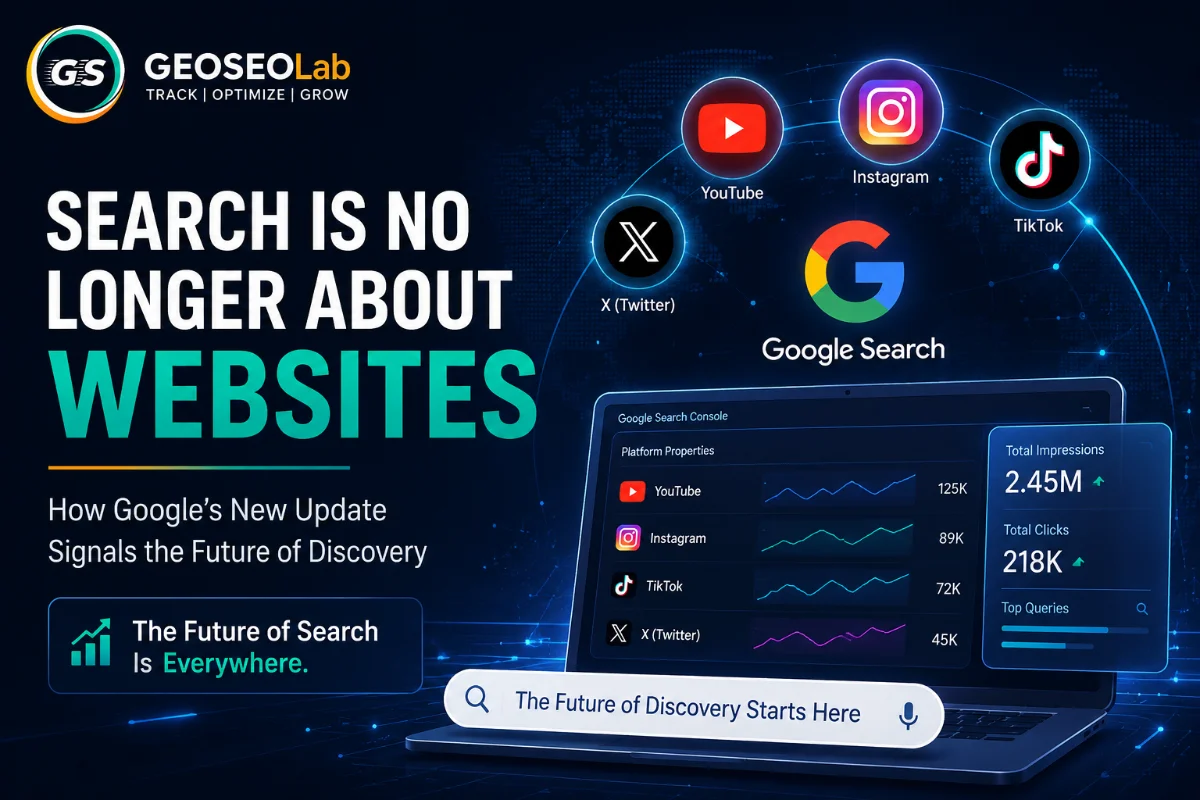
Search Is No Longer About Websites
For years, digital marketing teams have worked with a relatively simple assumption.If your website ranked well on Google, people would find it. If people found it, they would visit it.If they visited it, some of them would become customers.
This relationship shaped almost every SEO strategy built over the past two decades. Agencies focused on keywords, technical optimization, backlinks, and content because websites were the center of the search ecosystem. Everything eventually led back to a domain.But search no longer behaves the way it once did.A customer researching a software platform might first discover a YouTube review through Google Search. Someone comparing healthcare providers may see Instagram content indexed in Search before visiting an official website. Another user may ask ChatGPT for recommendations, verify those recommendations on LinkedIn, watch product demonstrations on YouTube, and only then decide whether the company's website is worth visiting.The website is still important.It simply isn't the only destination anymore.This shift has been happening quietly for several years, but Google's latest Search Console update makes something very clear.Google itself is beginning to treat a brand's entire digital presence as something worth measuring—not just its website.Last week, Google introduced Platform Properties in Google Search Console, allowing creators, publishers, and businesses to measure how their Instagram, TikTok, X, and YouTube content performs inside Google Search and Discover. Until now, Search Console primarily helped website owners understand how webpages performed. With this update, Google is acknowledging that content published outside a traditional website is also becoming part of the search experience.At first glance, it looks like another product enhancement.In reality, it signals something much larger.
It suggests that Google is no longer viewing search visibility through the narrow lens of websites alone.
Instead, search is becoming an ecosystem where multiple content formats, platforms, and entities contribute to how a brand is discovered.That distinction matters because many businesse are still measuring success using a framework that was designed for a different internet.
The Website Is No Longer the Beginning of Every Customer Journey
Think about how people researched a business ten years ago. A customer searched for a topic.Google displayed a list of webpages.The user clicked one of those links.The company had a chance to explain who they were, what they offered, and why they deserved trust.The website acted as the starting point of the relationship.Today, that sequence is becoming far less predictable.Someone searching for "best accounting software for freelancers" might first watch a YouTube comparison that appears in Google Search.Another person searching for a cosmetic clinic may discover Instagram before ever reaching the clinic's official website.Someone researching an AI visibility platform may ask ChatGPT for recommendations, compare answers with Google AI experiences, read discussions on Reddit, browse LinkedIn posts, and finally visit the websites of only two shortlisted companies.The website hasn't disappeared.Instead, it has become one stop within a much broader discovery journey.Customers now build familiarity with brands across multiple digital touchpoints before deciding where to invest their attention.Each touchpoint contributes to trust.Each touchpoint shapes perception.
Each touchpoint influences whether the customer continues exploring—or moves on to a competitor. Businesses that measure only website traffic are increasingly observing only one chapter of a much longer story.
Google's Latest Update Quietly Confirms This Shift
Google rarely introduces features without a strategic reason. Platform Properties in Search Console allow verified Instagram, TikTok, X, and YouTube accounts to appear as measurable properties alongside websites.
Businesses can now understand which Google queries lead users to their social content, identify their best-performing posts in Search, analyze impressions and clicks, and view high-level performance insights from a single interface.
From a technical perspective, this simplifies reporting. From a strategic perspective, it changes how marketers should think about visibility. For years, marketers asked: "How is my website performing in Google Search?" Google's latest update encourages a different question:"How is my brand performing across every searchable surface that Google can index?"
Those questions are fundamentally different. One focuses on a website.The other focuses on digital presence.This distinction becomes even more significant when we consider how AI-powered search experiences are evolving.Google Search is increasingly surfacing videos, discussions, creator content, business profiles, AI-generated summaries, and multiple content formats within a single results page.Search has become far more than a collection of blue links.
If Google is expanding the definition of what can be measured, businesses should probably expand the definition of what they optimize.
The Era of Single-Channel SEO Is Ending
For many years, digital marketing operated through specialized teams.SEO teams optimized websites.
Social media teams managed engagement.Video teams created YouTube content.PR teams focused on media coverage.Brand teams worked on positioning.These functions often operated independently, measured by different KPIs and reported through separate dashboards.Search is making those boundaries increasingly difficult to maintain.
A YouTube video can rank for commercial search queries.An Instagram Reel may appear for branded searches.A Reddit discussion may influence purchasing decisions.A LinkedIn article can establish expertise that later affects AI-generated recommendations.Meanwhile, AI systems increasingly synthesize information from multiple public sources rather than relying exclusively on individual webpages.From the customer's perspective, these are not separate marketing channels.
They are simply different ways of learning about a brand.That is why optimizing channels independently is becoming less effective than optimizing the overall information ecosystem surrounding a business.The strongest brands are no longer those with only the best websites.They are the brands whose expertise remains consistent wherever customers encounter them.
Visibility Is Becoming an Ecosystem, Not a Ranking
Perhaps the most important lesson from Google's latest update is not about Search Console at all.
It is about measurement.Traditional SEO dashboards were built around keywords, rankings, impressions, clicks, and organic sessions.Those metrics remain valuable.But they increasingly describe only website performance.
They do not explain how users discover a brand through creator content.They do not reveal whether YouTube videos are introducing customers to the business.They do not show how indexed Instagram content contributes to branded search demand.They certainly do not explain whether AI systems consistently recognize and recommend the company.
Visibility is becoming larger than any individual channel.It is becoming the combined effect of every trustworthy digital signal a brand creates.And that is precisely why businesses need to rethink what "being visible" actually means.
The Digital Presence Framework: Why Visibility Must Be Measured as an Ecosystem
The most valuable insight from Google's latest Search Console update isn't the feature itself. It's the mindset behind it.
For years, marketers have measured digital success by evaluating individual channels. SEO reports focused on websites. Social media teams reported engagement and followers. Video teams measured watch time. Public relations teams tracked media mentions. Every department had its own dashboard, its own KPIs, and its own definition of success.
The customer never experienced those channels separately. When someone researches a business today, they don't consciously think, "Now I'm doing SEO research" or "Now I'm consuming social media."They're simply trying to answer a question.One answer leads them to another.A Google search introduces them to a YouTube review. That review leads them to a LinkedIn profile. They check customer reviews, ask ChatGPT for a comparison, read Reddit discussions, and finally visit the company's website before making a decision.From the customer's perspective, this is one continuous journey.From the marketer's perspective, it's often measured as five disconnected channels.That's the disconnect businesses need to solve.Instead of asking which channel generated the customer, organizations should start asking a different question:"How consistent is our digital presence wherever customers discover us?"
That question shifts the focus from channel optimization to ecosystem optimization. And in an AI-powered search environment, ecosystem optimization is becoming increasingly important.
AI Doesn't Read Your Website. It Reads Your Reputation.
One of the biggest misconceptions surrounding AI Visibility is the belief that generative AI systems only rely on website content.They don't. Large Language Models build responses by identifying patterns across a wide range of publicly available information. That includes websites, documentation, business profiles, trusted publications, discussion forums, research papers, public datasets, videos, and numerous other sources.
When someone asks, "Which AI visibility platform is best for healthcare businesses?"the AI isn't simply scanning one webpage.It is attempting to understand which companies consistently appear credible across the broader information ecosystem.That means a company's reputation is increasingly becoming a structured digital asset. If your website describes your business as an AI Visibility platform, your LinkedIn page positions you as an SEO agency, your Google Business Profile focuses on web development, and third-party directories describe something else entirely, AI systems receive conflicting signals.Those inconsistencies don't just confuse customers.They can also reduce confidence in how your business is represented.The opposite is equally true.When a company's positioning remains consistent across multiple trusted sources, AI systems have stronger evidence to understand what that organization actually does.
That doesn't guarantee recommendations.But it creates a much stronger foundation for becoming a reliable entity within AI-generated answers.
Why This Matters for GEO?
Generative Engine Optimization has often been reduced to one question:"How do I get ChatGPT to mention my business?"That question is understandable.It's also incomplete.The real objective isn't collecting mentions.
The real objective is becoming a trustworthy entity that AI systems understand accurately.Mentions become a consequence of clarity, authority, consistency, and usefulness.Businesses sometimes look for shortcuts.
They ask whether publishing hundreds of AI-generated articles will improve AI visibility.They ask whether repeating the same keywords will increase citations.They ask which prompt engineering techniques will guarantee recommendations.
Those questions assume AI visibility can be manipulated the same way rankings were sometimes manipulated years ago.
Search history suggests otherwise.Every major search evolution has rewarded organizations that genuinely improve information quality rather than those searching for loopholes.The AI era appears to be following the same direction.
The businesses most likely to succeed are those investing in expertise, original thinking, transparent communication, and consistent digital identities.
From SEO to GEO to Digital Presence Optimization
Perhaps the biggest mistake businesses could make over the next few years is treating every new search trend as a replacement for the previous one.SEO is not disappearing.GEO is not replacing SEO.AI Visibility is not replacing either discipline. Instead, search is becoming layered.SEO continues helping businesses become discoverable through traditional search experiences.GEO focuses on improving how information is interpreted, connected, and represented within generative systems.AI Visibility measures whether that information actually appears when customers ask important questions.Digital Presence Optimization sits above all three.It asks a broader question.
Is every public signal your business creates working together to strengthen trust?
That includes your website.Your Google Business Profile.Your LinkedIn presence.Your YouTube channel.Your research.
Your documentation.Your customer reviews.Your media mentions.Your educational content.Your public expertise.Viewed individually, each signal appears relatively small.Viewed together, they form the digital identity that both search engines and AI systems increasingly rely upon.
GEO SEO Lab's Perspective
The search industry often reacts to every product announcement with predictions about the future.Some claim SEO is ending.Others argue AI will replace websites.Still others insist that traditional search will remain unchanged.
Reality is usually more balanced.Google's latest Search Console update does not signal the end of websites.
It signals the expansion of what Google considers measurable search visibility.That distinction matters.Businesses shouldn't respond by abandoning their websites in favor of social media.Nor should they ignore AI while focusing only on traditional rankings.The smarter strategy is integration.Build a technically sound website.Publish genuinely useful content.
Develop recognizable expertise.Maintain consistent positioning across every digital platform.Strengthen entity signals.Monitor AI visibility alongside organic search performance.Most importantly, remember that customers don't experience your marketing through isolated channels.They experience your brand.The organizations that understand this shift earliest will stop optimizing individual assets and start optimizing their entire digital presence.That is where the next competitive advantage will emerge.
Final Thoughts
Every major change in search begins quietly.The introduction of PageRank looked like a technical improvement before it transformed digital marketing.Mobile-first indexing initially appeared to be another algorithm update before it fundamentally changed website development.AI-powered search is following a similar pattern.The changes happening today are not only about better answers or conversational interfaces.They are redefining what visibility actually means.Google's decision to measure social and creator platforms inside Search Console is one example of that broader transformation.Search is becoming less about destinations and more about digital presence.Businesses that continue measuring only website performance may gradually lose sight of how customers actually discover them.Those that begin measuring their complete digital ecosystem will be better prepared for a future where trust is built across many touchpoints rather than one.
Visibility has never been more valuable.But visibility is no longer confined to a website.It lives wherever customers encounter your brand—and wherever search engines and AI systems learn who you are.
Key Takeaways
Search is evolving from website discovery to ecosystem discovery.Google's latest Search Console update reflects that broader direction.AI systems increasingly evaluate businesses through consistent digital signals rather than isolated webpages.The future belongs to organizations that optimize not just their websites, but their entire digital presence.
SEO remains essential.GEO expands that foundation.AI Visibility measures the outcome.Together, they create a more complete strategy for modern search.
Search Is No Longer About Websites. It’s About Digital Presence.
Why Google’s Latest Search Console Update Reveals a Much Bigger Transformation in How Brands Are Discovered Across Search and AI.
The 20-Year Illusion of the Linear Web
To understand the magnitude of the current shift, we must first look at the history of digital discovery.
The 20-Year Illusion of the Linear Web
To understand the magnitude of the current shift, we must first look at the history of digital discovery.
Twenty years ago, the internet was a directory of destinations. Search engines acted as the ultimate gatekeepers, and websites were the exclusive venues where businesses could tell their stories. If a user wanted to know about "best accounting software for freelancers," they typed the query into a search bar, scanned ten blue links, clicked one, and read the copy. In this environment, the website acted as the absolute starting point of the relationship. The business had a captive audience. They could control the narrative, design the user experience, and guide the visitor down a meticulously crafted conversion funnel. Because the website was the sole point of discovery and conversion, the marketing industry built massive infrastructures to protect and promote it. Search Engine Optimization (SEO) became a multi-billion-dollar discipline entirely focused on domain authority, page speed, keyword density, and meta tags. The metrics of success were equally confined: organic sessions, bounce rates, time on page, and goal completions.
The Fragmentation of Attention
Then, the internet evolved. The rise of social media, the explosion of creator economies, the dominance of video, and the advent of community-driven platforms like Reddit and Quora fundamentally changed human behavior.
Consumers stopped trusting corporate websites as their primary source of truth. They began seeking out peer validation, unfiltered reviews, and visual proof. They wanted to see the product in action on YouTube. They wanted to read the complaints on Reddit. They wanted to see the company culture on Instagram.
Today, that sequence of discovery is entirely unpredictable. The customer journey is no longer a straight line from search engine to website. It is a chaotic, multi-touchpoint web of micro-interactions.
Consider a modern buyer researching an AI visibility platform:
- They ask an AI assistant like ChatGPT for a list of top tools.
- They take that list to YouTube to watch comparison videos from independent tech reviewers.
- They search the brand names on LinkedIn to see if the companies have credible leadership teams.
- They look up the brands on G2 or Trustpilot to read customer grievances.
- Finally, they visit the websites of the two shortlisted companies to check pricing and book a demo.
In this scenario, the website didn't generate the demand. It merely captured a decision that was made across four other platforms. Businesses that measure only website traffic are increasingly observing only the final chapter of a much longer, more complex story. They are suffering from severe attribution blindness.
The Catalyst — Google’s Search Console Paradigm Shift
Google rarely introduces product updates without a profound strategic motive. For years, Google Search Console (GSC) was strictly a tool for webmasters. It helped website owners understand how their HTML pages performed in Google Search. It was the ultimate dashboard for the "destination" era.
But last week, Google introduced Platform Properties in Google Search Console.
This update allows verified creators, publishers, and businesses to measure how their Instagram, TikTok, X (formerly Twitter), and YouTube content performs directly inside Google Search and Google Discover.
Until this moment, if a brand's YouTube video ranked on the first page of Google, the traffic and engagement data lived in YouTube Analytics, while the website's performance lived in GSC. The two were siloed. With this update, Google is allowing these third-party social and video accounts to appear as measurable properties alongside traditional websites within the Search Console interface.
Businesses can now understand:
- Which Google search queries lead users to their social content.
- Which specific social posts are generating the most impressions in Search.
- High-level performance insights of their off-site content from a single, unified dashboard.
The Technical Reality vs. The Strategic Implication
From a purely technical perspective, this simplifies reporting. But from a strategic perspective, it represents a philosophical earthquake in how digital visibility is defined.
For twenty years, marketers asked one fundamental question: "How is my website performing in Google Search?"
Google’s latest update forces us to ask a vastly different question: "How is my brand performing across every searchable surface that Google can index?" Why did Google make this change? The answer lies in user behavior. Google has recognized that for younger demographics (particularly Gen Z), platforms like TikTok and Instagram have replaced traditional search engines for initial discovery. Furthermore, users increasingly rely on YouTube for complex, visual problem-solving. By integrating these platforms into Search Console, Google is acknowledging a hard truth: they no longer own the entirety of the web's valuable content. To keep users searching on Google, Google must index, surface, and measure the content that lives on competing platforms. This distinction is critical. Google is expanding the definition of what constitutes a "search result." It is no longer just a webpage. It is a video, a social post, a discussion thread, an AI-generated summary, and a business profile. If the world's largest search engine is expanding its definition of what can be measured, businesses must urgently expand their definition of what they optimize.
The Fall of the Siloed Marketing Department
One of the most significant casualties of this new ecosystem is the traditional, siloed marketing department.
For years, digital marketing operated through highly specialized, isolated teams.
- The SEO Team optimized the website, tracked keyword rankings, and built backlinks.
- The Social Media Team managed Instagram and TikTok, focusing on followers, likes, and engagement rates.
- The Video Team produced YouTube content, measured by watch time and subscriber growth.
- The PR Team focused on media coverage and domain authority.
- The Brand Team worked on overarching positioning and messaging.
Video win? When an Instagram Reel appears in Google Discover and drives a massive spike in branded search traffic the next day, who gets the credit? When a Reddit discussion heavily influences an AI-generated recommendation, which department is responsible for managing that narrative?
The Customer Doesn't See Channels
From the customer's perspective, these are not separate marketing channels. They do not think, "I am now engaging with this brand's social media strategy," followed by, "Now I am interacting with their SEO strategy."They are simply trying to solve a problem. They are moving fluidly across platforms, gathering signals, and building a composite image of a brand in their mind.A fragmented internal team creates a fragmented external brand. If the SEO team is writing highly technical, corporate blog posts, but the social team is posting casual, meme-heavy content, and the PR team is positioning the founder as a luxury lifestyle guru, the market receives conflicting signals.In the traditional web, this inconsistency was somewhat forgivable because the user experienced these channels at different times. In the modern Discovery Economy—where AI systems synthesize all this data in seconds, and users cross-reference platforms instantly—inconsistency destroys trust.The strongest brands of the next decade will not be those with just the best websites or the most viral TikToks. They will be the brands whose expertise, voice, and value proposition remain perfectly consistent wherever a customer happens to encounter them. Optimizing channels independently is becoming vastly inferior to optimizing the overall information ecosystem surrounding a business
AI Doesn't Read Your Website. It Reads Your Reputation.
To truly understand why digital presence has eclipsed the website, we must look at the mechanics of Artificial Intelligence.
One of the most dangerous misconceptions surrounding AI Visibility and Generative Engine Optimization (GEO) is the belief that generative AI systems only rely on website content to form answers.They do not.Large Language Models (LLMs) and AI search experiences (like Google's AI Overviews, Perplexity, and ChatGPT) build responses by identifying patterns, consensus, and authority across a massive, diverse range of publicly available information. This training data includes websites, yes, but it also includes:
- Business profiles and directories (Crunchbase, LinkedIn, G2)
- Trusted journalistic publications
- Discussion forums (Reddit, Quora, Stack Overflow)
- Academic research papers and public datasets
- Video transcripts (YouTube)
- Podcast show notes
- Social media discourse
When a user asks an AI, "Which AI visibility platform is best for healthcare businesses?", the AI is not simply scanning the "About Us" pages of ten different software companies. It is attempting to understand which companies consistently appear credible, authoritative, and relevant across the broader information ecosystem.
The Mechanics of Entity Resolution
This brings us to a critical concept in modern search: Entity Resolution.
Search engines and AI models no longer look at the web as a collection of keywords on pages. They look at the web as a "Knowledge Graph"—a massive network of interconnected entities (people, places, brands, concepts) and the relationships between them.
Your business is an entity. Your CEO is an entity. Your product is an entity.
AI systems determine the authority of your entity by looking for consensus across multiple, independent sources. This is where your digital presence becomes your most valuable asset.
Imagine a scenario where a company's digital signals are misaligned:
- Their website describes them as an "Enterprise AI Visibility Platform."
- Their LinkedIn company page categorizes them as a "Digital Marketing Agency."
- Their Crunchbase profile lists them under "Web Development."
- Third-party directories describe them as "SEO Consultants."
When an AI system attempts to resolve this entity, it encounters conflicting data. In the world of machine learning, conflicting data lowers the "confidence score." If the AI lacks confidence in what your business actually does, it will not recommend you to a user asking a specific, high-stakes question. It will default to a competitor whose digital signals are perfectly aligned.Conversely, when a company's positioning, terminology, and expertise remain consistent across their website, their executive profiles, their podcast appearances, and their third-party reviews, the AI's confidence score skyrockets. The system clearly understands the entity.This means a company's reputation is no longer just a PR concept; it is a structured, machine-readable digital asset. AI doesn't just read what you say about yourself on your homepage. It reads what the rest of the internet says about you, and it looks for alignment.
Generative Engine Optimization (GEO) vs. Traditional SEO
As this ecosystem evolves, a new discipline has emerged: Generative Engine Optimization (GEO). However, the industry's understanding of GEO is currently plagued by short-term thinking.Generative Engine Optimization has often been reduced to a single, tactical question: "How do I get ChatGPT to mention my business?"That question is understandable, but it is fundamentally incomplete. It treats AI like a traditional search engine that can be gamed with the right keywords or prompt engineering hacks. The real objective of GEO isn't collecting superficial mentions. The real objective is becoming a trustworthy, undeniable entity that AI systems understand accurately and cite naturally.Mentions are simply a byproduct of clarity, authority, consistency, and usefulness.
The Fallacy of AI Shortcuts
Businesses are already looking for GEO shortcuts. They ask whether publishing thousands of AI-generated blog posts will improve their AI visibility. They ask whether repeating specific keyword clusters will force AI citations. They ask for secret prompt templates to manipulate LLM outputs.These questions assume that AI visibility can be manipulated the same way search rankings were manipulated in 2012. But search history suggests otherwise. Every major algorithmic evolution—from Panda to Penguin to the Helpful Content Update—has systematically punished those searching for loopholes and rewarded those who genuinely improve information quality.The AI era is following the exact same trajectory. LLMs are specifically designed to filter out spam, identify original thought, and prioritize consensus from authoritative sources.
The Three Pillars of GEO
To succeed in Generative Engine Optimization, businesses must shift their focus from manipulating algorithms to feeding the Knowledge Graph. This requires three core pillars:
- Information Consensus: AI models look for facts that are corroborated by multiple sources. If you claim to be the "fastest software in the industry" on your website, but no independent review site or tech publication corroborates that claim, the AI will view it as marketing fluff, not fact. GEO requires generating third-party validation (PR, guest posts, interviews, reviews) that aligns with your core messaging.
- Entity Clarity: Using structured data (Schema markup) on your website to explicitly tell search engines who you are, what you do, and who your leadership team is. This must perfectly match your off-site profiles.
- Original Contribution: AI models are trained on existing data. If your website only summarizes what others have already said, the AI has no reason to cite you. It will simply cite the original source. To be cited by AI, you must produce original research, proprietary data, unique frameworks, and contrarian expert analysis that expands the AI's knowledge base.
From SEO to GEO to Digital Presence Optimization (DPO)
Perhaps the biggest mistake businesses could make over the next five years is treating every new search trend as a replacement for the previous one. The industry loves a narrative of destruction: "SEO is dead," "Social is the new search," "AI will replace websites."
Reality is much more nuanced. Search is not being replaced; it is becoming layered.
- Traditional SEO continues to help businesses become discoverable through structured, intent-driven search experiences. It ensures the technical foundation of your owned properties is flawless.
- Generative Engine Optimization (GEO) focuses on improving how your information is interpreted, connected, and represented within generative AI systems and Knowledge Graphs.
- AI Visibility is the measurement layer. It tracks whether your entity actually appears and is accurately represented when customers ask AI systems important commercial questions.
But all three of these disciplines sit beneath a much larger, more comprehensive strategy: Digital Presence Optimization (DPO).
The Digital Presence Optimization Framework
Digital Presence Optimization sits at the top of the hierarchy. It asks the ultimate, overarching question: Is every public signal your business creates working in harmony to strengthen market trust?
DPO recognizes that visibility is no longer a ranking. It is the combined, compounding effect of every trustworthy digital signal a brand creates. It encompasses:
- Your website architecture and content.
- Your Google Business Profile and local maps presence.
- Your LinkedIn company page and the personal profiles of your executives.
- Your YouTube channel and podcast appearances.
- Your proprietary research and whitepapers.
- Your technical documentation and open-source contributions.
- Your customer reviews on G2, Trustpilot, and industry directories.
- Your media mentions and PR coverage.
- Your community engagement on Reddit and niche forums.
Viewed individually, each of these signals might appear relatively small. A single podcast interview doesn't drive massive traffic. A well-written LinkedIn post doesn't immediately result in a sale. But viewed together, they form an impenetrable digital identity.When a customer (or an AI) interacts with this ecosystem, they don't see isolated marketing efforts. They see a dominant, authoritative, and trustworthy industry leader.The DPO Audit: Where to Start To transition to a Digital Presence Optimization model, organizations must first conduct a brutal, honest audit of their current ecosystem.
- The Consistency Check: Search for your brand across five different platforms. Is your value proposition identical on your website, your LinkedIn, your Crunchbase, and your YouTube about page? If there is variance, you are confusing both humans and algorithms.
- The Sentiment Analysis: What is the unfiltered consensus about your brand on platforms you do not control? Search your brand name on Reddit. Read your 3-star reviews. AI systems weigh negative sentiment on independent platforms heavily.
- The Expertise Gap: Are your founders and subject matter experts visible? In the AI era, people buy from people. Anonymity is a liability. Ensure your experts are publishing, speaking, and engaging on external platforms.
- The Citation Audit: When an AI is asked about your core industry problem, does it cite your original research? If not, you need to invest in creating proprietary data that the market cannot ignore.
Rethinking Measurement — The Ecosystem Attribution Model
One of the most significant barriers to adopting Digital Presence Optimization is the legacy measurement infrastructure. Traditional SEO dashboards were built around keywords, rankings, impressions, clicks, and organic sessions.
As we established earlier, those metrics increasingly describe only website performance. They are entirely blind to the broader discovery journey.
They do not explain how users discover a brand through a TikTok video indexed in Google Discover. They do not reveal whether a YouTube tutorial is the primary driver of branded search demand. They certainly do not explain whether AI systems consistently recognize and recommend the company in zero-click environments.
If a customer discovers you via an AI summary, validates you on LinkedIn, and converts on your website three weeks later, traditional last-click attribution gives 100% of the credit to "Direct Traffic." The AI and LinkedIn get zero credit. This leads executives to underfund the very channels that are actually building market demand.
Measuring the Unmeasurable
To survive the transition to the Discovery Economy, businesses must adopt an Ecosystem Attribution Model. This requires tracking proxy metrics that indicate overall brand health and digital presence strength, rather than just direct website conversions. Key metrics in the DPO era include:
- Branded Search Volume: An increase in people searching for your specific brand name on Google is the ultimate proof that your off-site digital presence (social, PR, AI, video) is working.
- Share of Model: A new metric for the AI era. Regularly prompt industry-relevant questions into ChatGPT, Gemini, and Perplexity. Track how often your brand is mentioned, recommended, or cited compared to competitors.
- Entity Consistency Score: An internal audit metric tracking the alignment of your brand messaging across top-tier directories, social profiles, and owned assets.
- Dark Social Referrals: Using "How did you hear about us?" (HDYHAU) surveys at the point of checkout or demo booking to capture the untrackable journeys from podcasts, private Slack groups, and AI assistants.
- Cross-Platform Engagement: Utilizing tools like Google's new Platform Properties in Search Console to measure how off-site content contributes to overall search visibility.
Visibility is becoming larger than any individual channel. It is the gravity your brand exerts across the entire internet.
The Psychology of Zero-Click Searches and Micro-Validations
To fully grasp why the website is no longer the sole destination, we must understand the psychology of the modern user. We are living in the era of the "Zero-Click Search" and the "Micro-Validation."A zero-click search occurs when a user's query is answered directly on the search engine results page (SERP) via an AI Overview, a featured snippet, or a knowledge panel, requiring no visit to a website. Marketers have historically panicked over zero-click searches, viewing them as lost traffic.But this is a fundamental misunderstanding of user intent. Not every search is a transactional quest for a website. Many searches are simply micro-validations.When a user searches "[Brand Name] pricing" or "[Brand Name] reviews" or "[Founder Name] background," they are not necessarily looking to read a blog post. They are looking for a quick data point to validate a decision they are already making.If your digital presence is optimized, you will win these micro-validations without needing the user to click through to your site
- The AI Overview will accurately summarize your pricing model.
- The Knowledge Panel will display your founder's impressive credentials.
- The indexed Reddit thread will show authentic user praise.
The user gets their answer, their confidence in your brand increases, and they move closer to a purchase. You didn't get the website click, but you won the psychological battle. In the Discovery Economy, winning the micro-validation is often more important than capturing the initial click.
GEO SEO Lab’s Perspective
The search and digital marketing industry has a habit of reacting to every product announcement with apocalyptic predictions.
- When social media rose, they said SEO was dead.
- When voice search emerged, they said screens were obsolete.
- Now, with the rise of generative AI, they claim the website is finished.
At GEO SEO Lab, our perspective is grounded in reality, not hype.
Google's latest Search Console update does not signal the end of websites. The website remains the most critical piece of owned real estate a business has. It is where transactions happen, where deep-dive resources live, and where you have absolute control over the user experience.
What the update does signal is the expansion of what Google considers measurable search visibility. It is an admission that discovery happens everywhere.
Businesses shouldn't respond to this by abandoning their websites in favor of a TikTok-only strategy. Nor should they ignore AI while obsessing over traditional blue-link rankings. The winning strategy is integration.
- Build a technically flawless website that serves as the ultimate source of truth for your entity.
- Publish genuinely useful, original content that cannot be easily replicated by an AI summarizer.
- Develop recognizable, human expertise by putting your founders and subject matter experts in front of cameras and microphones.
- Maintain absolute consistency in your positioning across every digital platform, directory, and social profile.
- Strengthen your entity signals through structured data and third-party PR.
- Monitor your AI visibility and overall digital presence with the same rigor you apply to organic search performance.
Most importantly, remember that customers do not experience your marketing through isolated channels. They experience your brand as a singular entity. The organizations that understand this shift earliest will stop optimizing individual assets in silos and start optimizing their entire digital presence. That is where the next massive competitive advantage will emerge.
Final Thoughts: The Compounding Nature of Trust
Every major change in the history of search begins quietly, disguised as a minor technical update.
The introduction of PageRank looked like a simple academic algorithm before it created a trillion-dollar advertising industry. Mobile-first indexing initially appeared to be just another webmaster guideline before it fundamentally changed how the entire internet was designed.
AI-powered search and the integration of social platforms into search analytics are following the exact same pattern. The changes happening today are not merely about providing better answers or building conversational interfaces. They are fundamentally redefining what visibility actually means.
Search is becoming less about driving traffic to destinations and more about establishing a dominant, trustworthy digital presence.
Businesses that continue measuring only website performance will gradually lose sight of how modern customers actually discover, evaluate, and trust them. They will wonder why their traffic is flat while their competitors—who seem to be everywhere, on every platform, in every AI summary—capture all the market share.
Those who begin measuring and optimizing their complete digital ecosystem will be uniquely prepared for a future where trust is built across dozens of touchpoints rather than just one.
Visibility has never been more valuable. But visibility is no longer confined to a domain name. It lives wherever customers encounter your brand, and wherever search engines and AI systems learn who you are. The website is no longer the sun. It is a vital planet in a much larger, infinitely more complex solar system. It is time to map the entire galaxy.
Key Takeaways
- The Paradigm Shift: Search is evolving from website-centric discovery to holistic ecosystem discovery. The website is no longer the starting point of the customer journey; it is a validation point.
- The Google Signal: Google's latest Search Console update (Platform Properties) reflects a major strategic direction. Google is acknowledging that social, video, and third-party content are intrinsic parts of the search experience.
- The AI Reality: AI systems do not just read your website; they evaluate your entire digital reputation. They rely on entity resolution and cross-platform consensus to determine brand authority and accuracy.
- The End of Silos: The era of single-channel marketing is ending. SEO, PR, Social, and Video must converge into a unified Digital Presence Optimization (DPO) strategy to ensure consistent brand messaging.
- The Future Framework: SEO remains the essential foundation. GEO expands that foundation into AI systems. AI Visibility measures the outcome. Together, they create a comprehensive strategy for dominating modern search
Tags
Frequently Asked Questions
Find answers to common questions about this topic
About the Author

Aman Kesharwani
SEO Expert & Content Creator
Experienced digital marketing professional specializing in SEO strategies, content optimization, and data-driven marketing solutions. Passionate about helping businesses grow their online presence and achieve better search rankings.
Related Articles
View all posts
Google's AI Content Guidance: What Website Owners Need to Change Right Now
Google's AI Content Guidance: What Website Owners Need to Change Right NowPublication: GEO SEO LabCategory: SEO Strategy / Content Governance / Google...
Google Can Crawl Your Page: So Why Isn't It Getting Indexed?
Google Can Crawl Your Page: So Why Isn't It Getting Indexed?Imagine pouring weeks of painstaking effort into a comprehensive, deeply researched articl...
Your Brand Can Rank #1 and Still Lose the AI Search
Your Brand Can Rank #1 and Still Lose the AI SearchGoogle AI Overviews Are Changing Brand Search, and What It Means for SEOEditorial DisclosureThis ar...