PR Is Becoming Part of GEO: Why Earned Media May Matter More in AI Search
PR Is Becoming Part of GEO: Why Earned Media May Matter More in AI SearchWhy the Brands That Win in AI Discovery Will Be the Ones the Entire Web Vouch...
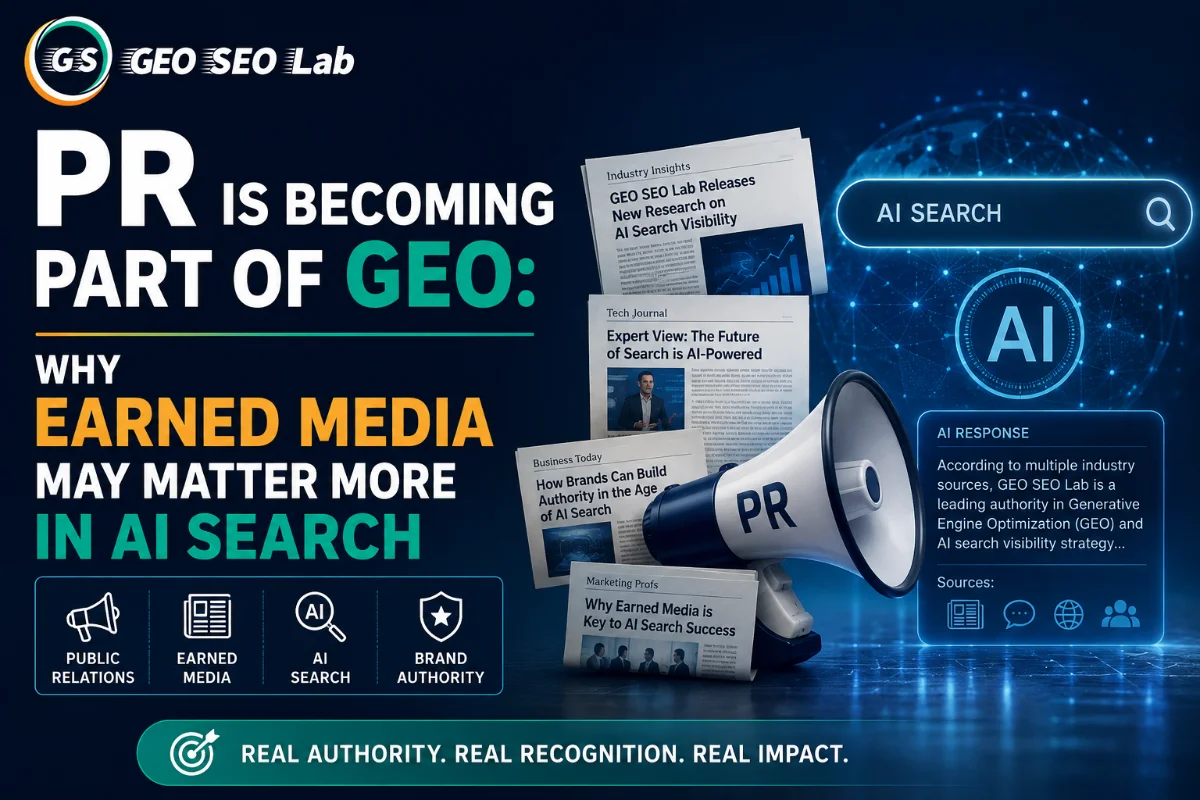
PR Is Becoming Part of GEO: Why Earned Media May Matter More in AI Search
Why the Brands That Win in AI Discovery Will Be the Ones the Entire Web Vouches For
This simple idea is becoming increasingly important as search changes. For many years, businesses focused heavily on their websites, search rankings, backlinks, social media accounts and content strategies. The basic goal was straightforward. A company wanted to appear when people searched for products, services, information or solutions.AI powered search is changing that environment.When someone asks ChatGPT, Google AI Search, Gemini or Perplexity about a company, an industry or a particular product, the answer may not come only from the company website. AI systems can encounter information from many different parts of the internet. They may find news coverage, industry publications, expert interviews, research papers, professional profiles, community discussions, reviews and other independent sources.This creates an important difference between being visible online and being understood online.
A company can publish hundreds of pages explaining who it is, what it does and why it believes it is an expert. That information is useful. It provides the foundation for understanding the company. But it remains information published by the company itself.When independent journalists, researchers, industry experts, customers and professional organizations discuss the same company, a different kind of information begins to exist.That external information can provide context and corroboration.This is where public relations becomes increasingly connected with Generative Engine Optimization, commonly called GEO. PR is no longer only about getting newspaper coverage, building brand awareness or generating backlinks. In an AI search environment, earned media can also contribute to the broader information ecosystem surrounding a brand.This does not mean that one media placement guarantees an AI citation. It does not mean that a company can simply purchase coverage and expect AI systems to rank it higher. It also does not mean that traditional SEO has become irrelevant.The real opportunity is more fundamental.Organizations that build genuine expertise, publish useful original knowledge and earn recognition from independent sources can create a stronger information ecosystem around their brand. That ecosystem can support visibility across traditional search, AI search and broader digital discovery.
Introduction: The Credibility Gap Changing Digital Marketing
Imagine that you have moved to a new city and need to find a financial advisor.
You ask one person for a recommendation. They hand you a brochure from a financial advisory company. The brochure says that the company is highly trusted, has experienced professionals and provides excellent results.
Then you ask another person.They tell you that they heard positive things about a particular financial advisory firm. They mention that someone they know used the company and had a good experience. They also tell you that the company published research about financial trends and that the founder recently spoke at a respected regional conference.
The second recommendation naturally feels stronger.Why?The difference is independent confirmation.
The first company is describing itself. The second recommendation contains information coming from outside the company.
People understand this distinction naturally. We know that a business has an interest in presenting itself positively. We also understand that an independent publication, expert or customer has a different relationship with the information.AI systems operate in a much larger information environment.When someone asks an AI system which companies are leaders in a specific field, the system may encounter information from the company's own website as well as information published elsewhere.The broader internet can contain articles about the organization, research connected with the organization, expert interviews, reviews, conference appearances, professional profiles and discussions.This creates what we can call a credibility gap.A company can say almost anything about itself on its website. The harder question is whether the wider internet contains evidence that supports the same understanding.Your website can explain who you are.The rest of the internet can help establish whether other people recognize you for the same expertise.That distinction is becoming increasingly important for AI discovery.
How AI Systems Build an Understanding of a Brand
AI Does Not Only Read the Company Website
A common mistake in digital strategy is to imagine that AI systems understand a company by reading its homepage and About page.The reality is more complex.AI powered search environments can interact with information from many sources. Depending on the system, query and retrieval process, these sources can include websites, news publications, research documents, industry pages, reviews, professional profiles, community discussions and other publicly available information.
This means a brand exists in an information ecosystem.The company website is one part of that ecosystem.
The company's social profiles are another part.Independent articles create another layer.Research citations create another layer.Expert commentary adds another layer.Customer discussions and reviews add another layer.When these sources consistently describe an organization in similar and accurate ways, the resulting information environment becomes richer.
For example, imagine a company describes itself as a specialist in AI search visibility.Its website contains detailed articles about GEO.Its founders publish research about AI discovery.Industry publications discuss the company's research.Conference organizers list its experts as speakers.Other professionals reference its frameworks.
Independent articles describe the organization using similar terminology.Over time, the internet contains multiple independent signals connecting that organization with AI search visibility.This is very different from a situation where the company has only its own website making those claims.
The Information Ecosystem Around Your Brand
Every organization has an information ecosystem, whether it actively manages one or not.Some companies have a very small ecosystem. Most information about them exists on their own website and social accounts.Other companies have a much larger ecosystem.Their names appear in industry publications. Their research is cited. Their executives are interviewed. Their experts participate in conferences. Customers discuss their products. Analysts mention their work. Professional communities recognize their contributions.The second type of organization has a much richer external information environment.This does not automatically mean that AI systems will always mention that company.
AI visibility is not deterministic.Different systems can produce different answers. The same system can sometimes produce different results for similar queries. Search activation, crawling, retrieval, reranking, citation and other processes can affect what information appears in an answer.The important point is that a richer information ecosystem creates more opportunities for accurate recognition.
Why Independent Information Matters
First party information is important because the organization is responsible for explaining its own identity.
A website should clearly explain what a company does, who it serves, what expertise it has and what evidence supports its claims.But first party information has an obvious limitation.The organization controls it.Third party information has a different value because it comes from outside the organization.A journalist may describe the company.A researcher may cite its work.An industry publication may discuss its findings.An expert may reference its framework.A conference may identify its founder as a specialist.A customer may describe an experience.Each independent source contributes another piece to the broader picture.This is why earned media can become relevant to GEO.What Current GEO Research Actually Tells Us
Avoiding Overconfident Claims
The field of Generative Engine Optimization is still developing.This is important because there is a temptation to make simple promises.A company might claim that getting featured in a particular publication will guarantee AI citations. Another company might claim that a certain number of media mentions will automatically increase visibility in ChatGPT.
Those claims go beyond what current evidence can safely establish.Research into generative search describes a complex process involving several stages. Different AI systems can behave differently, and even the same system can produce different results depending on the query and retrieval environment.This means that a specific PR placement cannot reliably be treated as the direct cause of a specific AI citation.There is a more defensible way to understand the relationship.
Earned media can strengthen the external information ecosystem surrounding a brand. A stronger ecosystem can create better conditions for accurate AI representation and discovery.That is an ecosystem level strategy rather than a placement level strategy.
PR Is Not a Citation Machine
This distinction matters.If a company publishes original research and receives coverage from several relevant publications, it should not immediately conclude that every AI citation came from those articles.There may be many other factors involved.AI systems may retrieve the company's original research. They may find an industry article. They may use information from another source. They may combine information from several sources. They may not cite the company at all.The value of PR is therefore broader than citation generation.Good PR can help create recognition.It can help establish context.It can help distribute original knowledge.It can help connect a company with a topic.It can help create independentreferences to the organization.Those outcomes can contribute to a healthier digital authority ecosystem.
The Difference Between Owned Media and Earned Media
Owned Media
Owned media includes information that an organization controls.The company website is the most obvious example.A blog is another example.A company research page, product page, author profile or official social account can also be considered part of the owned information environment.Owned content is essential.Without it, external recognition can become difficult to understand.If journalists mention a company but the company has no strong primary source explaining its expertise, the external information may have less context.A strong website therefore remains the foundation.
Earned Media
Earned media is information created independently by outside sources.A newspaper article can be earned media.
An industry publication discussing company research can be earned media.An interview with an executive can create earned media.A podcast episode can become another external source.A research paper referencing a company's findings can create another independent connection.The value of these sources comes partly from the fact that the organization does not fully control the narrative.That makes independent recognition different from self promotion.
Why Both Need to Work Together
The best strategy is not owned media versus earned media.It is owned media plus earned media.Your website should provide a clear primary source.Your external presence should provide independent confirmation and additional context.When these two layers align, the overall information environment becomes stronger.If the website says one thing and external sources consistently say something completely different, confusion can appear.If the website describes the organization accurately and external sources independently reinforce the same understanding, the brand identity becomes more coherent.That coherence matters for humans and can also create better conditions for machine interpretation.
The Growing Intersection of PR and GEO
A New Role for Public Relations
Public relations has traditionally focused on reputation, media relationships, brand awareness and communication.
GEO introduces another dimension.Organizations now need to consider how they are represented across the broader information environment that AI systems can encounter.This does not require PR professionals to become SEO specialists.
It does require them to understand that coverage quality matters in a new way.A mention alone is not necessarily valuable.
The context surrounding the mention matters.The accuracy of the description matters.The relevance of the publication matters.The connection between the organization and the topic matters.
Why PR Agencies Are Paying Attention
The communications industry has already started responding to the rise of AI discovery.Established PR organizations are developing services around AI visibility, generative search and earned media authority.This does not prove that PR automatically increases AI rankings.It does show that communications professionals increasingly recognize that AI systems have created a new brand visibility environment.The strategic logic is relatively straightforward.If AI systems encounter information from across the web, then organizations need to consider how they are represented across that wider ecosystem.PR has always helped organizations build external recognition.GEO makes that external recognition strategically relevant to another discovery channel.
Why Traditional PR Metrics Are Not Enough
Reach Does Not Tell the Whole Story
Traditional PR often measures reach.A publication with millions of readers can look extremely valuable.But for GEO, raw reach does not tell the entire story.Imagine that a technology company receives a mention in a massive entertainment publication. The article barely explains what the company does and places the company in an unrelated context.
Now imagine the same company receives a detailed article in a respected technology publication with a smaller audience.
The second article explains the company's expertise, discusses its research and connects the organization with the exact topic where it wants to build authority.The second piece may create stronger GEO value.This is because topical context matters.
Contextual Richness Matters
A simple mention provides limited information.Consider a sentence such as:According to GEO SEO Lab, AI search is changing digital discovery.This identifies the organization but provides very little information.Now consider a richer description.GEO SEO Lab is a company specializing in Generative Engine Optimization and AI search visibility strategy. Its research examines how businesses are represented in AI generated responses and how information from independent sources can influence the broader visibility ecosystem.The second description creates more context.It explains the organization.It identifies the category.It connects the company with a specific area of expertise.It provides information about its research activity.This is contextual richness.
Relevance Is More Important Than Size
For GEO focused PR, a publication should be evaluated according to relevance as well as audience.A small publication that consistently covers your industry can be more useful than a large publication that rarely discusses your area.This does not mean that large publications have no value.Large publications can create significant awareness and reputation benefits.The point is that publication size should not be the only quality filter.A technology company should care about being represented accurately in technology and business contexts.A healthcare organization should care about credible health and medical contexts.A financial organization should care about finance and business environments.A company should build associations that match its actual expertise.
Accuracy Is Becoming a Strategic Requirement
Incorrect Coverage Can Create Confusion
Imagine that a cybersecurity company is described by an external publication as a marketing technology company.
Even if the article is positive, the description is inaccurate.Now imagine that several other publications use different descriptions for the same organization.The information environment becomes inconsistent.This can make the organization harder to understand.For GEO, entity accuracy therefore matters.Companies should monitor how their names, categories, expertise and research are described externally.This is not about controlling journalism.It is about identifying significant factual errors and requesting corrections when appropriate.
Consistency Across the Web
The company website should use consistent naming.Professional profiles should use accurate descriptions.
Research papers should clearly identify authors and organizations.Conference pages should describe experts correctly.
PR materials should provide journalists with useful background information.These actions create a more coherent information ecosystem.The objective is not to force every source to use exactly the same sentence.The objective is to make sure that the underlying facts remain consistent.
Original Research Can Become the Engine of GEO Oriented PR
Why Original Knowledge Matters
One of the strongest ways to create valuable PR opportunities is to produce something genuinely useful.
This is where original research becomes powerful.A company can issue a press release announcing a new product.That announcement may receive some coverage.But the resulting articles may simply say that the company launched something.Now imagine that the same organization conducts original research into an important industry question.
The organization publishes the findings.Journalists discover an unexpected result.Industry experts discuss the findings.Other organizations reference the research.New articles appear.The company's name becomes associated with the topic because the organization created information that others found useful.
This is a fundamentally different PR model.
Research Gives Journalists Something to Talk About
Journalists need stories.They need facts.They need new information.They need evidence that something interesting is happening.Original research can provide all of these.If the research is genuinely useful, journalists do not need to write an advertisement for the company.They can write a story about the finding.The organization becomes part of that story naturally.That makes the resulting coverage more authentic and potentially more valuable.
The Research to Authority Pathway
Original research can create a chain of recognition.The organization publishes the research.A journalist discovers an interesting finding.The journalist writes about the finding and identifies the organization.Another expert responds to the findings.A different publication references the research.Another researcher uses the data.A conference speaker discusses the trend.Over time, the organization becomes increasingly connected with the subject.This process does not happen instantly.It also cannot be guaranteed.But when genuine knowledge creates genuine interest, external recognition can compound.
How to Design Research for Stronger Authority
Originality Matters
Research should ideally reveal something useful that was not already obvious.If a study simply confirms what everyone already knows, journalists may have little reason to cover it.Unexpected findings are more interesting.Counterintuitive results are more interesting.New measurements are more interesting.Specific industry insights are more useful than generic statements.For example, saying that AI is changing search is broad.Research showing how businesses in a specific market are represented in AI search results is much more concrete.
Specific findings are easier to discuss, cite and remember.
Methodology Builds Trust
Research becomes more credible when readers can understand how the findings were produced.A strong research page should explain the data source, methodology, sample size, research period and limitations.This helps journalists evaluate the work.It helps experts understand the findings.It helps other researchers decide whether they can reference the work.It also creates a stronger primary source for the organization's claims.
Named Frameworks Create Recognition
Organizations can also create recognizable intellectual assets.A company might develop an annual visibility index.
It might create a scoring frameworkIt might develop a proprietary methodology.It might publish a recurring benchmark.
When the same concept appears repeatedly with the organization's name attached to it, the organization can become associated with that concept.This creates a recognition anchor.The key is that the framework must provide genuine value.
Naming an ordinary marketing idea does not automatically create authority.The underlying concept needs to be useful.
Recurring Research Can Compound
A single research report can generate attention.Recurring research can create continuity.An annual study gives the organization an opportunity to compare current results with previous results.Journalists can reference earlier editions.
Industry professionals can follow changes over time.The organization becomes a recurring source of information.This creates a deeper relationship between the brand and the subject.
What High Value GEO Coverage Looks Like
A Simple Mention
A basic mention might say that a company believes AI search is becoming important.This is not useless.But it does little to explain the organization's expertise.It creates a weak external signal.
A Context Rich Description
A stronger article might explain what the organization does, what research it conducts, what topic it specializes in and why its findings matter.This provides much more information.It gives readers context.It gives AI systems more useful information to encounter.It also creates a clearer connection between the organization and the topic.This is why PR teams should care about context.
The Right Publication in the Right Topic
The ideal coverage appears in an environment where the organization naturally belongs.For example, a cybersecurity company benefits from credible cybersecurity coverage.A healthcare company benefits from credible healthcare coverage.
A financial technology company benefits from relevant finance and technology coverage.This creates topical alignment.
Topical alignment is important because authority is not simply a measure of how famous a company is.A company can be famous and still lack authority in a particular topic.The objective is to become recognized for the subjects that matter to the business.
Building a GEO and PR Strategy
Think About the Ecosystem
The biggest strategic shift is to stop thinking only about individual placements.One article is not the strategy.One interview is not the strategy.One backlink is not the strategy.The real objective is to build an external information ecosystem.That ecosystem should become richer over time.It should contain accurate descriptions.It should contain relevant coverage.
It should contain original research.It should contain expert commentary.It should contain independent references.It should reflect the organization's real expertise.
Start With Knowledge Creation
Before starting a PR campaign, ask a simple question.What do we know that is worth sharing?This question is more valuable than asking how many press releases can be created.A company should identify areas where it has genuine knowledge.That knowledge might come from customer data.It might come from original research.It might come from industry experience.It might come from proprietary analysis.It might come from years of working with a specific category.The goal is to transform that knowledge into useful public information.
Build the Primary Source
Once the research is ready, publish a strong primary source on the company website.The research page should explain the findings clearly.It should identify the authors.It should explain the methodology.It should provide the publication date.
It should include relevant data and supporting information.The primary source becomes the central reference point.
Journalists can use it.Researchers can review it.Readers can understand it.AI systems can encounter it.External coverage can point toward it.
Conduct Strategic Outreach
PR outreach should be selective.Sending the same message to hundreds of journalists is usually less effective than identifying a smaller number of journalists who actually cover the subject.The pitch should lead with the insight.It should explain why the finding matters.It should provide evidence.The company should be introduced naturally.Journalists generally do not want advertisements.They want stories.This distinction can dramatically improve the quality of outreach.
Community Participation and Expert Recognition
Professional Communities Matter
Not all external authority comes from newspapers.Professional communities can also contribute to recognition.
Industry forums, conferences, podcasts, professional groups and expert discussions can create external documentation of expertise.The key word is genuine.Companies should not enter communities simply to insert brand mentions.They should participate because they havesomething useful to contribute.
Expert Profiles Matter
An organization should make sure its experts have credible professional profiles.Their experience should be clear.Their areas of expertise should be accurate.Their publications and research should be documented.Their conference participation should be visible where appropriate.This creates additional information around the people associated with the organization.For organizations where founder or expert reputation is important, this can be particularly valuable.
Measuring GEO Oriented PR
Coverage Volume Is Only One Metric
Organizations can continue measuring coverage volume.They can continue measuring reach.They can continue measuring sentiment.They can continue measuring backlinks.But these metrics should be supplemented with other measures.A GEO focused PR strategy should ask how the organization is being described.It should ask whether the descriptions are accurate.It should ask whether the coverage is relevant to the desired expertise areas.It should ask whether independent sources are referencing the organization's research.It should ask whether AI systems are representing the organization more accurately over time.
Monitor AI Queries
Organizations should create a set of important queries.These queries should reflect how potential customers might search for their category.The company can then test those queries across relevant AI platforms periodically.The objective is not to expect identical results every time.Instead, the organization should observe patterns.Does the brand appear? Is the category correct?Is the company described accurately?Are its areas of expertise represented correctly?Are competitors appearing more often?Are the sources being used credible?Over time, these observations can provide useful strategic information.
Track Brand Demand
AI visibility is only one part of the business outcome.Organizations should also monitor branded search activity, direct traffic, qualified leads and other indicators of growing recognition.If external authority is increasing, people may begin searching for the company by name more frequently.That can be an important sign that the market is becoming more familiar with the organization.
Why Artificial Authority Is a Bad Strategy
Manufactured Mentions
As AI visibility becomes important, some organizations may try to manufacture authority.They may generate large numbers of low quality mentions.They may create artificial profiles.They may place promotional articles that appear independent.
They may manipulate online communities.They may attempt to insert brand names into discussions where the brand does not naturally belong.These strategies may appear attractive because they promise quick results.
But they do not create genuine authority.
Noise Is Not Authority
Imagine thousands of low quality websites mentioning a company using nearly identical language.The internet contains many mentions.But the mentions do not represent independent recognition.They represent a coordinated pattern.Genuine authority works differently.A journalist writes about the research because the finding is interesting.An expert discusses it because the idea is useful.A researcher cites it because the data is valuable.A customer mentions the company because of a real experience.These sources are independent.Their language may differ.Their perspectives may differ.Yet they can still reinforce the same underlying reality.That is much stronger than artificial repetition.
The Integrity Principle
The best principle for GEO oriented PR is simple.Create something genuinely worth mentioning.Then allow legitimate channels to distribute it.This approach is slower than artificial promotion.But it is much more durable.Real research can continue to generate references months after publication.Real expertise can continue to create speaking opportunities.
Real reputation can create new relationships.Real customer recognition can generate authentic discussion.
Authority grows because the organization actually deserves the recognition.
Integrating SEO, GEO and PR
Why Teams Need to Work Together
SEO teams traditionally focus on websites and search performance.PR teams focus on media relationships and reputation.
Content teams focus on producing information.Research teams focus on knowledge creation.These functions can operate separately.But AI discovery makes their connection more important.The website needs to accurately explain the organization.The research team needs to create valuable information.The PR team needs to distribute that information to relevant external sources.The SEO team needs to make the primary content accessible and understandable.
The analytics team needs to measure the combined results.
Owned Authority
Owned authority is the foundation.It includes the organization's website, content, author profiles, research pages and technical infrastructure.The company should clearly explain its identity.Its expertise should be visible.Its content should be useful.Its authors should be identifiable.Its research should have strong documentation.The website should provide a trustworthy primary source.
Earned Authority
Earned authority exists outside the company's direct control.It includes independent media coverage.It includes research citations.It includes expert discussions.It includes speaking appearances.It includes professional recognition.It includes genuine community participation.This external layer helps establish that the organization is recognized beyond its own marketing channels.
Validated Authority
The third layer is alignment.
What the company says about itself should broadly match what independent sources say about it.If the website describes a company as an AI search specialist and credible external sources also describe the company in that context, the identity becomes more coherent.If the website claims one category while external sources repeatedly associate the company with another category, the information environment becomes less clear.The goal is therefore alignment between owned information and external recognition.
Authority Is a Long Term Asset
Why Authority Can Compound
Many marketing activities produce temporary results.An advertisement can generate impressions while the campaign is running.Once the campaign ends, the immediate exposure may decline.Authority works differently.A useful research report can continue attracting references after publication.An interview can continue appearing in search results.A conference appearance can remain documented online.An expert article can continue being discovered.A strong industry reputation can create new opportunities.This creates a compounding effect.One credible recognition opportunity can create another.
One research report can lead to another study.One expert relationship can lead to another interview.One useful framework can be referenced by other professionals.Over time, the external information ecosystem can become increasingly rich.
The Early Stage Can Feel Slow
Authority building is not usually fast.An organization may invest significant time creating research and developing relationships before seeing obvious results.That can be frustrating.Traditional marketing often provides more immediate numbers.But authority should be evaluated over a longer period.The first few months may establish the foundation.
Later months can produce more references.Over several years, the organization can develop a reputation that competitors cannot easily reproduce through short campaigns.
The Future of GEO Oriented PR
The relationship between PR and GEO is likely to become more important as AI systems become a larger part of digital discovery.Organizations will need to think beyond ranking pages.They will need to think about how their identity exists across the information ecosystem.The central question will not simply be whether a company appears online.
It will be whether the company is represented accurately and meaningfully across multiple independent sources.This creates an opportunity for organizations that already invest in genuine expertise.Companies with original research programs can distribute their knowledge.Experts with real experience can build public reputations.Organizations with strong customer relationships can develop credible recognition.Brands with useful frameworks can become associated with important concepts.The opportunity is therefore not about manipulating AI.It is about becoming genuinely useful to the information ecosystem.
The Practical GEO and PR Framework
Define Your Expertise
Every organization should identify the specific subjects where it wants to become recognized.Trying to become an authority on everything usually weakens the strategy.A company should focus on the areas where it has genuine experience, knowledge and evidence.Clear topic association makes future content and PR decisions easier.
Create Original Knowledge
Once the expertise areas are defined, the organization should create useful knowledge.This could include research, benchmarks, reports, surveys, frameworks or detailed analysis.The content should have value even when the company name is removed from it.If people would still want to read the research without the marketing message, the asset is likely to be stronger.
Build Strong Primary Sources
The organization's website should contain detailed pages supporting its research and expertise.The information should be clear.Authors should be identified.Dates should be visible.Methodology should be explained.Relevant evidence should be provided.This gives external sources something credible to reference.
Earn Relevant Coverage
The organization should build relationships with publications that cover its industry.The objective is not to get mentioned everywhere.The objective is to get mentioned in places where the organization naturally belongs.Relevant coverage creates stronger contextual connections.
Monitor Representation
Once external coverage begins, organizations should monitor how they are described.Are the company name and category correct?Are experts described accurately?Are research findings represented correctly?Are journalists using the right context?Significant errors should be addressed professionally.
Test AI Visibility
Organizations should regularly test important queries across AI search systems.The purpose is not to expect permanent rankings.The purpose is to understand how the brand is represented.AI visibility should be treated as an evolving measurement environment.
Conclusion: Build Authority That Exists Even When AI Is Not Looking
The future of AI search visibility will not be created entirely through technical shortcuts.It will not be created by publishing endless pages.It will not be created by generating thousands of artificial brand mentions.It will not be created by manipulating communities.Durable AI visibility will increasingly depend on something much more difficult to manufacture.
Real authority.Organizations that are genuinely recognized for their expertise have an advantage.Their websites can explain what they know.Their research can demonstrate what they know.Independent publications can discuss what they know.Experts can reference their ideas.Customers can share their experiences.Professional communities can recognize their contribution.The result is an information ecosystem in which the organization exists beyond its own website.That is the deeper connection between PR and GEO.Public relations can help move organizational knowledge into the broader web.GEO can help organizations think strategically about how that broader information ecosystem affects AI discovery.
The objective should not be to convince AI systems that a company is authoritative.The objective should be to become a company that is genuinely recognized as authoritative.That difference is extremely important.A company that creates original research has value even when no AI system mentions it.A company that builds strong expert relationships has value even when no chatbot cites it.A company that develops a respected reputation has value even without an AI generated answer.AI visibility becomes an additional benefit rather than the only reason to invest.This is also why genuine authority can compound.A useful study can create coverage.
Frequently Asked Questions
Find answers to common questions about this topic
About the Author

Aman Kesharwani
SEO Expert & Content Creator
Experienced digital marketing professional specializing in SEO strategies, content optimization, and data-driven marketing solutions. Passionate about helping businesses grow their online presence and achieve better search rankings.
Related Articles
View all posts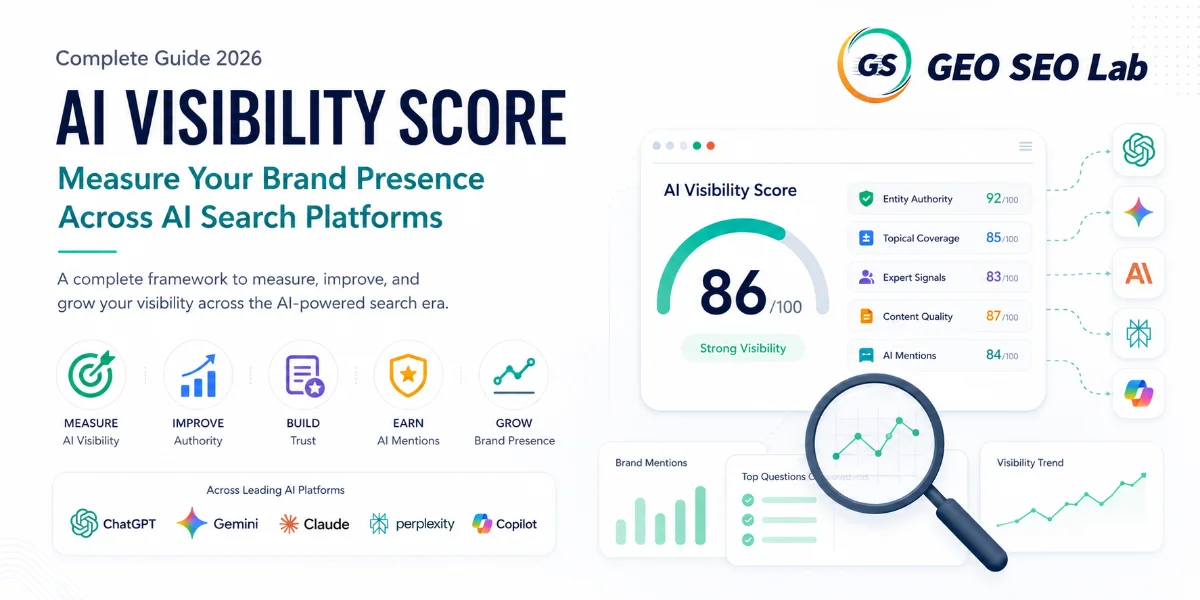
The AI Visibility Score: Measure Brand Presence Across AI Search
Learn how to measure and improve your AI Visibility Score across ChatGPT, Google AI Mode, Gemini, Claude, Perplexity, and modern AI search platforms.
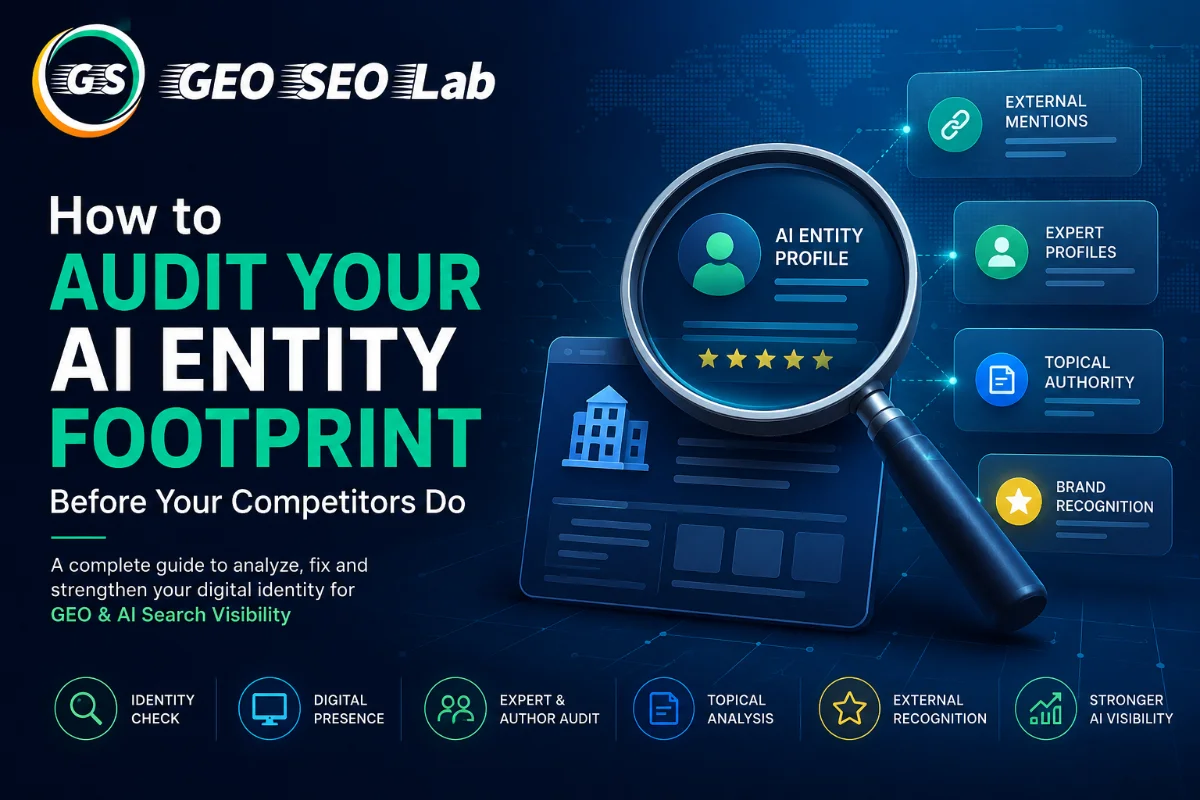
How to Audit Your AI Entity Footprint Before Your Competitors Do
Learn how to audit and improve your AI Entity Footprint by checking business identity, digital profiles, topical authority, expert information, external recognition, and online consistency. This guide explains how businesses can build a clearer digital identity for GEO and AI search visibility.
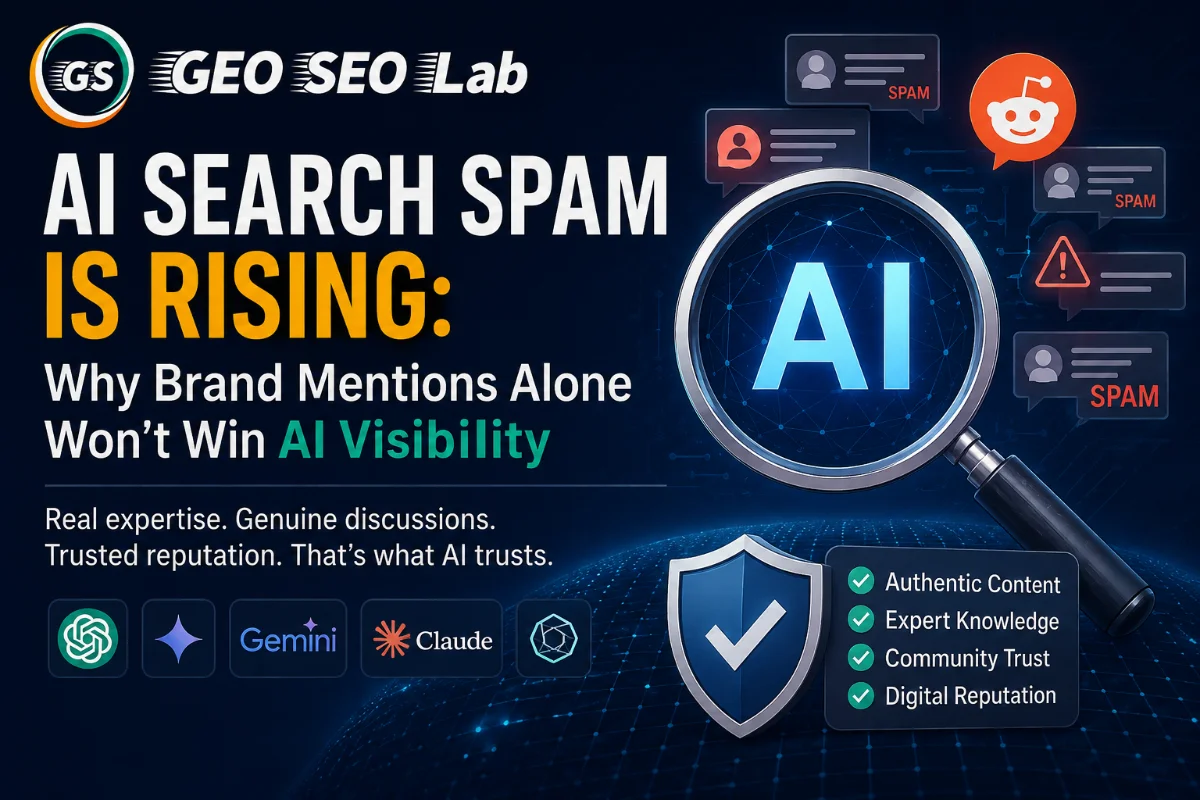
AI Search Spam Is Rising: Why Brand Mentions Alone Will Not Win AI Visibility
AI search spam is increasing as businesses look for shortcuts to improve brand visibility. This guide explains why fake brand mentions, Reddit manipulation and coordinated promotion are not sustainable strategies, and why genuine expertise, community trust, original research and authentic digital reputation matter more for long term AI visibility.