Google Just Gave SEO a New Metric: AI Visibility in Search Console
Google’s AI Performance reporting in Search Console is changing how businesses measure search visibility. Learn what AI impressions mean, how AI visibility differs from traditional rankings, and how businesses can use this data to improve SEO, GEO, content strategy and digital visibility.
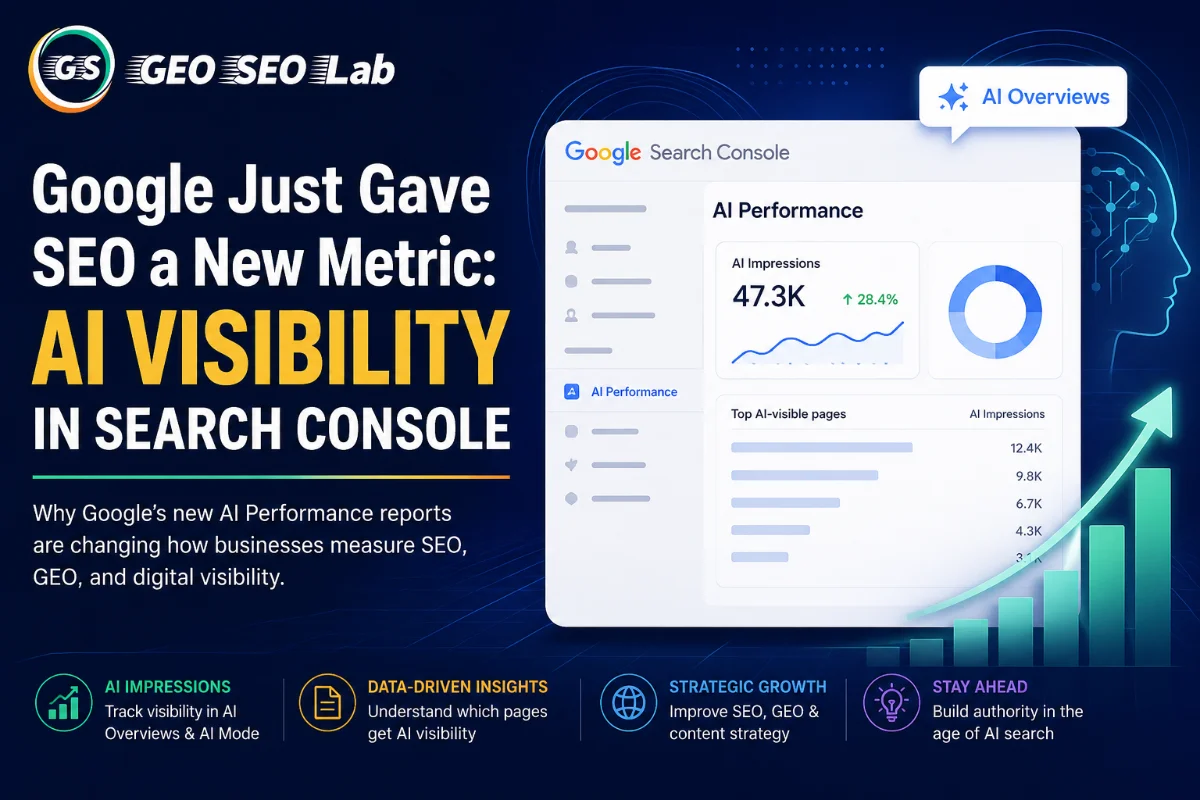
Google Just Gave SEO a New Metric: AI Visibility in Search Console
Why Google’s New AI Performance Reports Are Changing SEO Measurement
For many years, SEO reporting was built around a few basic questions. Where does a website rank on Google? How many people click on the website? How much traffic comes from organic search? These questions became the foundation of SEO because traditional Google Search worked mainly through a list of links.Businesses created content, optimized pages, built links, improved technical SEO and then watched their rankings and traffic. If a page moved from position ten to position three, that was considered progress. If clicks increased, the SEO strategy was considered successful.
That way of measuring search performance is still important. However, the way people search for information is changing.
Google now provides answers through AI powered experiences such as AI Overviews and AI Mode. Instead of showing only a list of websites, Google can summarize information from different sources and present an answer directly to the user.This creates a new question for businesses.Is our website being used as a source inside these answers?
Until recently, finding a reliable answer to that question was difficult. Businesses had to manually search questions, test different prompts and check whether their pages appeared in AI generated responses. Some companies also used third party tools that estimated visibility across different AI platforms.
These methods could be useful, but they were not the same as having direct data from Google.
Google’s introduction of AI Performance reporting in Search Console changes this situation. Eligible websites can now get information about how their pages appear in Google’s AI powered search experiences.
This is important because Search Console has always been one of the most trusted sources for understanding how a website performs in Google Search.The arrival of AI visibility data means businesses can begin looking at traditional search performance and AI search performance together.It does not mean that rankings and clicks no longer matter. They still matter greatly. Instead, businesses now have another part of the search journey to measure.This new measurement can help companies understand which pages are being discovered through AI search, which topics appear to have stronger visibility and where content improvements may create new opportunities.For SEO teams, content teams and business leaders, this is more than another number in a dashboard. It represents a change in the way digital visibility can be understood.
The Old SEO Measurement Model Is Changing
Traditional SEO measurement has always focused heavily on rankings, impressions, clicks, traffic and conversions.
A company might publish an article targeting an important keyword. After several weeks, the SEO team checks Search Console and sees that the page is ranking on the first page. The team then checks the number of impressions and clicks. If traffic increases, the page is considered successful.This model works well when users discover websites by looking through search results and clicking links.AI search adds another layer to this process.A user may ask Google a question and receive an AI generated answer. The answer may contain information taken from several websites. The user might understand the answer without visiting every source.This means a website can contribute to the user's search experience even when the user does not click on the website.That creates a measurement problem.Traditional click based reporting can tell us whether users visited a website. It does not always tell us how much exposure a website received inside an AI generated answer.AI Performance reporting begins to address that gap.
Instead of asking only whether someone clicked, businesses can also ask whether their content was visible within Google's AI search experience.
This creates a broader view of search visibility.
Why AI Visibility Was Difficult to Measure Before
Before first party AI performance reporting became available, companies had to depend on different methods to understand their visibility.One common method was manual testing.A marketer would search an important question on Google or another AI platform and look at the answer. They would then check whether their company or website was mentioned.The problem was that search results could change.
Two people could search the same question and receive different results. Results could also change over time as search systems updated their responses.Manual checking also became difficult when a company had hundreds of important topics.Another problem was scale.A business might want to know how visible it was across hundreds or thousands of questions. Checking every question manually would require a huge amount of time.
Third party platforms helped solve part of this problem. They could track mentions, citations and other forms of visibility across AI platforms.These tools can still be useful, especially for competitive research and cross platform monitoring. However, their data is not the same as first party Google data.This distinction matters because businesses need reliable information when making important content and marketing decisions.
Google Search Console provides data directly connected to Google Search. The addition of AI performance information therefore gives businesses a stronger foundation for understanding their visibility inside Google's own AI experiences.
What Google’s AI Performance Reporting Means
The most important idea is simple.
Google is making AI search visibility measurable.
The exact information available can depend on the reporting implementation and eligibility of a website, but the new reporting direction gives businesses insight into how their pages are appearing in Google's AI powered search experiences.AI impressions are one of the most important parts of this new measurement.
An AI impression can be understood as exposure of a website's content within an AI search experience. This is different from a normal search result impression.Traditional impressions tell us that a website listing was shown in search results.
AI visibility tells us that content from the website appeared within an AI powered search experience.
That difference is important because the user experience is different.
A traditional search result gives the user a list of options.
An AI search experience can provide a direct explanation and use information from several sources to create that explanation.
A website that becomes part of that answer is participating in the user's research process.
Page Level Visibility Can Reveal Important Patterns
One useful part of AI performance reporting is understanding which pages are receiving visibility.
This is valuable because a website may have hundreds or thousands of pages, but only a small number may receive significant exposure in AI search.Suppose a company publishes content about digital marketing, technical SEO, local SEO and content strategy.If the data shows that its technical SEO articles receive much more AI visibility than its other pages, that can provide a useful signal.The company may already have stronger expertise and better content depth around technical SEO.Instead of treating that information as a simple reporting number, the company can investigate why those pages perform well.Perhaps the pages contain original examples. Perhaps they are regularly updated. Perhaps the information is clearly explained. Perhaps the site has strong internal connections between related topics.
The data does not automatically tell the company why the page was selected.
However, it gives the company a starting point for investigation.
That is where measurement becomes useful for strategy.
Device and Country Data Can Add More Context
Search behavior is not the same for every user.
People use different devices, and search behavior can vary between countries and markets.
If AI performance data provides device and country information, businesses can use it to understand where their visibility is coming from.An international company may discover that its AI visibility is strong in one market but weaker in another.
That can lead to further investigation.The company may have different content coverage in different regions. It may have stronger local authority in one country. It may also need better localization or more region specific information.
Device information can also provide useful context about how people are discovering information.
These details become more useful when combined with other website data rather than being viewed alone.
AI Visibility Is Not the Same as Traditional Rankings
One of the biggest mistakes businesses can make is treating AI visibility as another form of ranking.
It is not.Traditional ranking is based on position.
If one website appears in position one and another appears in position five, the first website has a higher traditional ranking.AI search works differently.An AI generated answer may use information from several sources. There may not be a simple position one, position two and position three relationship between those sources.
The question becomes whether a source is useful and trustworthy enough to be included.
This means a website can rank very well in traditional search and still have limited AI visibility for the same topic.
The opposite can also happen.A page that does not receive the highest traditional ranking may still provide useful information that becomes part of an AI generated answer.
This is why SEO teams need to understand both systems.
Traditional SEO helps a website become discoverable in normal search results.
GEO focuses more heavily on making information useful, understandable, trustworthy and easy for search systems and AI powered experiences to interpret.
These areas overlap, but they should not be treated as exactly the same thing.
Why AI Impressions Matter Even When Clicks Are Low
At first, businesses may look at AI impressions and ask an obvious question.
If people are not clicking, why should the impression matter?
This is a reasonable question because traditional digital marketing has usually connected impressions with clicks and conversions.AI search introduces another type of value.
Imagine that someone searches for information about choosing an SEO agency. Google provides an AI generated explanation and mentions a company as one of the sources used to build the answer.
The user may not click the company website at that moment.
However, the user has now seen the company name while actively researching a business related topic.
That exposure can contribute to brand awareness.
The user may later search for the company directly. They may remember the name when comparing providers. They may encounter the same company again through another search.
This does not mean every AI impression creates a business result.
It means that exposure can have value even when the immediate click is missing.
Businesses therefore need to look at AI visibility as one part of the complete customer journey.
AI Visibility Can Support Brand Recognition
Brand recognition develops through repeated exposure.
A user who sees the same company mentioned across several relevant searches may gradually become familiar with that company.This can be particularly valuable for businesses operating in competitive industries.
If ten companies provide similar services but one company repeatedly appears in useful search answers, that company can gain an advantage in recognition.The user may not immediately visit the website.
But when the user eventually needs the service, the familiar company may already be part of their consideration.
This is one reason AI visibility should not be evaluated only through direct traffic.
SEO reporting needs to recognize that discovery can happen before a website visit.
Authority Becomes More Important
AI search also creates a stronger connection between visibility and perceived authority.
When a company's information is repeatedly used as a source for answers, users may begin to associate that company with expertise.This is especially important for businesses that sell knowledge based services.
Consulting firms, technology companies, financial organizations, healthcare information websites, educational platforms and professional service businesses all depend heavily on trust.
For these organizations, being visible when users ask important questions can be valuable even when the user does not immediately click.The challenge is that authority cannot be created simply by adding more words to a page.
It requires useful information, accurate claims, evidence, experience and consistency.
What the AI Performance Report Does Not Tell You
It is important not to treat Google's AI Performance reporting as a complete solution to every AI visibility question.
The data provides valuable information, but there are still important gaps.
For example, a report may show that a page is receiving AI impressions.
It may not explain exactly why Google selected that page.It may not tell you which sentence was used.It may not tell you which part of the page influenced the generated answer.It may not explain why another competitor was selected for a similar question.This means businesses still need their own analysis.The most useful approach is to combine first party data with content analysis, competitive research and manual testing.
Competitive Data Is Still Important
Businesses rarely operate alone.
If your website receives a certain number of AI impressions, that number becomes much more meaningful when you understand the competitive environment.A company may believe its visibility is strong because the number is increasing.
But if competitors are growing much faster, the company's relative position may actually be weakening.
Google's own reporting does not necessarily provide all of the competitive context required for this analysis.
Businesses therefore need additional monitoring.They can study important topics, test relevant searches and observe which companies appear consistently.This information can help identify gaps.
If a competitor is frequently mentioned for a topic where your company has genuine expertise, that deserves investigation.
The goal should not be to copy the competitor.
The goal should be to understand what information they provide that users and search systems find useful.
Cross Platform Visibility Still Matters
Google is not the only place where people use AI powered search.
Users also discover information through platforms such as ChatGPT, Gemini, Claude and Perplexity.
A company that measures only Google's AI visibility will therefore have an incomplete picture of its overall AI discovery presence.This does not reduce the importance of Google's data.
It simply means that businesses should understand the difference between Google specific visibility and overall AI visibility.
Search Console can become the foundation for understanding Google.
Additional monitoring can help businesses understand what is happening across other platforms.
Together, these sources create a more complete picture.
From Measurement to GEO Strategy
The real value of new measurement data comes from what a business does with it.
Simply adding AI impressions to a monthly report will not improve content.
The important question is what the data can teach the organization.
A useful process starts by identifying pages with strong AI visibility.
Once these pages are identified, the content team can examine them carefully.
What topics do they cover?How detailed are they?Do they include original research?Are claims supported by evidence?
Is the content written by someone with relevant experience?Is the page regularly updated?Does it connect naturally to related pages?Does the website have a strong knowledge base around the subject?These questions can reveal patterns.
The patterns can then influence future content decisions.
Finding Where Google Already Recognizes Your Expertise
High AI visibility can provide a useful signal about areas where your organization already has recognition.
Suppose a technology company notices that its cybersecurity guides consistently receive AI visibility.
That does not mean the company should immediately move to another topic.
Instead, it may make sense to build deeper coverage around cybersecurity.
The company could publish practical guides, original research, case studies, technical explanations and frequently asked questions.Over time, this creates a stronger knowledge ecosystem.
One strong article becomes the starting point rather than the final destination.
Finding AI Visibility Gaps
The opposite situation is equally important.
A company may have an important business topic where it expects strong visibility, but the data shows very little AI exposure.This is a potential content gap.The company should then investigate what is missing.Maybe the page provides only a basic explanation.Maybe the information is outdated.Maybe there is no original research.Maybe the topic is not supported by related content.Maybe the organization has not clearly demonstrated its experience.Maybe the content does not answer the questions users actually ask.The point is not to assume one specific reason.The data should lead to investigation.
Understanding What High Performing Pages Have in Common
One of the most useful activities is comparing successful pages.Imagine that a website has twenty pages receiving AI visibility.The team can study these pages together.Perhaps most of them include original statistics.Perhaps most have clear expert authorship.Perhaps they contain examples from real projects.Perhaps they have strong internal linking.
Perhaps they are updated frequently.Patterns like these can become valuable internal knowledge.This is much more useful than blindly following general content advice.The company begins learning what works for its own website and industry.
Measuring the Effect of Content Updates
Content improvements should not be treated as random changes.
If a company updates an important page, it should document what changed.Maybe new research was added.Maybe outdated statistics were replaced.Maybe expert information was included.Maybe several related questions were answered.Maybe the page structure was improved.After the update, the company can monitor performance over time.
If AI visibility increases, that becomes useful evidence.It does not prove that one specific change caused the increase because many external factors can affect search performance.
However, repeated testing can reveal patterns.
Over time, this creates an internal understanding of what improvements are associated with stronger visibility.
The Four Types of Content Performance
Businesses can compare AI visibility with traditional organic traffic to understand different situations.
A page with strong AI visibility and strong organic traffic is performing well across both search experiences.
These pages deserve protection.They should remain accurate, current and useful.A page with strong AI visibility but weak organic traffic is more interesting.The content may already have strong information value, but users may not have enough reason to visit the website.The company can examine whether the page offers deeper value beyond the summary users receive in search.A page with strong organic traffic but weak AI visibility presents another opportunity.
The page already performs well in traditional search, but the content may need stronger evidence, original information, expert experience or broader topic coverage.Finally, pages with weak AI visibility and weak organic traffic require honest evaluation.Some may need improvement.Others may not deserve additional investment.
Content teams should be willing to make that distinction.
Building Topic Clusters Around Successful Pages
When a page consistently performs well in AI search, it can become the center of a larger knowledge ecosystem.
For example, a company may have a successful guide about technical SEO.
Instead of publishing unrelated articles every week, the company could build supporting resources around that subject.
A beginner guide can explain the basics.An advanced guide can cover complex implementation.A practical guide can explain how to solve common problems.A case study can demonstrate real results.Original research can provide new information.A glossary can explain important terminology.A frequently asked questions resource can answer specific user concerns.A service page can connect the knowledge to the company's offering.
All of these resources can be connected through internal links.The result is a deeper and more organized knowledge ecosystem.
Why Original Research Matters
Original research is difficult to replace because it provides information that may not exist elsewhere.
A company can publish its own survey, benchmark, industry analysis, customer research or performance study.
This gives the website something different from hundreds of articles repeating publicly available information.
Original information can also strengthen the credibility of surrounding content.If a company repeatedly publishes useful research within a specific field, it creates a stronger association between the organization and that subject.
This is valuable for both users and search systems.
Practical Experience Makes Content Stronger
Experience is another important part of useful content.
A page that explains how something works is helpful.A page that explains how the organization actually implemented it can be much more useful.Real examples provide details that generic explanations often miss.They can show what went wrong, what worked, what had to be changed and what results were observed.Businesses have a large amount of this information internally.Customer conversations, project experiences, implementation problems and successful processes can all become valuable content.The challenge is turning that experience into clear resources that people can actually use.
Creating a Regular AI Performance Review
AI performance should become part of normal content operations.That does not mean checking the dashboard every few hours.Search data naturally changes.A more useful approach is to review trends regularly.
A weekly review can identify significant changes.The team can ask which pages gained visibility, which pages lost visibility and whether important changes happened around the same period.
This creates a habit of observation.Over several months, trends become much easier to understand than isolated numbers.
Monthly Comparison With Traditional SEO
A monthly review can go deeper.The team can compare AI visibility with traditional organic traffic.This helps identify pages that are performing differently across the two search environments.It also helps decide where content resources should be allocated.If a page receives strong organic traffic but weak AI visibility, it may deserve a content quality review.
If another page receives strong AI visibility but weak direct traffic, the company can investigate how to create stronger reasons for users to visit.This comparison prevents the organization from becoming dependent on one metric.
Testing Content Improvements
Testing should become part of the content process.When a page is updated, the team should record the changes.The team can then monitor the page over the following weeks.The goal is not to expect an immediate result.Search systems need time to process changes, and external factors can affect visibility.The important thing is consistency.
If a company performs many structured tests over time, it can build a useful internal knowledge base.That knowledge can improve future decisions.
Develop Existing Strong Topics Before Expanding Too Quickly
Content teams often want to publish about new subjects.New keywords look exciting.New trends create pressure to publish quickly.But spreading resources too widely can weaken the overall knowledge base.
If a company already has strong evidence of visibility in a topic, developing that topic further may produce better results.
The company already has experience.It already has supporting content.It may already have an audience.It can build on that foundation instead of starting from zero.This does not mean companies should never explore new subjects.It means new topics should be balanced against opportunities that already show evidence of success.
The Relationship Between AI Visibility and Business Results
AI visibility should eventually be connected to business outcomes.
This is not always easy.A user may see a company in an AI generated answer today and visit the website several weeks later through a branded search.Traditional analytics may not clearly connect those two events.
That is why businesses should avoid claiming that every AI impression creates a specific conversion.
Instead, organizations should look for broader patterns.They can monitor branded searches, direct traffic, assisted conversions, enquiries and customer feedback.Over time, these signals can help show whether greater AI visibility is contributing to brand discovery.
AI Visibility as a New SEO KPI
AI visibility is likely to become an increasingly common part of search reporting.This does not mean traditional SEO metrics are disappearing.Organic traffic remains important.Rankings remain important.Clicks remain important.Conversions remain important.Technical health remains important.AI visibility adds another dimension.A modern search dashboard can therefore show how the website performs across different discovery paths.Traditional search explains how users find and visit the website through normal search results.AI visibility explains how often the organization's information becomes part of AI powered search experiences.Together, these measurements create a broader understanding of digital visibility.
What Businesses Should Do in the First 30 Days
The first step is to check whether AI Performance reporting is available for the organization's Search Console properties.
If it is available, the team should record the initial data.The first measurement becomes the baseline.The company should identify which pages are already receiving AI visibility and compare those pages with its most important business topics.
The team should also begin documenting important AI visibility observations outside Google.
This creates a stronger starting point for future comparisons.The objective during the first month should not be to completely change the content strategy.The objective should be understanding the current situation.
What Businesses Should Do in the First 90 Days
After the initial baseline is established, the company can start using the data for decisions.The content team should identify the strongest topic areas.It should study the pages performing well and look for common characteristics.
At the same time, the company should identify important topics where visibility appears weak.A few pages can then be selected for structured improvement.The company can update those pages and monitor what happens.This creates the beginning of an internal testing system.
What Businesses Should Build Over Six Months
Over a six month period, organizations can develop a broader AI visibility measurement system.Google data can be combined with monitoring across other major AI platforms.Content teams can begin producing more original research.
Topic clusters can be expanded.Competitive visibility can be monitored.The company can also create stronger editorial standards.Instead of asking only whether an article targets a keyword, the team can ask whether the article adds something useful that readers cannot easily find elsewhere.This change can improve the quality of the entire content operation.
What Businesses Should Build Over 18 Months
Long term, AI visibility can become part of executive reporting.Leadership teams may want to know not only how much organic traffic the website receives but also how visible the organization is within AI powered discovery.
Historical data becomes increasingly valuable at this stage.A company with eighteen months of AI visibility data can begin identifying long term patterns.It can see which topics are growing.It can see which content investments are producing stronger visibility.It can also understand where competitors are gaining ground.This creates a much more mature approach to digital visibility.
The AI Visibility Growth Cycle
Strong AI visibility can create a cycle that benefits the organization over time.Original research creates useful information.
Useful information strengthens the organization's knowledge authority.Stronger knowledge authority can improve the chances of being recognized as a useful source.Greater visibility increases brand exposure.Repeated exposure can support recognition and trust.Greater recognition can create more opportunities for research, partnerships and industry participation.Those opportunities can produce more original information.The process can then continue.
This is why organizations should think beyond individual articles.The goal is not simply to make one page visible.
The goal is to build a knowledge ecosystem that becomes stronger over time.
Why Knowledge Quality Is Becoming More Important
The growth of AI powered search makes information quality increasingly important.
Publishing more content is not automatically better.A website with hundreds of shallow articles may have less value than a website with fewer but stronger resources.Useful content should answer real questions.It should be accurate.
It should be understandable.It should include relevant evidence.It should reflect genuine experience when experience is important.It should also be maintained.Outdated information can reduce the usefulness of a resource.This means content maintenance should become part of the normal publishing process.
Why SEO and GEO Should Work Together
Traditional SEO and GEO should not be treated as competing disciplines.They solve different parts of the visibility problem.Technical SEO helps search systems access and understand a website.On page SEO helps organize information around relevant search needs.Off page authority can help establish credibility.GEO focuses more directly on visibility within generative and answer based search experiences.The strongest strategy connects these areas.A technically weak website can struggle regardless of content quality.A technically strong website with shallow information can also struggle to establish meaningful authority.The goal is therefore to build a website that is accessible, useful, credible and well organized.
The Importance of Entity Consistency
Businesses should also pay attention to how their organization is represented across the web.Company name, services, people, expertise areas and important facts should be consistent.If different websites describe the organization in completely different ways, it becomes harder to establish a clear understanding of the entity.Consistent information across the company website, professional profiles, industry publications and trusted external sources can help create a clearer picture.This is particularly important for companies trying to establish expertise in a specific subject.
Content Should Give Users a Reason to Visit
One challenge created by AI search is that users can receive a summary without visiting the original page.
That means websites need to provide value beyond the basic answer.A page should not simply repeat information that can be summarized in a few sentences.It should offer deeper explanations, practical examples, original research, tools, case studies, data or other useful resources.The goal is to make the website valuable even after the user has already received a basic answer.
This can improve the relationship between visibility and direct website engagement.
Measuring the Gap Between Visibility and Traffic
The difference between AI visibility and website traffic can reveal useful information.Suppose a page receives strong AI exposure but very little traffic.The company should not automatically conclude that the page is failing.Instead, it should ask why.Maybe the AI answer is satisfying the user's immediate question.Maybe the page does not provide a strong reason to continue reading.Maybe the content needs better internal links.Maybe the page needs tools, examples or deeper information.Understanding the reason is more useful than simply looking at the numbers.
Building a Better Content Strategy
The arrival of AI visibility data creates an opportunity to make content strategy more evidence based.Instead of publishing based only on keyword volume, teams can consider several signals.They can look at existing organic performance.They can examine AI visibility.They can study business importance.They can evaluate the strength of existing expertise.They can identify content gaps.They can also consider whether the organization has something original to contribute.This creates a more balanced approach to content investment.
The Complete AI Visibility Measurement Approach
A mature measurement system should begin with reliable data.
The organization should know whether Search Console AI reporting is available and should establish a baseline when it becomes available.The company should identify its strongest AI visible pages and understand which business topics they represent.It should compare AI visibility with organic traffic.It should monitor important competitors.It should test important searches manually where appropriate.It should track visibility across other major AI platforms when those platforms matter to the business.It should also document content changes so that future performance can be compared against actual improvements.The goal is to move from observation to learning.
Frequently Asked Questions
Does AI Performance reporting replace traditional Search Console reporting?
No.
Traditional Search Console reporting remains important because it provides information about organic search impressions, clicks, rankings and other performance signals.AI Performance reporting adds another dimension by showing visibility within Google's AI powered search experiences.Businesses should use both.Traditional search still produces significant website traffic, while AI search can create exposure and discovery in a different way.
Looking at only one of these areas would provide an incomplete view of search performance.
Is AI Performance reporting available for every website?
Availability depends on Google's rollout and eligibility.Businesses should check their Search Console accounts to see whether the reporting is available for their properties.If it is not yet available, organizations can continue using other forms of monitoring while waiting for access.The important thing is to establish a baseline as soon as reliable first party data becomes available.
What should businesses do if AI impressions increase but clicks do not?
They should not immediately consider the increase a failure.
AI impressions and traditional clicks represent different types of visibility.An increase in AI impressions can mean that the organization's information is being exposed to more users through AI search.However, the business should still examine the relationship between exposure and website visits.The team can improve internal links, calls to action and deeper resources so that users who want more information have a clear reason to visit the website.
How does AI Performance data help GEO?
It gives GEO strategy a stronger measurement foundation.Instead of relying only on general recommendations, businesses can observe which pages are receiving AI visibility and study what those pages have in common.
They can then improve other pages, measure the results and gradually develop their own understanding of what works.
This turns GEO into an ongoing learning process.
Does ranking number one guarantee AI visibility?
No.
A high traditional ranking does not automatically guarantee that a page will appear in an AI generated answer.
Traditional ranking and AI source selection involve different processes.A website can perform very well in normal search while receiving limited visibility within AI experiences.
This is why businesses should monitor both areas.
Can a page have AI visibility without generating many clicks?
Yes.
AI search can provide users with information directly.
A user may see a company or website mentioned in an AI generated answer without visiting the source.
That exposure can still contribute to awareness and recognition.Businesses should therefore avoid treating every AI impression as if it were equivalent to a traditional search click.
Should businesses stop focusing on traditional SEO?
No.
Traditional SEO remains essential.
Technical optimization, useful content, website performance, internal linking, authority and search intent continue to matter.
AI visibility adds another layer to search strategy.The best approach is to strengthen the fundamentals while also preparing content for the changing search environment.
Why is original research useful for AI visibility?
Original research gives a website information that may not be available elsewhere.
Surveys, benchmarks, experiments, case studies and industry data can make content more useful and distinctive.
When a company repeatedly contributes original information, it can build a stronger reputation around its subject area.
How often should AI visibility be reviewed?
A weekly review can be useful for identifying major changes and emerging patterns.A deeper monthly analysis is more useful for strategic decisions.The exact frequency should depend on the size of the website and the amount of data available.The important point is to focus on trends rather than reacting to every small daily change.
What should companies measure alongside AI visibility?
Companies should continue measuring organic traffic, clicks, rankings and conversions.They can also monitor branded searches, direct traffic, enquiries and other business outcomes.For broader AI visibility, they can monitor relevant platforms beyond Google.Together, these measurements provide a more complete picture of how people discover and interact with the organization.
Final Thoughts
Google's AI Performance reporting represents an important change in search measurement.For years, businesses mainly measured visibility through rankings, impressions, clicks and traffic.Those metrics are still important, but they no longer describe the entire search experience.AI powered search creates another path through which people discover information.
A user can ask a question, receive an answer and encounter information from a business without following a traditional search result.That means visibility itself is becoming more complex.The introduction of first party AI performance data gives businesses a new way to understand this changing environment.The biggest opportunity is not simply to report AI impressions.The real opportunity is to learn from them.Businesses can identify the topics where their expertise is already being recognized.They can discover gaps in their content.They can compare successful and unsuccessful pages.
They can test improvements.They can develop stronger topic clusters.They can publish original research.They can monitor competitors.They can connect AI visibility with broader business outcomes.
Most importantly, they can begin building a long term knowledge strategy instead of treating search visibility as a collection of isolated keywords.The future of SEO will not be defined by one metric.Rankings will continue to matter.
Clicks will continue to matter.Traffic and conversions will continue to matter.But AI visibility is becoming another important part of the picture.Organizations that learn how to measure it, understand it and use it intelligently will be better prepared for the changing way people discover information.The companies that succeed will not simply publish more pages.
They will build stronger knowledge ecosystems.They will document real experience.They will publish useful research.
They will keep important information current.They will create content that provides genuine value.And they will use search data to continuously improve what they publish.Google's new AI performance reporting is therefore more than another Search Console feature.It is a sign that search measurement itself is expanding.The question for businesses is no longer only whether their website ranks.The bigger question is whether their knowledge is being discovered, trusted and surfaced when people ask important questions.That is where AI visibility becomes strategically important.
And as AI powered search continues to develop, understanding this new form of visibility will become an increasingly important part of modern digital strategy.
Frequently Asked Questions
Find answers to common questions about this topic
About the Author

Aman Kesharwani
SEO Expert & Content Creator
Experienced digital marketing professional specializing in SEO strategies, content optimization, and data-driven marketing solutions. Passionate about helping businesses grow their online presence and achieve better search rankings.
Related Articles
View all posts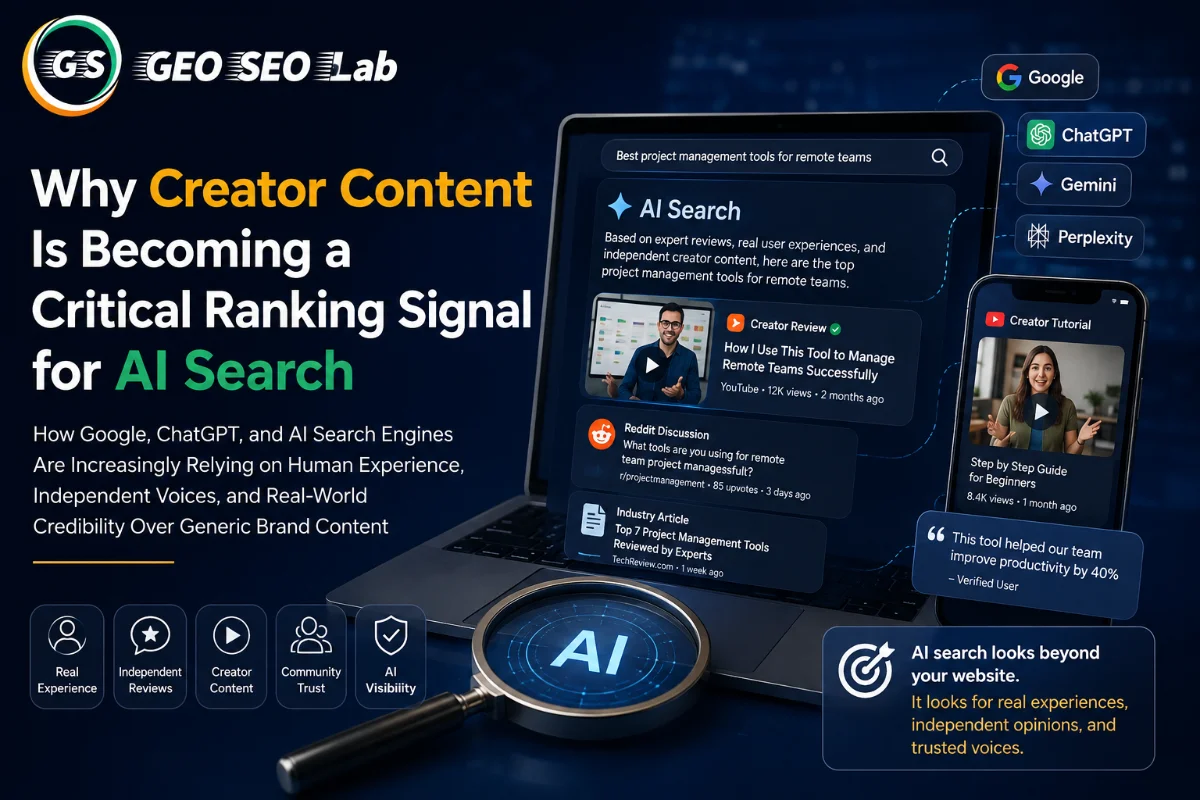
Why Creator Content Is Becoming a Critical Ranking Signal for AI Search
Creator content is becoming an important part of AI search visibility. Learn why real experience, independent reviews, expert opinions, customer discussions and professional communities can influence how AI search systems understand a brand and its expertise.
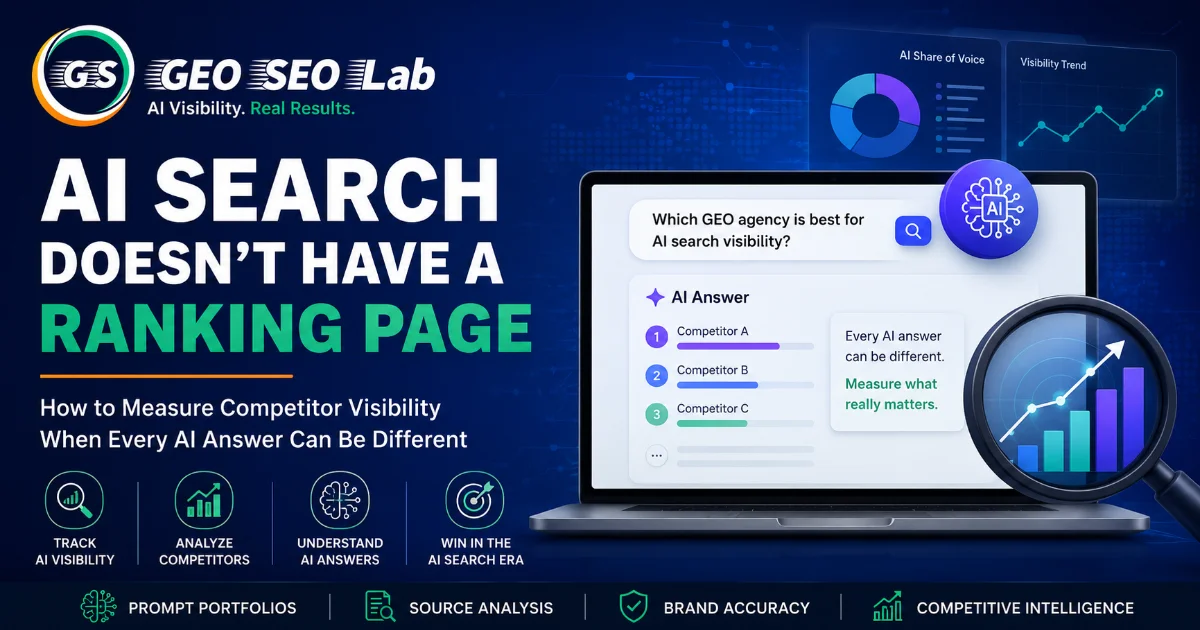
AI Search Doesn’t Have a Ranking Page: How to Measure Competitor Visibility
AI search has changed how businesses compete online. Learn how to measure AI competitor visibility, track AI Share of Voice, analyze brand mentions, monitor competitors, and build a practical AI competitive intelligence strategy.
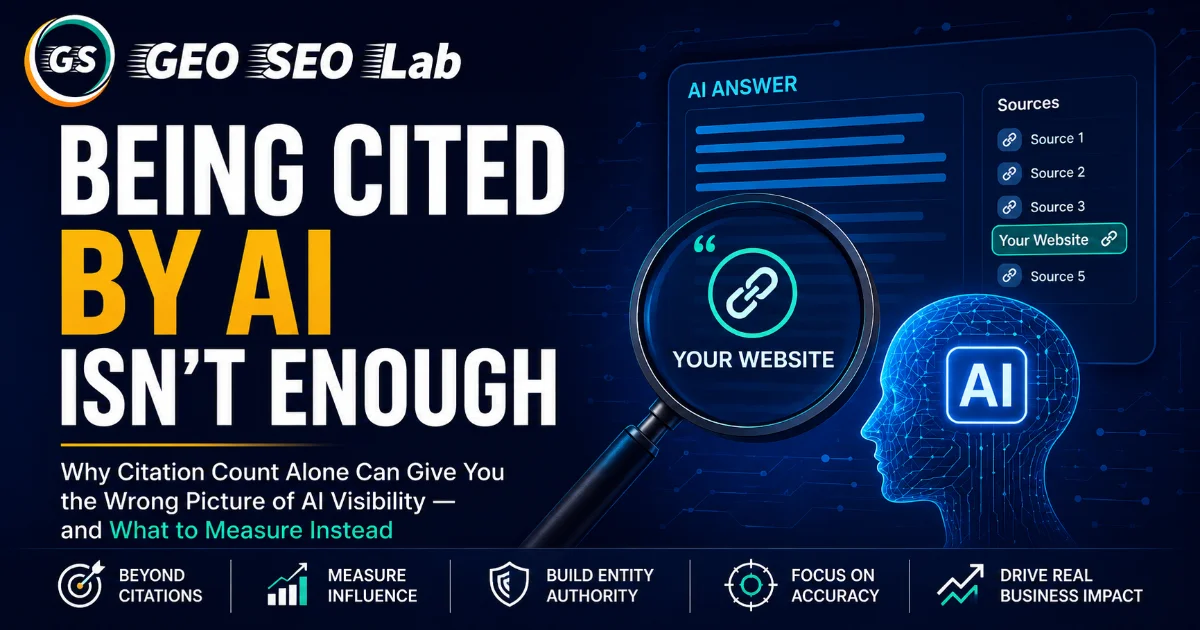
Being Cited by AI Isn't Enough: Why AI Visibility Needs Better Metrics
AI citation count can show that your content is being selected, but it does not reveal how much your knowledge actually influences AI generated answers. Learn why businesses need to measure informational contribution, content quality, entity authority, accuracy, competitive visibility, and real business impact.