What Is Semantic SEO? A Beginner's Guide to Smarter Search Optimization in 2026
Semantic SEO helps search engines understand the meaning and context behind your content rather than just matching keywords. This beginner-friendly guide explains how Semantic SEO works, why it matters in 2026, and how it can improve your website's visibility in Google Search, AI Overviews, ChatGPT, Gemini, and other AI-powered search platforms.
Table of Contents
- Introduction
- Understanding Semantic SEO
- Why Search Engines Needed Semantic SEO
- From Keywords to Meaning
- Understanding Search Intent
- Why Semantic SEO Improves User Experience
- The Relationship Between Semantic SEO and Artificial Intelligence
- Why Semantic SEO Matters in 2026
- How Search Engines Understand Content
- The Role of Natural Language Processing (NLP)
- Understanding Entities in Semantic SEO
- Why Entities Matter for Search Rankings
- Building Topical Authority
- The Importance of Context in Content
- Internal Linking and Semantic Relationships
- Google's Knowledge Graph Explained
- Semantic SEO vs Keyword Stuffing
- Why Semantic SEO Supports AI Search
- Applying Semantic SEO to Your Content
- Creating Content That Satisfies User Intent
- Building a Strong Topical Ecosystem
- Writing Naturally for Readers and Search Engines
- The Role of Fresh Content
- Why Trust Matters in Semantic SEO
- Common Semantic SEO Mistakes to Avoid
- The Future of Semantic SEO
- Measuring Success Beyond Rankings
- Final Thoughts
- Frequently Asked Questions (FAQs)
What Is Semantic SEO?
A Beginner's Guide to Smarter Search Optimization in 2026
Search engine optimization has changed dramatically over the last decade. There was a time when ranking on Google mainly depended on using the right keywords as many times as possible. Website owners would repeat the same phrase throughout an article, add it to headings, meta tags, image names, and URLs, believing that more repetitions would automatically result in better rankings.
That approach no longer works.
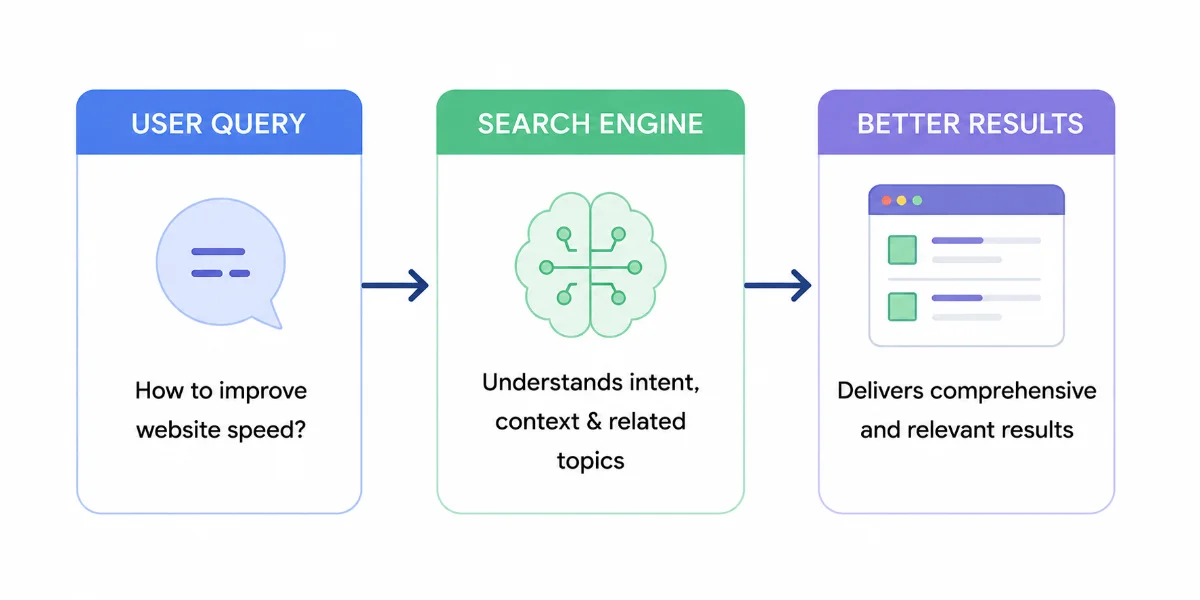
Modern search engines have become much smarter. Instead of simply matching keywords, they now try to understand what users actually mean when they search. They analyze the context behind every query, identify relationships between words and concepts, recognize entities such as people, places, brands, and products, and evaluate whether a piece of content genuinely answers the user's question.
This transformation has changed the way websites should be optimized.
Today, successful SEO is less about individual keywords and more about meaning, relevance, and context. This is exactly where Semantic SEO comes into the picture.
Semantic SEO is one of the most important concepts in modern search optimization because it helps search engines understand your content the same way a human reader would. Rather than focusing on a single keyword, Semantic SEO encourages you to cover an entire topic naturally and comprehensively. The result is content that is more useful for readers and easier for search engines to interpret.
As artificial intelligence continues to reshape search through Google AI Overviews, ChatGPT, Gemini, Perplexity, and other AI-powered platforms, Semantic SEO has become even more valuable. These systems don't simply look for matching words. They look for trustworthy information, meaningful relationships between ideas, and complete answers that satisfy user intent.
Understanding Semantic SEO is no longer optional for businesses, marketers, bloggers, or website owners. It has become one of the strongest foundations of long-term organic visibility.
Understanding Semantic SEO
Semantic SEO is the practice of creating content that focuses on the meaning behind a topic rather than targeting a single keyword repeatedly.
When someone searches for information online, they are usually trying to solve a problem or answer a question. Search engines understand this. Instead of matching exact phrases, they attempt to understand what the searcher actually wants.
Imagine someone types "best laptop for video editing."
Years ago, search engines mainly searched for pages containing those exact words.
Today, they also understand related concepts like graphics cards, RAM, processors, SSD storage, Adobe Premiere Pro, rendering performance, battery life, display quality, thermal management, and professional workflows.
Even if an article doesn't repeat the exact keyword dozens of times, it can still rank well because it thoroughly covers everything someone looking for a video editing laptop needs to know.
That is Semantic SEO in action.
Instead of writing for search engines, you write for understanding.
Instead of optimizing individual keywords, you optimize complete topics.
Instead of chasing algorithms, you focus on helping people.
Why Search Engines Needed Semantic SEO?
The internet has grown beyond anything anyone imagined.
Every minute, thousands of new articles, videos, guides, and discussions are published. If search engines still relied only on keyword matching, users would constantly receive poor-quality results filled with keyword stuffing and duplicate information.
Google realized this problem years ago.
Users wanted answers, not pages overloaded with repeated phrases.
As search technology evolved, Google introduced major algorithm improvements that allowed it to better understand language and context. Updates such as Hummingbird, RankBrain, BERT, and more recently MUM fundamentally changed how search engines interpret information.
Instead of asking whether a page contains certain words, modern algorithms ask much deeper questions.
Does this page actually answer the user's question?
Does it cover the topic completely?
Does it explain related concepts?
Is the information trustworthy?
Would a reader leave satisfied after reading it?
These are the kinds of signals Semantic SEO helps address.
From Keywords to Meaning
One of the biggest changes in SEO has been the shift from keywords to meaning.
Imagine someone searches for "how to fix a slow website."
One article simply repeats the phrase "fix a slow website" twenty times.
Another article discusses hosting quality, caching, Core Web Vitals, image optimization, browser caching, lazy loading, JavaScript optimization, CSS minification, CDN implementation, server response time, database optimization, and performance monitoring.
Which article is more useful?
Most people would immediately choose the second one because it explains the topic thoroughly instead of repeating the same phrase.
Search engines make the same decision.
Semantic SEO encourages writers to naturally include related ideas, supporting concepts, and meaningful context instead of artificially repeating one keyword.
This creates richer content that satisfies readers while helping search engines understand exactly what the page is about.
Understanding Search Intent
Every search begins with an intention.
Sometimes people want to learn something.
Sometimes they want to compare products.
Sometimes they are ready to buy.
Other times they simply want to visit a specific website.
Semantic SEO begins by understanding this intention before writing a single sentence.
For example, someone searching for "What is Semantic SEO?" is probably looking for an explanation rather than a sales page.
They expect simple language, practical examples, historical context, and guidance they can actually understand.
If instead they land on a page trying to sell SEO software without answering their question, they are likely to leave immediately.
Search engines monitor these behaviors over time because user satisfaction matters.
Content that genuinely fulfills search intent naturally performs better than content designed only to attract clicks.
This is why understanding your audience has become just as important as understanding search engines.
Why Semantic SEO Improves User Experience
Many people think Semantic SEO exists only for Google.
In reality, it benefits readers first.
Imagine reading an article about electric vehicles.
Instead of only discussing electric cars, the article naturally explains charging stations, battery technology, driving range, maintenance costs, government incentives, environmental impact, resale value, and future innovations.
You leave with a complete understanding of the topic.
You don't need to open five additional websites to fill in missing information.
This is exactly what modern search engines want.
Their goal is to help users find reliable answers quickly.
When your content naturally answers follow-up questions before readers even ask them, your page becomes far more valuable.
That value often leads to longer reading sessions, increased trust, more shares, and stronger organic performance.
The Relationship Between Semantic SEO and Artificial Intelligence
Artificial intelligence has accelerated the importance of Semantic SEO.
Traditional search engines displayed lists of links.
AI-powered search experiences generate complete answers.
Platforms such as Google AI Overviews, ChatGPT, Gemini, and Perplexity attempt to understand entire topics before generating responses.
They analyze context rather than isolated keywords.
They recognize relationships between ideas.
They evaluate how well information connects together.
This makes Semantic SEO more valuable than ever.
A page that thoroughly explains a topic using clear language, logical structure, accurate information, and meaningful context has a much better chance of being understood by both traditional search engines and AI-powered systems.
Instead of optimizing content only for algorithms, website owners now need to optimize for understanding.
That is the true purpose of Semantic SEO.
Why Semantic SEO Matters in 2026?
The future of search is becoming increasingly conversational.
People no longer search using short keyword phrases alone.
Instead of typing "SEO tips," someone may ask, "How can I improve my website's rankings without buying backlinks?"
Search engines understand these conversational queries remarkably well.
They identify the user's problem, analyze related concepts, and present comprehensive answers.
Semantic SEO allows websites to match this evolution naturally.
Rather than creating dozens of thin pages targeting slightly different keywords, businesses can publish comprehensive resources that answer multiple related questions within one valuable article.
This approach benefits readers because they receive more complete information.
It benefits search engines because they gain a clearer understanding of the topic.
And it benefits website owners because high-quality, semantically rich content often remains valuable for years instead of becoming outdated after every algorithm update.
The shift toward AI-powered search makes this strategy even more important. As search engines become better at understanding language, websites that prioritize clarity, context, expertise, and relevance will continue to outperform content written solely around keywords.
Semantic SEO is not replacing traditional SEO—it is helping SEO evolve into something much more focused on people. The websites that succeed in the coming years will be those that create content for understanding rather than manipulation, for education rather than repetition, and for lasting value rather than short-term rankings.
What Is Semantic SEO? A Beginner's Guide to Smarter Search Optimization in 2026?
One of the biggest reasons Semantic SEO has become so important is that search engines have learned to understand information in a way that is much closer to how people think. Humans rarely communicate by focusing on individual words. Instead, we understand ideas, relationships, context, and meaning. If someone mentions "Apple," we instinctively recognize that the conversation could be about a technology company or a fruit depending on the surrounding context.
Modern search engines now work in a surprisingly similar way.
When Google or an AI-powered search engine analyzes a page, it doesn't simply count how many times a keyword appears. Instead, it tries to understand what the page is actually discussing. It identifies the main topic, recognizes related concepts, understands how those concepts connect to one another, and determines whether the page provides enough information to satisfy the user's search intent.
This ability to understand meaning instead of just matching keywords is what makes Semantic SEO so powerful.
One of the technologies behind this improvement is Natural Language Processing, often referred to as NLP. NLP enables computers to understand human language beyond its literal words. Instead of treating every sentence as isolated text, it examines grammar, sentence structure, context, relationships, and meaning.
Consider someone searching for "How can I make my website load faster?"
A traditional search engine might have looked only for pages containing those exact words.
A modern search engine understands that the user may also benefit from information about image optimization, caching, Core Web Vitals, browser rendering, server response times, content delivery networks, JavaScript optimization, CSS compression, lazy loading, and hosting performance.
Even if those exact words are not included in the search query, they are closely related to solving the user's problem.
That deeper understanding is exactly what Semantic SEO aims to support.
Another concept closely connected with Semantic SEO is the idea of entities.
An entity is simply something that search engines can clearly identify as a unique object. It could be a person, company, city, country, product, organization, software application, event, or even a scientific concept.
For example, when Google sees the word "Tesla," it no longer relies only on surrounding keywords to determine its meaning. It recognizes Tesla as a specific company, understands that Elon Musk is associated with it, knows that it manufactures electric vehicles, stores information about its products, and understands how Tesla connects with broader topics like renewable energy, autonomous driving, batteries, and transportation.
This ability allows search engines to understand relationships rather than isolated words.
That is why modern SEO is becoming increasingly entity-focused instead of keyword-focused.
When writing content, naturally mentioning relevant entities helps search engines understand the overall context of your page.
Imagine you're writing an article about technical SEO.
Instead of repeating the phrase "technical SEO" over and over again, a semantically optimized article naturally discusses XML sitemaps, robots.txt, structured data, crawl budget, canonical tags, indexing, page speed, Core Web Vitals, mobile usability, schema markup, internal linking, and server response codes.
Each of these concepts strengthens the overall meaning of the article.
Together, they help search engines build confidence that the page thoroughly covers technical SEO rather than only mentioning the keyword.
This brings us to another important concept known as topical authority.
Topical authority refers to how comprehensively a website covers a subject.
Imagine two websites discussing digital marketing.
The first website publishes a single article about SEO.
The second website has detailed guides covering keyword research, technical SEO, local SEO, Semantic SEO, link building, Core Web Vitals, structured data, AI search optimization, Google Search Console, content strategy, internal linking, website audits, crawlability, indexing, and search intent.
Which website appears more trustworthy on the subject of SEO?
The answer is obvious.
The second website demonstrates much deeper knowledge because it covers the topic from multiple angles.
Search engines recognize this.
Rather than rewarding websites that publish isolated articles, they increasingly reward websites that build complete knowledge hubs around important topics.
Semantic SEO encourages exactly this approach.
Instead of asking, "What keyword should I target next?"
You begin asking, "What information does my audience still need to fully understand this topic?"
That simple shift changes everything.
Content becomes more educational.
Readers stay longer.
Internal links become more meaningful.
Search engines develop greater confidence in the website's expertise.
Artificial intelligence systems also benefit because they can easily identify relationships between related articles.
Another important element of Semantic SEO is context.
Words rarely exist in isolation.
Their meaning depends entirely on the surrounding information.
Take the word "Java."
Without context, it could refer to a programming language, an Indonesian island, or simply coffee.
Search engines analyze surrounding sentences to determine which meaning is correct.
If the article discusses programming concepts like variables, classes, APIs, Spring Boot, and object-oriented programming, Google understands that Java refers to the programming language.
If the article discusses volcanoes, tourism, beaches, and Indonesia, the meaning changes completely.
Context removes ambiguity.
That is why modern SEO emphasizes natural writing rather than forced keyword repetition.
Clear context helps both readers and search engines understand your message.
Internal linking also plays a surprisingly important role in Semantic SEO.
Every internal link creates a relationship between pages.
When a website links an article about Semantic SEO to another article discussing search intent, and then connects that page with articles about entities, structured data, and topical authority, search engines begin understanding how these subjects relate.
Over time, the website develops a strong semantic structure.
Readers also benefit because they can continue learning without leaving the website.
A well-organized internal linking strategy creates a knowledge network instead of a collection of unrelated pages.
Search engines appreciate this organization because it improves both crawlability and understanding.
Another fascinating aspect of Semantic SEO is Google's Knowledge Graph.
The Knowledge Graph is Google's massive database of entities and relationships.
Whenever you search for a famous person, company, city, movie, or organization, you often see detailed information displayed directly in search results.
Google already understands these entities because they exist within its Knowledge Graph.
As your website consistently publishes accurate information connected to recognized entities, search engines gain additional confidence in your content.
This doesn't mean you should randomly mention popular brands or celebrities.
Instead, relevant entities should appear naturally wherever they genuinely help explain a topic.
For example, an article discussing AI-powered search might naturally reference Google Search, ChatGPT, Gemini, Perplexity, Microsoft Bing, OpenAI, structured data, machine learning, and natural language processing because they all contribute meaningful context.
Semantic SEO is about building understanding, not increasing word count.
One misconception many beginners have is that Semantic SEO simply means adding lots of synonyms throughout an article.
That is only a very small part of the process.
Replacing "SEO" with "search optimization" every few paragraphs does not automatically make content semantically optimized.
True Semantic SEO involves exploring a subject from multiple perspectives, answering related questions naturally, introducing connected concepts, explaining relationships, and helping readers build complete understanding.
Think of it like teaching rather than selling.
A good teacher doesn't repeat the same definition throughout an entire lesson.
Instead, they introduce examples, explain supporting ideas, connect related concepts, answer follow-up questions, and gradually build deeper understanding.
Semantic SEO follows exactly the same philosophy.
As AI-powered search continues evolving, this educational approach becomes even more valuable.
Large language models don't simply search for keywords.
They analyze meaning.
They compare multiple sources.
They evaluate context.
They recognize relationships between ideas.
The websites that organize information clearly and naturally are much easier for these systems to understand.
Ultimately, Semantic SEO is about speaking the language of understanding rather than the language of algorithms.
It encourages website owners to think less about manipulating rankings and more about becoming the best possible resource on a topic.
When that happens, readers gain better experiences, search engines gain greater confidence, and websites build sustainable visibility that continues growing even as search technology evolves.
What Is Semantic SEO? A Beginner's Guide to Smarter Search Optimization in 2026?
Understanding the theory behind Semantic SEO is only the first step. The real value comes from applying it while creating content. Fortunately, Semantic SEO is not about learning complicated algorithms or following secret ranking tricks. It is about changing the way you think about content.
Many beginners start an article by choosing one keyword and trying to include it as many times as possible. Although this approach was common years ago, modern search engines expect something much more meaningful. Instead of asking, "How many times should I use this keyword?" a better question is, "What information does my reader need to completely understand this topic?"
That simple shift changes the entire writing process.
Imagine you are writing an article about website speed. Instead of creating a short article that repeatedly mentions "website speed optimization," you naturally explain why websites become slow, how hosting affects performance, why image optimization matters, how browser caching works, what Core Web Vitals measure, how JavaScript impacts loading time, and why mobile performance is equally important. By discussing all of these related concepts, you create content that feels complete rather than limited.
This is exactly how Semantic SEO works.
The goal is not to increase the number of words but to increase the value of every paragraph. Readers should finish the article feeling that they truly understand the subject instead of needing to search for additional explanations elsewhere.
Creating content with this mindset also improves user satisfaction. Visitors spend more time reading because the article answers their next question before they even think of asking it. They trust the website more because the information feels thorough, logical, and well connected. Search engines notice these positive signals over time because useful content naturally earns more engagement, shares, references, and backlinks.
Another important part of Semantic SEO is maintaining consistency across your website. Every article should contribute to a larger knowledge base rather than existing as an isolated piece of content. If your website focuses on SEO, your articles should gradually cover every major aspect of the field. Readers who visit one page should easily discover related topics through natural internal links that continue their learning journey.
This creates a strong topical ecosystem.
When search engines crawl such a website, they recognize that it consistently publishes valuable information within the same subject area. Over time, this helps establish topical authority, making it easier for new content to gain visibility because the website has already demonstrated expertise in that niche.
Semantic SEO also encourages writers to think carefully about language. Good content does not rely on complicated vocabulary to sound professional. Instead, it explains difficult ideas using simple words that almost anyone can understand. Search engines increasingly reward this clarity because their ultimate goal is to help users find useful information, not academic language.
This is especially important as voice search and conversational AI continue becoming more popular. People now ask complete questions rather than typing short keyword phrases. Someone might ask, "How can I improve my website's visibility in AI search engines?" instead of simply searching for "AI SEO."
To answer these conversational searches effectively, content must read naturally. It should sound like an expert explaining a topic to another person rather than a machine attempting to satisfy an algorithm.
Artificial intelligence has accelerated this shift even further.
Platforms like ChatGPT, Google AI Overviews, Gemini, and Perplexity analyze complete ideas instead of individual keywords. They attempt to understand context, relationships, credibility, and usefulness before presenting information to users. This means that websites relying on outdated keyword-stuffing techniques will gradually struggle, while websites that prioritize clarity and depth will continue becoming more valuable.
Semantic SEO therefore supports not only traditional Google rankings but also the growing world of AI-powered search.
Another reason Semantic SEO has become essential is the increasing importance of content freshness. Information changes quickly, especially in industries like technology, digital marketing, healthcare, finance, and artificial intelligence. Updating existing articles with new examples, current statistics, recent developments, and improved explanations helps maintain relevance. Search engines appreciate websites that continue improving their content instead of publishing articles once and forgetting about them.
Fresh content also creates better experiences for readers. Nobody wants to follow advice that became outdated several years ago. When users consistently find current, accurate information on your website, trust naturally increases.
Trust remains one of the strongest foundations of successful Semantic SEO.
Even the most comprehensive article loses value if readers doubt its accuracy. Citing reliable sources when necessary, correcting outdated information, maintaining transparent author profiles, and writing honestly all contribute to stronger credibility. As search engines continue prioritizing trustworthy information, these qualities become increasingly important.
One common mistake many website owners make is creating multiple pages targeting nearly identical keywords. For example, one website might publish separate articles titled "What Is SEO?", "SEO Meaning," "Definition of SEO," and "SEO Explained." Although the titles appear different, they all answer essentially the same question.
This often creates unnecessary competition between pages.
Semantic SEO encourages consolidation instead of duplication. Rather than publishing several thin articles covering similar information, it is usually more effective to create one comprehensive resource that explores the subject in depth. Such content provides greater value for readers while helping search engines understand exactly which page should rank for that topic.
Another mistake is focusing too heavily on search engines instead of people.
Readers can easily recognize content written only to attract rankings. It often sounds repetitive, unnatural, and robotic. Every paragraph appears designed around a keyword instead of helping the audience.
High-quality content feels different.
It flows naturally, introduces new ideas gradually, provides meaningful examples, and maintains logical progression from one section to the next. Readers stay engaged because they are learning something valuable rather than reading repetitive text.
Semantic SEO rewards this natural writing style because it aligns with the way modern search engines evaluate quality.
Looking ahead, the future of search appears increasingly connected with artificial intelligence. Search engines are moving toward understanding conversations instead of isolated queries. They aim to answer complex questions, summarize multiple sources, compare information, and even anticipate follow-up questions before users ask them.
This evolution means that Semantic SEO will become even more important over the coming years.
Instead of optimizing pages around individual keywords, successful websites will focus on building complete knowledge centers. Every article will contribute to a larger network of information connected through logical relationships, clear explanations, and strong topical authority.
Businesses that embrace this approach today will be better prepared for tomorrow's search landscape.
Semantic SEO is also changing how success should be measured. Rankings remain important, but they are no longer the only indicator of effective content. Engagement, reader satisfaction, topical authority, brand recognition, and visibility across AI-powered platforms are becoming equally valuable. A well-written article that answers users' questions completely can continue attracting visitors for years because its usefulness extends beyond temporary algorithm changes.
Perhaps the greatest strength of Semantic SEO is its long-term sustainability.
Many SEO techniques lose effectiveness after major algorithm updates. Keyword stuffing, manipulative link building, and low-quality content have all declined over time as search engines became smarter. Semantic SEO follows a completely different philosophy. It aligns with the primary goal of every search engine: helping people find accurate, meaningful, and trustworthy information.
Because of this, it is unlikely to become outdated.
As artificial intelligence improves, understanding meaning will become even more important than understanding keywords. Search engines will continue rewarding websites that educate, inform, and genuinely solve users' problems.
In many ways, Semantic SEO represents the future of content creation.
Instead of writing for algorithms, writers create content for understanding. Instead of chasing rankings, they build authority. Instead of repeating keywords, they explain ideas. Instead of publishing dozens of thin articles, they develop comprehensive resources that readers trust.
These principles benefit everyone involved.
Readers receive better information.
Search engines deliver higher-quality results.
Businesses build stronger brands.
Content creators establish lasting credibility.
The internet becomes more useful because knowledge is organized around meaning instead of repetition.
Final Thoughts
Semantic SEO is much more than another digital marketing trend. It reflects the direction in which search technology has been moving for years. Modern search engines no longer rely on simple keyword matching because they are designed to understand language, context, relationships, and user intent.
For beginners, this may seem like a significant change, but it actually makes content creation simpler. The best strategy is no longer trying to outsmart search algorithms. Instead, it is about becoming the most helpful resource on a subject.
When you focus on educating your audience, explaining topics thoroughly, connecting related ideas naturally, and maintaining trust through accurate information, you are already practicing Semantic SEO.
As AI-powered search continues transforming the digital landscape, these principles will only become more valuable. Websites that prioritize meaning over manipulation, quality over quantity, and understanding over repetition will continue earning the confidence of both readers and search engines.
In the end, Semantic SEO is not simply about achieving higher rankings. It is about creating content that remains useful, relevant, and trustworthy long after it is published. That is what sustainable SEO looks like in 2026 and beyond.
Tags
Frequently Asked Questions
Find answers to common questions about this topic
About the Author

Aman Kesharwani
SEO Expert & Content Creator
Experienced digital marketing professional specializing in SEO strategies, content optimization, and data-driven marketing solutions. Passionate about helping businesses grow their online presence and achieve better search rankings.
Related Articles
View all posts
How to Turn FAQ Content Into GEO Content
How to Turn FAQ Content Into GEO ContentThink about the last time you searched for a complex product or a nuanced troubleshooting step. Did you type a...
How AI Decides Which Websites to Cite: Inside the Hidden Selection Process
Introduction: The New Gatekeepers of VisibilityPicture this. Someone types a question into ChatGPT, Perplexity, or Google's AI Overview box. Within se...
Why Does AI-Generated Content Need Humanization for SEO?
Why Does AI-Generated Content Need Humanization for SEO?The Real Reason Raw AI Drafts Underperform, and What Actually Fixes ItA GEO SEO Lab ReportEdit...